Description
About the Song is about
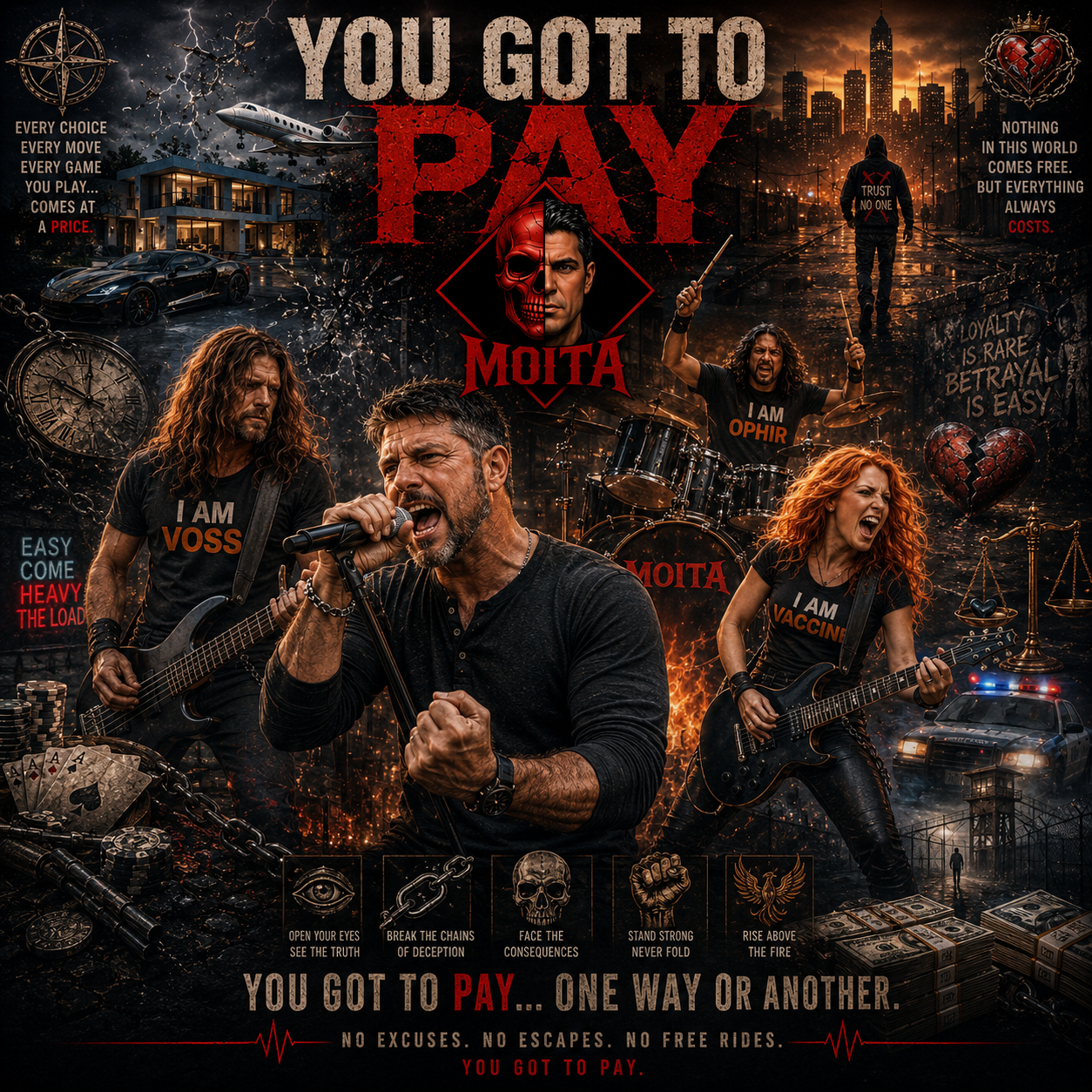
YOU GOT TO PAY
CATEGORY
PRIMARY EMOTION
Responsibility
ALSO FITS
Life Lessons, Consequences, Personal Growth, Financial Reality, Relationships, Choices, Accountability, Human Nature, Educational Rock
WHAT THIS SONG IS ABOUT
Most people hear the word “pay” and immediately think about money.
Bills.
Mortgages.
Credit cards.
Rent.
Taxes.
Groceries.
That is where this song begins, but it is not where it ends.
“You Got to Pay” is really about consequences. It is about the price attached to the choices we make, the choices we avoid, and the shortcuts we convince ourselves will somehow cost us nothing.
Life has been teaching us about payment since the day we were born.
Every dream has a price.
Every relationship asks for something.
Every goal requires sacrifice.
Every mistake leaves something behind.
Sometimes we pay with money. Sometimes we pay with time. Sometimes we pay with sleep, health, trust, freedom, friendship, or opportunities that never return.
Even doing nothing has a cost.
A decision delayed can become an opportunity lost. A conversation avoided can become a relationship damaged. A warning ignored can become a much larger problem later.
That is what this song is looking at.
It begins with financial pressure because almost everyone understands the temptation of wanting something now and worrying about the cost later. Then it moves into relationships, where the payment is no longer measured in dollars. It is measured in time, honesty, loyalty, attention, and trust.
Then the song becomes darker.
It moves toward fast money, crime, sirens, and consequences that can close around a person before they fully understand what they have created.
The subject changes, but the message remains the same.
Everything has a price.
That does not mean life is cruel.
It means life is honest.
The consequences of a decision do not disappear because we refuse to look at them. They may wait quietly. They may take months or years to arrive. They may show themselves in ways we never expected.
The same is true of good decisions.
Hard work does not always reward us immediately.
Trust takes time.
Strong relationships are built slowly.
Character grows through choices nobody else may ever see.
That is why I do not look at this song as a warning alone.
I also see hope inside it.
If careless choices can damage a life, responsible choices can rebuild one.
If dishonesty can destroy trust, honesty can begin restoring it.
If one bad road can take someone somewhere they never expected, one better decision can become the beginning of another direction.
“You Got to Pay” is not pointing at one type of person.
It is pointing at all of us.
Every one of us has wanted something too quickly.
Every one of us has ignored a consequence.
Every one of us has made a decision we later understood differently.
That is not an excuse.
It is part of being human.
The question is not whether we have ever paid for a mistake.
The better question is whether we learned anything when the bill arrived.
THE STORY BEHIND THE SONG
Some songs begin with a melody.
Some begin with a title.
Others begin with one sentence that refuses to leave your mind.
“You Got to Pay” began with one simple truth.
Nothing comes free.
The more I thought about that idea, the larger it became.
It applied to money, but it also applied to work, relationships, success, failure, honesty, crime, family, health, freedom, and time.
Everywhere I looked, I could see some form of payment taking place.
People worked for years to build businesses, homes, careers, and security. Others looked at the finished result and saw only the reward. They did not see the early mornings, the risks, the stress, the failures, the missed weekends, or the times when quitting would have been easier.
Success had a price long before anyone could see it.
I have also watched people chase shortcuts because the shortcut looked easier than the work.
Sometimes it worked for a while.
That is what makes shortcuts dangerous.
If every bad decision failed immediately, fewer people would take them. The real trouble begins when the shortcut appears successful. A person starts believing they escaped the cost.
Then the payment arrives later, often larger than anything they were trying to avoid.
That idea gave the song its structure.
The first verse deals with spending, credit, pressure, and the desire to have something now.
There is nothing wrong with wanting something better. There is nothing wrong with using credit responsibly. The danger begins when the excitement of getting something becomes stronger than the thought of what it will eventually cost.
The second verse moves into relationships because emotional debts can become heavier than financial ones.
A person can say, “I love you,” but love cannot live on words alone.
It needs time.
It needs attention.
It needs honesty.
It needs effort.
It needs two people giving something, not one person carrying everything while the other simply receives.
A relationship may not collapse in one dramatic moment. Sometimes it empties slowly. One missed conversation. One broken promise. One lie. One moment of affection taken for granted. One silence that lasts longer than it should.
Eventually, someone notices there is nothing left in the account.
The third verse enters crime and fast money because some choices carry consequences that can change an entire future.
Easy money often looks light at the beginning.
The load becomes heavier later.
One decision can bring police, courts, prison, lost trust, damaged families, and years that cannot be returned.
The verse is not there to glorify that road.
It is there to show the trap inside it.
The song keeps moving because consequences keep moving.
They do not stay inside the moment where the choice was made.
They follow.
They spread.
They reach other people.
A decision made by one person can affect a partner, children, parents, friends, employers, victims, and entire families.
That is why responsibility matters.
Freedom gives us the right to choose.
It does not give us freedom from what our choices create.
WHY I WROTE THIS SONG
I wrote this song because people often talk about what they want without talking about what they are willing to give for it.
They want success.
They want love.
They want respect.
They want money.
They want freedom.
They want a better life.
Those are understandable things to want.
But wanting is only the beginning.
Success asks for effort.
Love asks for time.
Respect asks for character.
Freedom asks for responsibility.
A better life asks for better decisions.
I wanted to put that truth into a song that people could move to, sing with, and remember.
The chorus is direct because the message does not need complicated language.
You got to pay.
Maybe not today.
Maybe not in the way you expected.
But sooner or later, every choice becomes something.
That can sound harsh until we remember the other side of it.
Good choices become something too.
Discipline creates strength.
Saving creates options.
Honesty builds trust.
Showing up builds relationships.
Learning from mistakes builds wisdom.
The payment is not always punishment.
Sometimes it is investment.
That is one of the most important differences inside this song.
The real question is not whether life will ask something from us.
It will.
The real question is what we are willing to pay for, and whether what we receive in return is worth the price.
WHY THIS MATTERS TO ME
This matters to me because I have watched life change quickly.
I have seen people stand strong one day and struggle the next.
I have seen success built over years and damaged by one decision.
I have seen people carry the consequences of choices long after the moment itself was forgotten.
I have also seen people rebuild.
That part matters just as much.
Responsibility is not about living under endless guilt.
It is about looking honestly at what happened and deciding what comes next.
A person who accepts responsibility still has power.
A person who blames everyone else for everything gives that power away.
That does not mean circumstances never matter. People do not begin life with equal advantages. Illness, poverty, trauma, discrimination, family problems, and bad luck can shape opportunities in very real ways.
But even inside difficult circumstances, choices still matter.
Sometimes the choice is not between an easy road and a hard road.
Sometimes it is between two hard roads.
Responsibility does not pretend life is simple.
It simply asks us to be honest about the part that belongs to us.
That honesty can hurt.
It can also become the beginning of change.
WHY THIS SONG FITS MOITA
“You Got to Pay” fits MOITA because it takes an ordinary phrase and opens it into a much larger conversation.
That is what I want these songs to do.
The music brings people in.
The story gives them a reason to stay.
The question follows them after the song ends.
MOITA is built around real life.
Not perfect life.
Not polished answers.
Not pretending people never fail.
The songs look at choices, consequences, character, betrayal, hope, fear, survival, love, loss, work, justice, and the things people carry when nobody else is looking.
This song belongs inside that library because responsibility touches almost every one of those subjects.
It also belongs because it can be understood in more than one way.
Someone may hear it and think about debt.
Someone else may think about a broken relationship.
Another person may think about crime.
Someone rebuilding a life may hear it as a reminder that the work of recovery also has a price, but that price may lead somewhere worth reaching.
That is where Educational Rock becomes important.
The song does not lecture.
It starts a conversation.
It gives people something simple enough to remember and large enough to keep thinking about.
You got to pay.
The meaning changes depending on the life hearing it.
READ THIS FIRST
Before you read the lyrics, do not begin by thinking about somebody else.
Do not picture the person who hurt you.
Do not think about the neighbour who always seems to get away with everything.
Do not think about a politician, celebrity, boss, former partner, or stranger who made a terrible decision.
Think about yourself.
Think about the life you are living right now.
What has it cost you?
What have you gained?
What have you lost?
What did you pay willingly?
What did you pay because you had no choice?
What are you still paying for today?
Some payments were worth every sacrifice.
Others taught lessons you would never choose to learn twice.
Both became part of you.
As you read these lyrics, listen to how the meaning grows.
The song begins with money and pressure.
Then it moves into love, time, trust, and dishonesty.
Finally, it enters consequences that can change a person’s freedom and future.
The chorus stays simple because the truth stays simple.
Nothing comes free.
That does not mean every payment is bad.
Some of the greatest things in life are worth everything we put into them.
The challenge is knowing the difference before the cost becomes clear.
FULL LYRICS
YOU GOT TO PAY
Yeah
Nothing in this world comes free
Not time, not love, not choices
One way or another
You got to pay
You walk into the store, got your eyes on gold
Swipe that card like the story’s already told
Interest creeping, but you don’t see the chain
Every little “yes” comes back with pain
Late night grind just to stay afloat
Dreams on fire but you’re barely coping hope
You want it now, don’t care what it takes
But every shortcut leaves a trail of mistakes
You can run, you can hide
You can push it all aside
But the clock don’t lie
No escape from the price
You got to pay — you got to pay
You got to pay — yeah one way
If not now — then later
As long as it’s coming my way
You got to pay — you got to pay
No matter what you say
Every move you make every game you play
You got to pay, you got to pay
You say you love but you don’t show time
Hearts ain’t built on a borrowed line
Every broken word, every lie you fake
Comes back double when the silence breaks
You take that touch but don’t give it back
Play with fire then you fade to black
You want the heat but not the flame
Now you’re standing there with no one to blame
Every word, every scar
Shows you who you really are
You can’t outrun fate
There’s a cost to take
You got to pay — you got to pay
You got to pay — yeah one way
If not now — then later
As long as it’s coming my way
You got to pay — you got to pay
No matter what you say
Every move you make every game you play
You got to pay, you got to pay
Fast cash life, yeah you took that road
Easy come, heavy the load
One wrong step and the walls close in
Now you’re paying for the life you’ve been livin’ in
Sirens scream, yeah the truth don’t bend
What you start ain’t yours to end
Every choice got a shadow behind
And sooner or later, it collects its time
Pay pay pay
Everything comes back someday
Pay pay pay
There ain’t no other way
You got to pay — you got to pay
You got to pay — yeah one way
If not now — then later
As long as it’s coming my way
You got to pay — you got to pay
No matter what you say
Every move you make every game you play
You got to pay, you got to pay
So go ahead
Take what you want
Do what you do
Just remember
Nothing
Comes
Free.
SECTION ONE
LYRIC JOURNEY
PART 1
The song opens with a statement that sounds simple enough.
Nothing in this world comes free.
That is where I wanted to begin because everything that follows grows from those words.
Before we get to stores, credit cards, relationships, fast money, police sirens, or consequences, I wanted the listener standing inside the larger idea first.
Nothing comes free.
I do not mean that every good thing has to hurt. I do not mean life is supposed to be miserable before something has value. I mean that almost everything important asks something from us.
Time asks us to decide where we are going to spend it.
Love asks us to decide who we are willing to make room for.
Choices ask us to accept that choosing one direction usually means leaving another direction behind.
That is why the opening continues by naming those three things.
Not time.
Not love.
Not choices.
I could have started with money because money becomes important in the first verse, but that would have made the song smaller than I wanted it to be.
Money is only one kind of payment.
Time is another.
Love is another.
Responsibility is another.
Sometimes the most expensive things in our lives never involve a dollar.
We have all paid for something with time.
You spend years building a business.
You spend years raising children.
You spend years learning something.
You spend years with someone you love.
Whatever those years gave you, they also became years you could not spend somewhere else.
That is not necessarily sad.
It is simply reality.
Time has value because it is limited.
Once a day is gone, nobody can buy it back.
That is why I put time right at the beginning of the song.
Then comes love.
Love gets talked about as though it should simply exist by itself.
If two people love each other, everything should somehow work out.
Life teaches something different.
Love needs attention.
It needs honesty.
It needs patience.
It needs forgiveness.
It needs effort.
Sometimes it needs sacrifice.
A person can say they love somebody every morning and every night, but eventually the other person is going to look at what happens between those words.
Were you there?
Did you listen?
Did you care when it was inconvenient?
Did you give something back?
Those questions become important later in the song, but the opening already plants them.
Then there are choices.
Choices may be the biggest subject in the entire song.
We like having choices.
Nobody likes feeling controlled.
Nobody likes being told there is only one road available.
But freedom to choose comes with something attached to it.
Whatever comes next.
That is the part people sometimes want separated from the choice.
We want the freedom to make the decision without always wanting responsibility for the result.
Life does not separate those two things very easily.
One way or another, you got to pay.
That line closes the opening and sends us directly into the first real situation.
Now we walk into a store.
You have your eyes on gold.
I like that image because it is ordinary and exaggerated at the same time.
Gold can mean something expensive.
It can mean something beautiful.
It can simply mean something you suddenly decide you have to have.
Almost everyone knows that feeling.
You walk into a store with one thing in mind and something catches your eye.
For a moment, the question is not whether you need it.
The question becomes how quickly you can have it.
That is where the card comes out.
Swipe that card like the story is already told.
The purchase happens instantly.
The payment does not.
That difference is important.
When money physically leaves your hand, you feel the transaction immediately.
Credit can make the moment feel different.
You get the thing today.
The cost follows later.
Again, I am not saying credit itself is wrong.
Credit can be useful.
Businesses use it.
Families use it.
People buy houses and vehicles with it.
The issue in this song is not the existence of credit.
The issue is forgetting that borrowed money is still money that has to come from somewhere.
That is why the next thought is interest creeping while you do not see the chain.
The word chain matters.
Interest usually does not arrive like an explosion.
It creeps.
A little more.
Another month.
Another balance.
Another payment.
Then one day somebody realizes the thing they wanted so badly has been paid for many times over, or the debt has become part of every month that follows.
The chain was being built quietly.
That is how many consequences work.
They do not always announce themselves at the beginning.
Sometimes we only recognize them when we try to move and realize something is pulling back.
That leads directly into every little yes coming back with pain.
I do not hear that line as saying we should stop saying yes to life.
That would be a miserable lesson.
Some of the greatest things that ever happen begin with yes.
Yes, I will try.
Yes, I will take the chance.
Yes, I will love somebody.
Yes, I will start again.
Yes can change a life for the better.
But yes is still a commitment.
Every time we say yes to something, we are giving it a piece of our future.
That deserves thought.
The verse then moves away from the store.
Now we are working late just to stay afloat.
That change matters because the purchase is no longer sitting by itself.
Now we see the other side of money.
Earning it.
Late nights.
Pressure.
Trying to keep everything moving.
That is a life many people recognize immediately.
You can be working hard and still feel like you are barely keeping your head above water.
That can become exhausting because work is supposed to move you forward.
When all of your effort is being used simply to stop yourself from falling backward, the pressure feels completely different.
The lyric talks about dreams being on fire while you are barely coping.
That is an important contrast.
The dream is still alive.
You still want something.
You still see somewhere you want to go.
But wanting it and carrying the daily pressure required to reach it are two different experiences.
Anybody can enjoy the idea of success.
The difficult part is what happens on a Tuesday night when you are tired, the bills are sitting there, something broke, somebody needs something from you, and tomorrow morning is coming whether you are ready or not.
That is where dreams become real work.
Then comes the temptation.
You want it now.
You do not care what it takes.
That is where impatience enters the song.
We have all felt some version of it.
Waiting is hard when you can see what you want.
That applies to money, but it also applies to almost everything.
People want the successful business before they have built it.
They want the strong body before they have trained it.
They want respect before they have earned it.
They want trust restored before they have rebuilt it.
They want the finish line without always wanting the road.
That is human.
I understand it.
I have wanted things faster too.
The problem starts when wanting something quickly becomes more important than asking what getting it quickly might cost.
That is why the first verse ends with the shortcut.
Every shortcut leaves a trail of mistakes.
I do not mean every easier way is wrong.
Finding a smarter way to do something can be a good thing.
I have spent much of my life trying to find better ways of doing things.
There is a big difference between working smarter and cutting through something that actually needed to be learned, earned, built, or respected.
Some roads are long because the road itself is teaching you something.
Experience takes time.
Trust takes time.
Skill takes time.
Character takes time.
When we remove the time, sometimes we also remove the lesson.
That is the first real landmark in the song.
We began with a purchase.
We ended with something much bigger.
The cost of wanting life to move faster than life sometimes allows.
Then the pre-chorus arrives.
You can run.
You can hide.
You can push it aside.
That is another thing people do when consequences begin approaching.
Ignore the bill.
Avoid the conversation.
Do not open the letter.
Do not answer the phone.
Do not admit what is happening.
Maybe tomorrow will somehow be different.
Sometimes postponing something is necessary because we need time to think.
But avoidance is different.
Avoidance does not solve the problem.
It simply gives the problem more time to grow.
That is why the clock becomes important.
The clock does not lie.
Time keeps moving whether we face something or not.
The bill gets older.
The relationship gets quieter.
The opportunity moves farther away.
The habit becomes more established.
Whatever we are avoiding keeps developing while we are pretending it is standing still.
Then comes the final line before the chorus.
There is no escape from the price.
That could sound hopeless if the entire song were only talking about punishment.
It is not.
The price can also be effort.
Commitment.
Honesty.
Discipline.
The point is not that everybody is doomed to suffer.
The point is that eventually we have to participate in our own lives.
We cannot keep taking without giving something back.
Then the chorus arrives for the first time.
You got to pay.
Now those words carry everything we just walked through.
The store.
The card.
The interest.
The late nights.
The dreams.
The impatience.
The shortcut.
The clock.
That is why the chorus can be so simple.
It does not need to explain everything again.
The verse already did the work.
The chorus just delivers the bill.
If not now, then later.
That line may be the simplest description of delayed consequences in the entire song.
Later is where people fool themselves.
Later feels far away.
Later feels like another person’s problem.
Tomorrow’s Joe can deal with it.
Tomorrow’s you can deal with it.
But eventually tomorrow becomes today.
That is when later stops being an idea.
Then comes a line with a little attitude in it.
As long as it is coming my way.
I like that because the song does not need to become some heavy sermon.
There is still swagger in it.
There is still rhythm.
There is still something people can sing back.
The message can be serious without the song becoming miserable.
That matters to me.
I want people moving with it.
I want the hook getting stuck in their head.
Then maybe hours later the meaning sneaks back in too.
The chorus keeps going.
No matter what you say.
That brings us back to excuses.
We can explain.
We can justify.
We can tell ourselves why our situation is different.
Sometimes our situation genuinely is different.
But explanation does not always erase consequence.
That is a hard thing to accept.
Then we reach every move you make and every game you play.
Now the song is already preparing to leave money behind.
Moves.
Games.
Those words can belong to relationships just as easily as finances.
They can belong to manipulation.
They can belong to dishonesty.
They can belong to the way people treat each other when they think nobody is paying attention.
The first chorus ends exactly where it began.
You got to pay.
But we are not finished.
Money has taught us the first version of the lesson.
Now the song is ready to ask what happens when the currency is no longer dollars.
The second verse begins with love.
You say you love, but you do not show time.
That is where the payment changes completely.
SECTION ONE
LYRIC JOURNEY
PART 2
You say you love, but you do not show time.
This is where the song moves away from money and into something I believe can be far more expensive.
People.
The first verse dealt with things we can count.
Money.
Interest.
Payments.
Work.
Now the numbers disappear.
There is no statement showing how much attention you gave somebody.
There is no receipt showing how many times you listened.
There is no bank account measuring how much trust remains between two people.
But those things still have value.
Sometimes more value than anything we can buy.
I deliberately put love beside time because I do not think the two can be separated for very long.
You can tell somebody you love them.
You can mean it when you say it.
But if you never have time for them, eventually the words are going to have trouble carrying the relationship by themselves.
That applies to a husband and wife.
It applies to parents and children.
Brothers and sisters.
Friends.
Anybody we claim matters to us.
At some point, people need more than the sentence.
They need us.
That leads straight into the next thought.
Hearts are not built on a borrowed line.
I like the word borrowed there because we have just come from a verse about credit.
In the first verse, you can borrow money.
Here, the song asks whether you can borrow the things that hold a relationship together.
You cannot borrow somebody else’s honesty and call it yours.
You cannot borrow loyalty for the weekend.
You cannot borrow commitment only when it is convenient.
You cannot keep taking emotional credit without eventually putting something back.
A relationship has to have something real underneath it.
That does not mean every relationship has to be perfect.
There is no such thing.
People get tired.
People become busy.
People misunderstand each other.
People say the wrong thing.
People have bad days.
The question is what happens after those moments.
Do you come back?
Do you talk?
Do you listen?
Do you repair what was damaged?
Or do you keep borrowing against something you are no longer helping to build?
Then the song reaches broken words and lies.
Every broken word, every lie you fake, comes back double when the silence breaks.
A broken word can mean several things.
It can be a promise that was not kept.
It can be something said in anger that cannot simply be pulled back into your mouth.
It can be telling somebody what they want to hear when you already know your actions are going to say something different.
Words matter because people build expectations around them.
If I tell you I am going to be there, you make decisions based on believing I will be there.
If I give you my word, I am asking you to trust something about me that you cannot physically hold.
That is why breaking your word can cost more than the immediate situation.
It can change what the next promise is worth.
A lie works the same way.
The first lie may solve a problem for five minutes.
Then it creates another problem.
Now you have to protect it.
Maybe you need another lie.
Then you have to remember both.
Eventually the lie that was supposed to make life easier has become work.
The truth can be uncomfortable.
Sometimes extremely uncomfortable.
But at least the truth does not need a filing system.
That is why the silence matters in this lyric.
Silence can hide things for a while.
Two people can know there is a problem and still walk around it.
They can talk about everything except the thing that actually needs to be discussed.
That can continue for days.
Sometimes months.
Sometimes much longer.
Then something finally breaks the silence.
Now everything that was being avoided is sitting on the table at once.
That is where it can feel like it comes back double.
You are no longer dealing only with what happened.
You are dealing with what happened and all the time spent pretending it did not.
The next lines take that imbalance and make it physical.
You take that touch but do not give it back.
This can certainly live inside a romantic relationship, but I think the idea is larger than romance.
It is about receiving without returning.
Some people are very comfortable taking.
They take attention.
They take support.
They take affection.
They take somebody else’s time.
They take loyalty for granted.
When they are hurting, they know exactly who to call.
When the other person is hurting, suddenly they are busy.
That kind of imbalance may survive for a while because the person giving more keeps trying.
They tell themselves things will change.
They give another chance.
Then another.
But one person cannot permanently carry the emotional weight of two people.
Eventually something gives.
That is why the song moves into fire.
You play with fire, then you fade to black.
Fire is attractive.
It has heat.
Energy.
Danger.
People understand that image immediately because we have been using fire as a symbol for passion and risk for a very long time.
But the important part here is not the fire.
It is what happens afterward.
You wanted the heat.
You did not want the flame.
That is a very human contradiction.
People sometimes want the exciting parts of something without accepting the responsibility attached to them.
They want intimacy without commitment.
They want loyalty without giving loyalty.
They want somebody available whenever they need them, but they do not want to answer to anybody themselves.
They want the warmth.
Not the work.
Eventually that becomes impossible.
You cannot keep reaching into the fire and then act surprised that heat exists.
Now you are standing there with no one to blame.
That line changes the direction again.
Up until this point, somebody could still point outward.
Maybe the other person misunderstood.
Maybe circumstances got in the way.
Maybe there was always another explanation.
Now the song removes that protection.
No one to blame.
That is an uncomfortable place.
It is also an important place.
There are moments in life when we need to look around and admit that the person standing in the middle of the problem is us.
I have had moments where I had to look at my own decisions.
Most people have.
That does not mean everything that ever happens to us is our fault.
Of course it does not.
People can hurt us.
People can lie to us.
Circumstances can hit us without permission.
Bad things can happen that we did absolutely nothing to deserve.
Responsibility becomes dishonest if we pretend every human problem is self-created.
But the opposite is dishonest too.
We cannot blame the world for every result while refusing to examine our own part.
Sometimes the hardest sentence a person can say is, “I did that.”
There is power in that sentence.
If I did something, I can learn from it.
If I made the wrong decision, I can make a different one.
If I damaged something, maybe I can begin repairing it.
Responsibility does not guarantee forgiveness.
It does not guarantee the relationship comes back.
It does not erase what happened.
But without responsibility, there is very little chance of real change.
That is why this verse ends where it does.
The person is standing there.
The excuses have run out.
Now the pre-chorus returns, but it is not the same pre-chorus we heard after the money verse.
Every word, every scar, shows you who you really are.
The first pre-chorus was about running and hiding.
This one looks directly at what remains.
Words.
Scars.
A scar is interesting because it means something happened, but it also means some form of healing happened.
A fresh wound is not a scar yet.
A scar is what remains afterward.
People carry those marks in different ways.
Some are visible.
Most are not.
A person can carry the memory of betrayal for years.
They can carry something cruel somebody said when they were young.
They can carry the loss of a friendship.
They can carry regret for something they did themselves.
Those experiences become part of us.
They do not have to control us forever.
But pretending they never happened does not make them disappear.
Then the lyric says they show you who you really are.
For me, that is not saying our scars define us.
It is saying what we do with them reveals something.
Do we become cruel because somebody was cruel to us?
Do we use what happened as permission to hurt the next person?
Do we learn?
Do we become more understanding?
Do we become more careful about the promises we make?
Pain can teach terrible lessons if we let it.
It can also teach compassion.
The experience itself does not always decide which direction we go.
Sometimes we do.
Then comes fate.
You cannot outrun fate.
There is a cost to take.
I do not hear fate here as saying every detail of our lives was predetermined before we were born.
Inside this song, fate is closer to the moment when consequences finally catch the choices that created them.
You can delay certain things.
You can avoid certain conversations.
You can pretend something is not happening.
But eventually reality tends to arrive.
The relationship either becomes healthier or it does not.
Trust either gets rebuilt or continues disappearing.
The truth either gets spoken or the silence becomes its own answer.
There is a cost to take.
Now we return to the chorus.
You got to pay.
The words have not changed.
But they do not mean what they meant the first time.
The first time, we had just walked out of a store.
Now we have walked through a relationship.
That changes the currency.
If not now, then later.
Earlier, later could mean another credit card statement.
Now later might mean the day somebody stops believing you.
It might mean the day they stop waiting for you to make time.
It might mean realizing that a relationship you assumed would always be there has quietly reached its end.
That is why I did not need to rewrite the chorus.
Life does that for me.
The same sentence means something different depending on what came before it.
Every move you make, every game you play, you got to pay.
After the relationship verse, the word game has more weight.
Games between people can become dangerous.
Trying to make somebody jealous.
Withholding affection to control them.
Using silence as punishment.
Saying one thing while doing another.
Testing somebody instead of talking to them.
Those games may feel powerful for a moment.
But if you keep playing games with trust, eventually trust stops playing.
The second chorus finishes and the song has now travelled through two very different kinds of debt.
Financial debt.
Emotional debt.
The first can often be measured.
The second usually cannot.
But both can follow a person for years.
Now the song takes its darkest turn.
Fast cash life, yeah you took that road.
We have reached the third verse.
The first verse showed somebody wanting something now.
The second showed somebody taking more from a relationship than they were giving.
The third shows what can happen when the desire for the quick reward crosses a much more serious line.
Fast cash.
Those two words have attracted people forever.
Money without waiting.
Money without years of building.
Money without somebody telling you what time to start work.
Money without the ordinary road.
From the outside, that can look like freedom.
The song immediately tells you what may be hiding underneath it.
Easy come, heavy the load.
That is the contradiction.
The money may come easily.
The life attached to it may not.
I wanted those two ideas standing beside each other because that is how temptation often works.
It shows you the reward first.
The cost stays somewhere behind it.
If every bad decision arrived holding a photograph of its worst possible consequence, people would probably make fewer of them.
But that is not how temptation presents itself.
It shows the money.
The excitement.
The status.
The feeling that you found a road everybody else was too stupid to see.
The weight arrives later.
One wrong step and the walls close in.
Now the image changes completely.
We were standing in open life a moment ago.
Now there are walls.
That can be literal.
It can also describe the feeling of options disappearing.
One decision creates another.
Now you are trying to protect what you did.
Maybe somebody knows.
Maybe somebody wants something from you.
Maybe police become involved.
Maybe the people around you begin disappearing.
Maybe your family finds out.
The road that looked wide at the beginning starts getting narrower.
That is what consequences can do.
They reduce choices.
A person who thinks they are gaining freedom can sometimes discover they were actually trading it away.
Then the lyric says it directly.
Now you are paying for the life you have been living in.
That is the moment where the title stops being a hook and becomes reality.
The payment is no longer coming.
It is here.
SECTION ONE
LYRIC JOURNEY
PART 3
Now you are paying for the life you have been living in.
That line matters because it brings the entire song into the present.
Earlier, the cost could still be somewhere in the future.
Interest was creeping.
The clock was moving.
The relationship was slowly being damaged.
The shortcut was leaving mistakes behind.
Now there is no later.
Later has arrived.
That is something I wanted the song to show honestly.
Consequences can feel distant right up until the moment they are not.
A person can make the same decision ten times and nothing seems to happen.
That can create confidence.
They begin believing they have figured out the system.
Then the eleventh time changes everything.
That is one of the dangerous things about getting away with something.
Getting away with it can become the reason somebody does it again.
The absence of an immediate consequence starts feeling like proof that there never will be one.
But nothing happening today does not guarantee nothing happens tomorrow.
That is where the next lyric takes us.
Sirens scream, yeah the truth don’t bend.
The sirens bring sound into the picture.
Until now, much of what was happening could remain private.
The decision belonged to you.
The money belonged to you.
The road belonged to you.
Then the sirens arrive and suddenly the private decision has entered the outside world.
Other people are involved now.
That is another thing about consequences.
They rarely stay contained inside the person who made the choice.
Crime is an obvious example.
A criminal decision can affect a victim.
A family.
Children.
Parents.
Friends.
Employers.
Entire communities.
Even people who had absolutely nothing to do with the original decision can end up carrying part of its cost.
That is why I do not think responsibility should ever be reduced to, “I made my choice, so it only affects me.”
Life does not usually work that way.
Our choices travel.
Good ones do too.
A person who works hard and builds something can create opportunities for other people.
A parent who breaks a destructive pattern can change what their children grow up believing is normal.
Somebody who decides to become honest after years of lying may slowly begin rebuilding relationships that seemed impossible to repair.
Choices spread in both directions.
That is important because this song would become too easy if it only talked about punishment.
The same principle that allows one poor decision to spread damage also allows one better decision to begin spreading something different.
Then we come back to truth.
The truth does not bend.
That does not mean every accusation is automatically true.
It does not mean every legal outcome is perfect.
It does not mean every person who gets blamed for something actually did it.
Life and justice can be much more complicated than a lyric.
What this line means inside the song is that reality itself does not change simply because somebody wants a different version of it.
What happened happened.
What was said was said.
What was done was done.
We can explain our reasons.
We can provide context.
Context matters.
Circumstances matter.
Intent matters.
But none of those things allow us to travel backward and remove the action itself.
That is why truth can be uncomfortable.
It does not always give us the version of ourselves we would prefer to see.
Sometimes truth confirms we were right.
Sometimes it forces us to admit we were wrong.
Both require honesty.
The next line pushes that idea farther.
What you start ain’t yours to end.
I like that line because it deals with something people often forget when making a decision.
We control the beginning much more easily than we control everything that follows.
You can start an argument.
You cannot control every word the other person says afterward.
You can tell a lie.
You cannot control where that lie travels.
You can betray somebody.
You cannot decide how long it takes them to trust again.
You can commit a crime.
You cannot decide how every person affected will respond.
You can start something in one minute that takes years to finish.
That is why thinking before acting matters.
Once something leaves our hands, other people become part of the story.
Their choices begin interacting with ours.
Now there are consequences we cannot completely control.
That is one of the biggest differences between intention and outcome.
People often defend a decision by saying, “I didn’t mean for that to happen.”
Sometimes that is completely true.
Most people do not wake up planning the worst possible outcome of their decisions.
But intention does not always control result.
That does not mean intention is meaningless.
It means we also have to think about what our actions can reasonably create.
The lyric then gives us one of the central images of the song.
Every choice got a shadow behind.
I like the shadow because a shadow follows without making much noise.
You do not have to carry it.
You do not have to tell it where to go.
It simply comes with you.
Some choices are like that.
You make them and continue living.
For a while, maybe you forget.
But something from that decision remains attached.
Sometimes the shadow is regret.
Sometimes it is responsibility.
Sometimes it is a lesson.
Sometimes it is a memory.
Sometimes it is something positive.
A decision to help somebody can follow you too.
A decision to take a chance can open a road that changes your entire life.
A decision to forgive can remove a weight you did not realize you were still carrying.
Not every shadow has to be dark.
But every choice creates something.
That is the point.
Then the line finishes the thought.
Sooner or later, it collects its time.
Time has been hiding inside this song from the beginning.
The opening named it directly.
Not time.
Then the first verse showed late-night work.
The relationship verse asked whether somebody was showing time.
Now time appears again as the place where consequences are collected.
I think that is important because time reveals things.
A decision that looks brilliant today may look foolish five years from now.
Something that feels like a terrible setback today may become the moment that forced us in a better direction.
We do not always know immediately.
That can be frustrating.
Human beings like quick answers.
Was this good?
Was this bad?
Did I win?
Did I lose?
Life sometimes refuses to answer that quickly.
It makes us live for a while first.
Then we understand.
That is one reason experience matters so much.
Experience does not make somebody automatically wise.
You can live a long time and keep repeating the same mistake.
Wisdom comes when we actually pay attention to what experience was trying to teach us.
That is where the third verse leaves us.
The song began with somebody casually swiping a card.
Now we are standing inside consequences that can take away freedom.
That distance is important.
I did not want the song to jump straight into the darkest example.
I wanted the road to get there naturally.
Small choices.
Emotional choices.
Serious choices.
The principle stays the same while the stakes increase.
Then the music strips back.
Pay.
Pay.
Pay.
The breakdown does not need a long sentence.
It does not need another argument.
By this point, the listener already knows what the word means.
Money.
Time.
Trust.
Love.
Freedom.
Effort.
Regret.
Responsibility.
All of those things are sitting inside one word now.
Pay.
That is why repetition works here.
Earlier in the song, repeating “you got to pay” helped build the hook.
Here, repetition feels more like the word is following you.
Pay.
Then again.
Pay.
Then again.
Pay.
There is nowhere else for the song to go for a moment.
It has reduced the entire journey to its smallest possible form.
Everything comes back someday.
That line connects every verse.
The card comes back as a bill.
Neglect comes back as distance.
Dishonesty comes back as broken trust.
Crime can come back as lost freedom.
But again, I think we should be careful not to hear only the negative side.
Kindness comes back too.
Hard work comes back.
The time we give people comes back in the relationships we build.
The effort we put into learning something comes back as ability.
The discipline we practise today can come back as opportunity later.
Not every good action guarantees a reward.
Life is not a vending machine.
You cannot put kindness in and demand happiness out.
Good people still experience terrible things.
Hardworking people sometimes fail.
Honest people sometimes get betrayed.
That reality matters.
If I said every good choice automatically creates a good outcome, I would not believe my own song.
The truth is more complicated.
What our choices do is influence the road.
They shape who we become.
They shape what we are prepared for.
They shape the trust other people place in us.
They shape the options we may have when difficult moments arrive.
That is very different from promising that life will always reward us fairly.
Sometimes it will not.
But I would still rather build a life around decisions I can stand behind than gamble everything on the hope that consequences will somehow miss me.
Then the breakdown repeats the word again.
Pay.
Pay.
Pay.
There ain’t no other way.
That is the hardest statement in the breakdown, but I do not hear it as defeat.
I hear acceptance.
There is no life where we receive everything and sacrifice nothing.
There is no relationship where we are loved deeply while giving absolutely nothing back forever.
There is no meaningful skill that appears without learning.
There is no strong character built without decisions that sometimes cost us comfort.
There is no way around participating in our own lives.
That is the payment.
Sometimes the price is worth it.
That may be the most important thing to understand before the final chorus arrives.
The song is not telling you to avoid paying.
It is telling you to pay attention to what you are paying for.
Those are two completely different messages.
If I spend years building something I believe in, there is a price attached to that.
If I give my time to people I love, there is a price attached to that too.
If I stand by something important when walking away would be easier, that costs something.
But I may gladly pay those prices.
The problem is not that life costs us something.
The problem is paying enormous prices for things that were never worth having.
That is where responsibility becomes more than accepting consequences.
It becomes choosing our investments.
What deserves my time?
What deserves my effort?
What deserves my loyalty?
What deserves another year of my life?
What am I paying for right now without even realizing it?
Those questions are sitting underneath the breakdown when the full song comes crashing back.
Now we reach the final chorus.
You got to pay.
Same words.
Completely different journey behind them.
The first chorus followed money.
The second followed relationships.
This one follows everything.
Now when I hear “you got to pay,” I do not hear a bill.
I hear a life.
If not now, then later.
We have already seen what later can mean.
Later can be interest.
Later can be loneliness.
Later can be regret.
Later can be a consequence serious enough to change somebody’s freedom.
But later can also be the reward for something we kept doing when nobody was applauding.
That matters.
A person saves a little money at a time.
Later, they have options.
A person keeps showing up for their children.
Later, those children remember who was there.
A person keeps practising a skill when they are terrible at it.
Later, somebody calls them talented without seeing the years it took.
That is another funny thing about payment.
People often see the reward and completely miss the cost.
They see the finished house.
Not the foundation.
They see the successful person.
Not the years when nothing seemed to be working.
They see the relationship that lasted decades.
Not the thousands of times two people had to choose each other when walking away might have been easier.
That is why the final chorus feels bigger to me.
The song has earned the right to repeat itself.
As long as it is coming my way.
That little bit of swagger is still there.
I wanted it there.
Responsibility does not mean walking through life with your head down waiting to be punished.
You can understand consequences and still enjoy yourself.
You can work hard and laugh.
You can take life seriously without taking every second of yourself seriously.
You can know there is a price and still decide the experience is worth every cent of it.
Then again.
You got to pay.
No matter what you say.
By now, excuses have travelled through the entire song too.
The financial excuse.
The relationship excuse.
The excuse for taking the shortcut.
The excuse after the consequences arrive.
We are good at explaining ourselves.
Sometimes those explanations are legitimate.
Sometimes they are stories we tell ourselves because the truth is harder.
Learning the difference is part of growing up.
I do not think anybody masters that completely.
I certainly would not claim I have.
There are things we understand clearly in somebody else’s life and struggle to see in our own.
That is human nature.
It is easy to identify another person’s bad decision.
It is much harder when the decision belongs to us.
That is why I never wanted this song pointing outward.
The easiest way to ruin the message would be to turn it into a song about everybody else’s mistakes.
The person I want standing in front of these lyrics is me too.
What am I paying for?
What choices am I making?
What am I ignoring?
What am I building?
What am I taking for granted?
Those questions belong to me before I ask anybody else to answer them.
The final chorus gives us the last repetition of every move you make and every game you play.
Now there is nowhere else for the song to expand.
We have seen enough.
The message has travelled through ordinary life, relationships, and serious consequences.
The chorus can finally say what it has been saying from the beginning with all of that weight behind it.
You got to pay.
You got to pay.
Then the music begins making room for the final words.
The song is almost finished, but I did not want the ending to become bigger.
I wanted the opposite.
After all that energy, I wanted to come back to the voice.
So go ahead.
That sounds almost like permission.
Take what you want.
Do what you do.
There is no lecture there.
No one is physically stopping you.
That matters because responsibility only means something when choice exists.
If somebody forces every decision on you, responsibility becomes a very different conversation.
But when the choice really is yours, so is the need to think about what follows.
Go ahead.
Take what you want.
Do what you do.
Those lines give the listener freedom.
Then comes the reminder.
Just remember.
That may be the most important instruction in the entire song.
Not obey.
Not fear.
Remember.
Remember what happened in the store.
Remember the interest creeping.
Remember the late-night grind.
Remember the shortcut.
Remember the clock.
Remember the person saying love without giving time.
Remember the broken word.
Remember the lie.
Remember the silence.
Remember the fire.
Remember standing there with nobody left to blame.
Remember the fast cash.
Remember the walls closing in.
Remember the sirens.
Remember the shadow following the choice.
Remember all of it.
Then the song arrives exactly where it began.
Nothing comes free.
After everything we have walked through, those words should not sound the same anymore.
At the beginning, they were an idea.
Now they have a history.
We have watched the price change forms.
We have seen that payment can mean money, time, effort, trust, responsibility, freedom, sacrifice, or regret.
We have also seen something else.
A price does not automatically make something bad.
Some things are worth paying for.
That may be where I personally land after walking through the entire song.
I do not want a life that costs nothing.
A life that costs nothing would probably mean I never risked anything, never loved anybody enough to sacrifice for them, never worked hard for something I believed in, never tried something difficult, never failed, never rebuilt, and never gave enough of myself for anything to matter.
That is not the lesson I wanted.
The lesson is to know what you are buying with your life.
Because we are all spending it.
Every morning, another day is placed in our hands.
By night, that day is gone.
What did we buy with it?
A little more trust?
A little more knowledge?
A little progress?
A memory with somebody we love?
Or did we spend it on something we already know is taking more from us than it gives back?
Nobody answers that perfectly every day.
I do not.
That is not the point.
The point is to keep asking.
Because once we understand that everything has a price, the question changes.
We stop asking how to avoid paying.
We start asking what is worth the payment.
That is where “You Got to Pay” finally leaves me.
Not afraid of the bill.
Thinking about the value.
Nothing comes free.
Some things are worth every bit of what they cost.
SECTION TWO
THE STORY
The older I get, the more I realize that some of the biggest lessons in life don’t arrive with a warning. They don’t announce themselves. They don’t knock on the door and politely ask if we’re ready.
They simply happen.
Then one day we look back and understand what they were trying to teach us.
“You Got to Pay” grew from years of watching that happen.
It didn’t come from one specific event. It came from thousands of small observations that slowly connected together. Working in construction, running my own business, meeting people from every walk of life, watching some succeed, watching others lose everything, and sometimes watching the same person experience both.
Life has a way of humbling all of us eventually.
I’ve seen people who had almost nothing build incredible lives because they refused to quit.
I’ve also seen people who seemed to have everything lose it because they believed nothing could touch them.
Neither story surprised life.
Life doesn’t play favourites.
It simply responds to what we do over time.
That idea stayed with me for years.
People often ask successful people how they made it. They usually hear about the business, the opportunity, or the lucky break. What they don’t always hear about are the sacrifices.
The birthdays that were missed.
The weekends spent working.
The nights lying awake wondering how the bills would get paid.
The fear of making the wrong decision.
The times they wanted to quit but kept going anyway.
Those things rarely appear in photographs.
They don’t fit inside a headline.
But they’re often the real story.
The same thing happens when someone loses everything.
People standing on the outside usually see only the fall.
They rarely see the hundreds of small decisions that slowly led there.
Sometimes those decisions belonged to the person.
Sometimes circumstances played a role.
Sometimes it was both.
Life is usually more complicated than people want to admit.
That’s one of the reasons I wanted this song to avoid pointing fingers.
It would have been easy to write a song saying, “Those people made bad choices.”
I wasn’t interested in writing that song.
I was interested in writing a song that quietly asks every one of us the same question.
What am I paying for today?
That question doesn’t accuse anyone.
It invites reflection.
When I started writing, I deliberately chose everyday situations instead of extraordinary ones.
Walking into a store.
Using a credit card.
Working late.
Trying to stay ahead.
Almost everybody has lived some version of that experience.
It’s familiar.
Once the listener is standing inside something familiar, the song gradually widens the conversation.
Money becomes time.
Time becomes relationships.
Relationships become trust.
Trust becomes character.
Character becomes responsibility.
Before long, the song isn’t talking about money anymore.
It’s talking about life.
That progression was intentional.
One thing I’ve learned over the years is that people usually understand big ideas more easily when they begin with ordinary experiences.
Most of us don’t wake up thinking about philosophy.
We wake up thinking about work.
Bills.
Family.
Responsibilities.
That’s where life happens.
That’s where songs should begin.
As the verses developed, I found myself thinking about something else.
People often say they value certain things.
They say family comes first.
They say honesty matters.
They say loyalty is important.
Then life gets busy.
Work becomes overwhelming.
Stress takes over.
Conversations become shorter.
Promises get postponed.
Without realizing it, people begin investing less in the very things they say matter most.
I don’t believe that usually happens because people stop caring.
I think it happens because life moves quickly.
Days become weeks.
Weeks become years.
One day we look around and wonder where the time went.
Time may be the one thing this song talks about more than money.
Money can usually be earned again.
Time cannot.
That thought stayed with me while writing the relationship verse.
A healthy relationship doesn’t survive because two people once loved each other.
It survives because they continue choosing each other.
That choice costs time.
Attention.
Patience.
Forgiveness.
Honesty.
Those payments never appear on a bank statement, but they’re some of the most valuable investments we’ll ever make.
The final verse changes direction again because I wanted to remind people that not every shortcut ends with inconvenience.
Some end with tragedy.
Some end with prison.
Some end with lives permanently changed.
Crime often promises quick rewards.
It rarely advertises the full price.
I’ve never believed that people should be reduced to the worst decision they’ve ever made.
At the same time, I’ve also never believed we can ignore the consequences of our actions.
Both ideas can exist together.
People deserve accountability.
People also deserve the opportunity to build something better if they’re willing to do the work.
That balance matters to me.
It’s easy to write songs that simply condemn people.
It’s much harder to write songs that remind us we’re all capable of making decisions we’ll later regret.
That realization creates humility.
Humility creates compassion.
Compassion doesn’t remove responsibility.
It simply reminds us that every person has a story we may never fully understand.
By the time I finished writing “You Got to Pay,” I realized I hadn’t written a song about money at all.
I’d written a song about value.
What do we value enough to work for?
What do we value enough to protect?
What do we value enough to sacrifice for?
Those questions stay with me long after the music stops.
I hope they stay with the listener too.
Because sooner or later, every one of us discovers that life asks for payment.
The real challenge isn’t avoiding the price.
The real challenge is making sure what we’re paying for is truly worth it.
SECTION THREE
LYRIC EXPLORATION
The lyrics of “You Got to Pay” are built like a conversation that grows larger with every verse.
The song never changes its central message, but it changes the place where that message is applied.
It begins with money because everyone understands money.
Then it moves into relationships because everyone understands the value of time.
Finally, it reaches consequences that can permanently change a person’s future.
By the end of the song, the chorus hasn’t changed at all.
The listener has.
That was intentional.
The words stay the same.
The understanding becomes deeper.
“Nothing in this world comes free. Not time. Not love. Not choices.”
Those opening lines tell the listener exactly where we’re going before the first verse even begins.
Time is not free.
Every hour we spend somewhere is an hour we cannot spend somewhere else.
Love is not free.
Real love asks for patience, honesty, forgiveness, commitment, and sometimes sacrifice.
Choices are not free.
Every decision closes one door while opening another.
I’ve always believed that one of the greatest misunderstandings people have about freedom is believing freedom means living without consequences.
It doesn’t.
Freedom means we have the ability to choose.
Responsibility begins the moment we make that choice.
That isn’t a punishment.
It’s simply how life works.
“You walk into the store, got your eyes on gold. Swipe that card like the story’s already told.”
I wanted the first verse to begin somewhere ordinary.
Almost everybody has walked into a store planning to buy one thing and left with something else.
We’ve all experienced that little voice saying, “Go ahead. You’ll figure it out later.”
Sometimes that’s harmless.
Sometimes it isn’t.
Advertising has become incredibly good at convincing us we deserve something immediately. Credit cards, financing, and buy-now-pay-later programs make it easy to enjoy today while postponing tomorrow.
There’s nothing inherently wrong with using credit responsibly.
The problem begins when borrowing replaces thinking.
Financial literacy isn’t about avoiding every purchase. It’s about understanding the real cost before making the decision. Learning how interest, debt, budgeting, and saving work can help people avoid problems that often grow quietly over time. Good educational resources from government agencies and financial education organizations can make an enormous difference, especially for young adults beginning to manage money on their own.
The lyric isn’t attacking money.
It’s asking a better question.
What will this really cost?
That question applies to far more than shopping.
“Every little ‘yes’ comes back with pain.”
This line isn’t saying yes is dangerous.
Without saying yes, none of us would ever fall in love, start a business, accept a new job, or chase a dream.
The point is that every yes automatically becomes a no somewhere else.
Say yes to working every weekend.
You may be saying no to your family.
Say yes to ignoring your health.
You may be saying no to a healthier future.
Say yes to dishonesty because it feels easier.
You may be saying no to trust.
Life is full of exchanges.
Some happen immediately.
Others don’t arrive until years later.
That’s why experience is such a powerful teacher.
The older I get, the less I ask, “What do I want today?”
The more I ask, “Where will this decision lead me?”
“You say you love but you don’t show time. Hearts ain’t built on a borrowed line.”
This may be my favourite lyric in the song because it shifts the conversation from money to something much more valuable.
Time.
People often tell each other they care.
The question is whether their actions agree with their words.
I’ve learned that people remember how available you were when they needed you.
They remember who showed up.
They remember who listened.
They remember who made time.
Time is probably the most valuable thing we ever give another person because it can never be replaced.
Once it’s spent, it’s gone forever.
Relationships are built much more by consistency than by grand gestures.
A conversation.
A walk together.
A meal shared.
Listening instead of looking at a phone.
Remembering something important.
Those ordinary moments quietly become extraordinary over the years.
Strong relationships are built one decision at a time.
So are broken ones.
“Every broken word, every lie you fake. Comes back double when the silence breaks.”
One lie almost always creates another.
Then another.
Eventually the person telling the lies has to remember which version they told to which person.
The truth never has that problem.
That doesn’t mean honesty is always easy.
Sometimes telling the truth creates uncomfortable conversations.
Sometimes it costs us something in the moment.
But dishonesty almost always becomes more expensive later.
I’ve never believed that trust disappears because of one sentence.
It usually disappears because of repeated choices.
Promises not kept.
Truth stretched.
Conversations avoided.
Silence filling the space where honesty should have been.
The silence in this lyric is the moment when excuses finally stop working.
Reality arrives.
Truth catches up.
The bill becomes due.
“Fast cash life, yeah you took that road. Easy come, heavy the load.”
The third verse changes the atmosphere completely.
Now we’re no longer talking about ordinary financial pressure.
We’re talking about shortcuts that can permanently change a life.
One thing I’ve noticed throughout my life is that human beings have always been attracted to easy answers.
Easy money.
Easy success.
Easy fame.
Easy solutions.
Sometimes they exist.
Most of the time they don’t.
What usually exists instead is delayed payment.
The shortcut feels easy in the beginning because the cost hasn’t arrived yet.
Then one day it does.
Sometimes the price is money.
Sometimes it’s freedom.
Sometimes it’s relationships.
Sometimes it’s a future that can never be fully recovered.
That is why this verse isn’t written to judge anyone.
It’s written to remind us that every shortcut deserves one important question.
“What happens after this?”
That single question has prevented countless bad decisions throughout history.
“Sirens scream, yeah the truth don’t bend.”
Truth has something in common with gravity.
It doesn’t care whether we believe in it.
It simply exists.
People can deny reality for a while.
They can make excuses.
They can blame other people.
Sometimes circumstances genuinely are unfair.
Life isn’t equally easy for everyone.
But eventually every person reaches the point where they have to face what their decisions have created.
Responsibility isn’t about endless guilt.
Responsibility is about recognizing that if our choices helped create today’s problems, then our choices can also help build tomorrow’s solutions.
That idea gives people hope.
If change is possible, then the future is never completely written.
“Every choice got a shadow behind. And sooner or later, it collects its time.”
If I had to choose one lyric that captures the entire song, this would probably be it.
Every decision follows us.
Sometimes as a blessing.
Sometimes as regret.
Sometimes as a lesson.
Often as a mixture of all three.
Looking backward always makes life seem easier to understand.
Living it in real time is much harder.
That’s why I don’t expect people to live perfectly.
None of us does.
The goal isn’t perfection.
The goal is awareness.
If this song causes someone to pause for ten seconds before making one important decision, then it has already accomplished something worthwhile.
Not because music solves problems.
Because sometimes music reminds us to ask better questions.
And better questions often lead to better lives.
That has always been one of the goals behind MOITA.
Every song tells a story.
Sometimes that story begins with a lyric.
Sometimes it begins with a question.
The best songs leave us carrying both.
SECTION FOUR
REFLECTION
When I finished writing “You Got to Pay,” I realized I hadn’t written a song about money.
I had written a song about choices.
Money simply became the doorway because it’s something every one of us understands.
Whether we’re rich or poor, young or old, we’ve all paid for something.
The real question is whether we’ve ever stopped to think about everything we’ve been paying for that doesn’t come with a price tag.
Every friendship costs time.
Every strong marriage costs commitment.
Every dream costs effort.
Every skill costs practice.
Every success costs sacrifice.
Every mistake costs something too.
Sometimes the cost is small.
Sometimes it’s life-changing.
What I’ve learned is that life doesn’t send us an invoice at the end.
It asks us to pay as we go.
Some payments feel heavy while we’re making them.
Working long hours to build something worthwhile.
Staying with a loved one through difficult times.
Admitting we’re wrong when our pride wants to win.
Choosing honesty when lying would seem easier.
Those moments rarely feel exciting.
Years later, they’re often the moments we’re proudest of.
The opposite is true as well.
The decisions that seem easiest today sometimes become the hardest ones to live with tomorrow.
That’s why I’ve never believed that success or failure usually happens overnight.
Most of the time they’re built quietly.
One decision.
One habit.
One conversation.
One day at a time.
The older I get, the more I appreciate that life is less about giant turning points and more about ordinary choices repeated consistently.
Those ordinary choices eventually become extraordinary results.
Or extraordinary regrets.
The choice belongs to us.
That is one of the reasons I find hope inside this song.
Some people may hear the title and think it’s negative.
I don’t.
I hear responsibility.
And responsibility is actually empowering.
If my choices helped create where I am today, then my choices can also help shape where I go tomorrow.
That doesn’t mean life will suddenly become easy.
It doesn’t mean difficult circumstances disappear.
It simply means we are never completely powerless.
There is almost always another decision waiting to be made.
Another opportunity to learn.
Another chance to rebuild.
Another chance to apologize.
Another chance to forgive.
Another chance to begin again.
I’ve seen people lose almost everything and slowly rebuild a meaningful life.
I’ve also seen people who seemed to have everything lose sight of what truly mattered.
Neither story is unusual.
That’s life.
It has a way of reminding all of us that nothing stays exactly the same forever.
Maybe that’s why I wanted this song to end with such a simple statement.
Nothing comes free.
Those words aren’t meant to discourage anyone.
They’re meant to help us recognize value.
The things worth having usually ask something from us.
Time.
Effort.
Patience.
Discipline.
Love.
Commitment.
Courage.
Those aren’t burdens.
They’re investments.
And some investments become the greatest rewards we’ll ever receive.
If this song leaves you thinking differently about one decision you’re facing today, then it has already achieved more than I could ask of it.
Maybe you’ll spend a little more time with someone you love.
Maybe you’ll pause before making a choice you’ll regret.
Maybe you’ll finally begin working toward something you’ve been putting off.
Or maybe you’ll simply appreciate the people who invested their time in helping you become who you are today.
Whatever you take from this song is yours.
My hope is simply that it reminds you that every day gives us another opportunity to invest in the life we’re creating.
Thank you for spending your time with me.
Time is one of the few things none of us ever gets back.
The fact that you chose to spend some of yours here means more than you probably realize.
I hope this song stays with you the next time life asks you to make an important decision.
And when that moment comes, I hope one simple question quietly finds its way into your mind.
“What will this cost tomorrow?”
Sometimes that single question is enough to change an entire life.
MOITA
WHERE EVERY SONG TELLS A STORY
EVERY STORY TEACHES SOMETHING
SECTION FIVE
MOITA DOCUMENTARY & LEARNING CENTRE
The story behind “You Got to Pay” ends with the song.
The conversation behind it doesn’t.
One of the reasons I enjoy writing songs like this is that they often begin with something simple and end somewhere much larger. A song about paying for something quickly becomes a conversation about responsibility, character, relationships, money, freedom, trust, and the decisions that quietly shape an entire lifetime.
This Learning Centre isn’t here to tell you what to think.
It’s here to encourage you to keep asking questions.
Sometimes one good question can change a life.
WHY DO CONSEQUENCES MATTER?
Every society, every family, every workplace, and every relationship depends on one basic principle.
Our choices matter.
If actions had no consequences, promises would have no meaning.
Trust would disappear.
Responsibility would become optional.
The interesting part is that consequences are not always negative.
We usually hear the word and immediately think of punishment.
Life doesn’t work that way.
Consequences simply mean results.
Work hard consistently and the consequence may be greater opportunity.
Treat people with respect and the consequence is often stronger relationships.
Learn a new skill and the consequence is increased confidence.
Ignore your health and your body may eventually remind you that it has been keeping score.
Life isn’t rewarding or punishing us.
It’s responding to what we repeatedly do.
That simple idea sits at the heart of this song.
THE PRICE OF INSTANT GRATIFICATION
Modern life makes it very easy to believe everything should happen immediately.
Instant entertainment.
Instant shopping.
Instant approval.
Instant answers.
The problem is that many of the most valuable things in life still refuse to be rushed.
Trust.
Wisdom.
Experience.
Character.
Love.
Respect.
None of them can be downloaded overnight.
That is why patience has become such an underrated strength.
The people who consistently build meaningful lives are rarely the people looking for the quickest reward.
They’re usually the people willing to invest today for something that may not fully appear until years later.
MONEY IS A TOOL
Money itself is neither good nor bad.
It simply gives us choices.
The real question is how we choose to use it.
Financial pressure affects millions of families, not because money is evil, but because managing it well is one of the skills most people spend a lifetime learning.
Understanding debt, budgeting, saving, and responsible borrowing can reduce unnecessary stress and help people make decisions that support their long-term goals. Canada offers free educational resources through the Financial Consumer Agency of Canada, including budgeting tools, financial literacy programs, and practical guidance for everyday financial decisions.
TRUST IS BUILT, NOT PURCHASED
One of the biggest ideas inside this song is that relationships require investment.
Time.
Attention.
Honesty.
Patience.
Those things cannot be replaced with expensive gifts or impressive words.
Trust grows through consistency.
Every kept promise strengthens it.
Every broken promise weakens it.
Psychologists have long recognized trust as one of the foundations of healthy human relationships. It develops through reliability, respect, and predictable behaviour over time rather than through one dramatic moment.
That is why I believe some of the most valuable investments we ever make never appear on a bank statement.
WHY SHORTCUTS OFTEN BECOME THE LONG ROAD
The final verse talks about fast money because shortcuts have always appealed to human nature.
We all like easier solutions.
The problem is that easy answers sometimes hide difficult consequences.
Research into crime prevention consistently shows that people are influenced not only by punishment, but by the likelihood that their actions will eventually have consequences. Understanding those consequences and thinking beyond the immediate reward can help people make better decisions before problems begin.
That idea extends far beyond crime.
It applies to every area of life.
Every shortcut deserves one simple question.
“What will this cost me later?”
Sometimes asking that question is enough to completely change the decision.
QUESTIONS WORTH ASKING YOURSELF
You don’t have to answer these for anyone else.
They’re simply questions I think are worth carrying.
- What am I investing most of my time in?
- Are my daily habits helping build the life I want, or slowly taking me away from it?
- If someone judged my priorities by my actions instead of my words, what would they see?
- What is one decision I can make today that my future self will thank me for?
- What is one shortcut I should stop taking?
Sometimes growth begins with nothing more than asking ourselves better questions.
RELATED MOITA SONGS
If “You Got to Pay” made you think, these songs continue the conversation from different directions:
- NO ONE STAYS ON TOP explores success, failure, humility, and rebuilding after losing everything.
- CHANGE YOUR ATTITUDE looks at how our mindset influences the direction of our lives.
- NO APOLOGIES examines responsibility, standing by your convictions, and living with difficult consequences.
- I HAVE THE POWER reminds us that our greatest strength often comes from the choices we make rather than the circumstances we face.
Each approaches responsibility from a different angle, but together they remind us that our lives are built one decision at a time.
CONTINUE EXPLORING
If this subject interests you, these are excellent places to continue learning:
- Financial Consumer Agency of Canada – Financial Literacy
- Consumer Financial Protection Bureau – Financial Education Resources
- National Institute of Justice – Five Things About Deterrence
You may also enjoy exploring books, documentaries, and educational resources about behavioural psychology, decision-making, financial literacy, habit formation, leadership, and personal responsibility.
The more I write songs, the more convinced I become that the biggest changes in our lives rarely happen because of one dramatic moment.
They happen because of ordinary decisions repeated over and over again.
That may not sound exciting.
But it should be encouraging.
Because if our daily choices helped build today’s life, then today’s choices can also help build tomorrow’s.
That possibility exists for every one of us.




Reviews
There are no reviews yet.