Description
About the So
ENDING DAYS
CATEGORY
PRIMARY EMOTION
Fear
ALSO FITS
Awareness, Survival, Evil, Loss of Innocence, Psychological Trauma, Human Predators, Courage Through Knowledge
WHAT THIS SONG IS ABOUT
Some songs are meant to entertain you for a few minutes.
Others follow you after the music stops.
ENDING DAYS belongs to the second kind.
This song came from something I read about a child who had been abducted. Years later, that child came home, but the person who returned was no longer the same child who had disappeared.
That stayed with me.
People naturally focus on the return.
The child was found.
The family got them back.
The nightmare was over.
But was it really over?
That was the question I could not leave alone.
What happens when someone survives, but the person they were before is gone?
What happens when innocence is not lost naturally through age and experience, but deliberately taken by another human being?
What happens when someone comes home carrying years of fear, manipulation, control, and damage that nobody else can fully see?
That is where ENDING DAYS began.
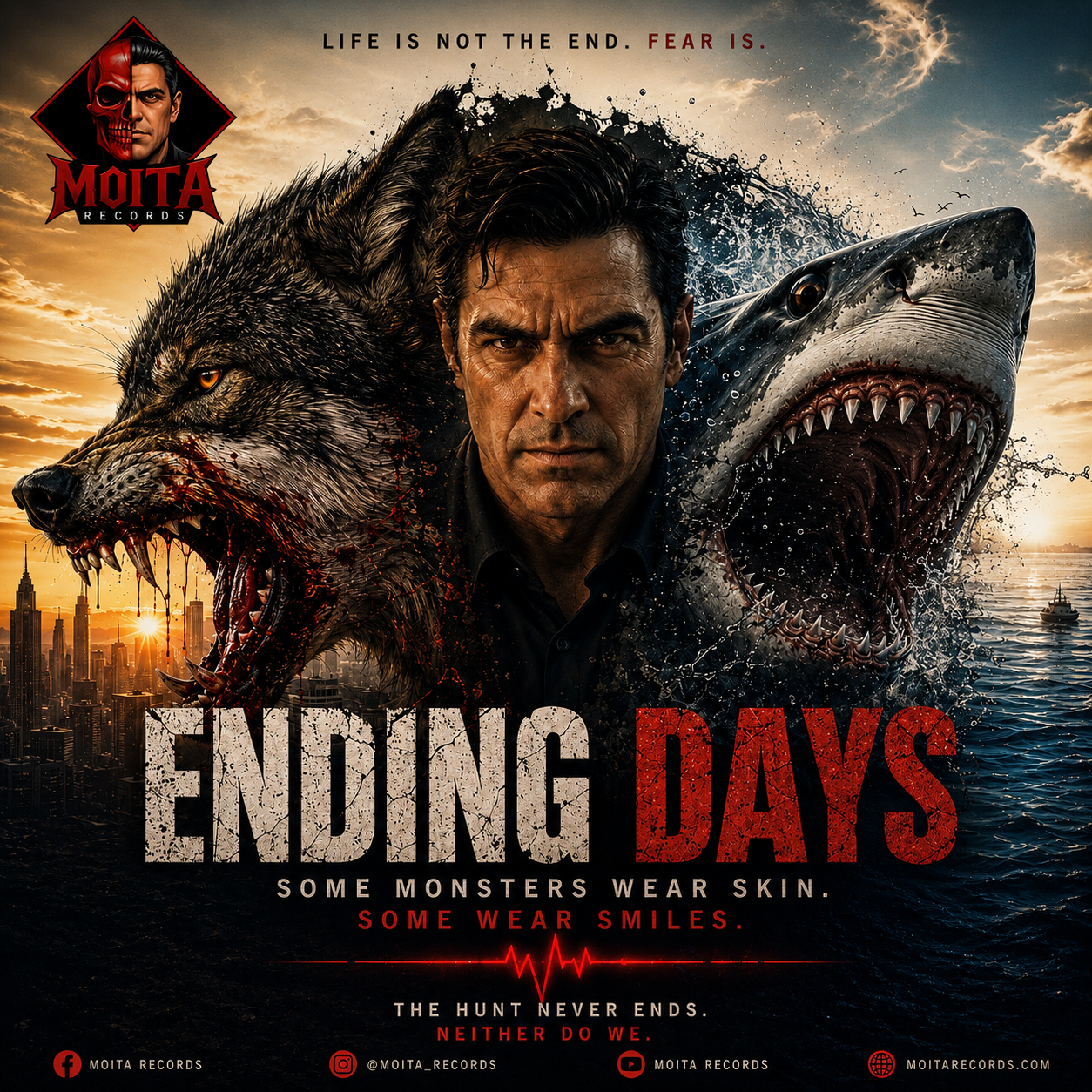
The wolf and the shark are not really animals in this song.
They are predators.
They represent the kind of people who watch, wait, study weakness, build trust, and move closer without showing what they really are.
The wolf is the threat you sense somewhere beyond the light.
The shark is the danger moving beneath a calm surface.
One waits on land.
One waits beneath the water.
Both survive by choosing the right moment to attack.
That is what made them fit this story.
Human predators do not always look dangerous.
They do not always arrive with violence.
Sometimes they arrive with patience.
Sometimes with kindness.
Sometimes with promises.
Sometimes with authority.
Sometimes with affection.
Sometimes they become trusted before they become feared.
That is what makes them dangerous.
This song is not about creating fear for the sake of it.
It is about looking directly at something most people would rather avoid.
There are people who deliberately take advantage of innocence, loneliness, fear, addiction, grief, trust, and the need to belong.
Ignoring that truth does not make it disappear.
The song gives that darkness a voice so the listener can recognize it.
Sometimes we understand danger better when we hear how it thinks.
THE STORY BEHIND THE SONG
I did not sit down intending to write a horror song.
I was reading a book about a child who had been abducted and later returned home.
The child survived.
That should have been the happy ending.
But the story did not feel finished to me.
The person who came back had been changed.
Whatever happened during those missing years had transformed that child into someone different.
That became the part I could not stop thinking about.
People can return physically and still spend years trying to find their way home inside themselves.
A body can survive while trust is destroyed.
A person can escape while fear continues living inside them.
A family can celebrate a return while slowly realizing that the person they lost did not come back unchanged.
That is a hard truth.
It is also an honest one.
No one walks through that kind of darkness and simply returns to who they were before.
That does not mean the survivor is broken beyond repair.
It means survival has a cost.
It means healing may become another long journey.
The more I thought about that child, the more the story grew beyond one abduction.
I started thinking about every kind of predator who changes another person’s life.
A person who abuses a child.
A trafficker who studies vulnerability.
A violent partner who slowly removes someone’s freedom.
A manipulator who isolates a person from everyone who might help.
A person who notices pain and sees opportunity instead of humanity.
The methods may be different, but the pattern often begins the same way.
Watch.
Wait.
Earn trust.
Test boundaries.
Create dependence.
Take control.
That is where the wolf came from.
A wolf does not need to announce itself.
It watches from a distance.
It understands timing.
It does not waste energy showing itself too early.
The shark brought another kind of fear.
You can stand beside the ocean and see calm water stretching for miles.
Everything looks peaceful.
But you cannot see everything moving underneath.
That became the perfect symbol for hidden danger.
A person can believe they are safe while something dangerous has already entered their life.
The warning signs may be small.
A question that feels a little too personal.
A favour that creates obligation.
A compliment designed to lower someone’s guard.
A relationship that slowly pushes everyone else away.
A person who always seems to know when someone feels lonely, rejected, frightened, or desperate.
The danger is not always obvious because predators often depend on appearing harmless.
That is one of the most frightening parts of the song.
The monster does not need to hide in a forest.
It may be standing in plain sight.
WHY I WROTE THIS SONG
I wrote ENDING DAYS because that story would not leave me alone.
It raised questions I did not have easy answers for.
How does someone survive something that changes who they are?
How does a child rebuild trust after trust was used against them?
How does a family welcome someone home when the person returning is still trapped inside what happened?
How do we protect people without teaching them to fear everyone?
How do we recognize manipulation before it becomes control?
I did not write the song because I had all the answers.
I wrote it because some questions deserve to be carried into the open.
The darkest things often survive through silence.
They survive because people do not want to discuss them.
They survive because warning signs are ignored.
They survive because victims are blamed for not seeing what was deliberately hidden from them.
They survive because predators know how to make themselves appear trustworthy.
The song speaks from the predator’s point of view, but it does not belong to the predator.
It belongs to the listener.
The voice is exposed so people can hear its arrogance.
Its patience.
Its hunger.
Its belief that nobody can escape.
That voice sounds powerful inside the song, but the fact that we can hear it changes everything.
Once something is recognized, it becomes harder to hide.
Once manipulation is understood, it becomes harder to excuse.
Once silence is broken, the predator loses one of its greatest protections.
That is why I wrote it this way.
Not to glorify darkness.
To drag it into the light.
WHY THIS MATTERS TO ME
This matters to me because a child should never have to return home as a stranger to themselves.
A child should be learning through curiosity.
Playing.
Laughing.
Making mistakes.
Growing naturally.
They should not be learning survival because another person decided to steal their safety.
What stayed with me most was not only that the child had been taken.
It was the thought of what had been done during the missing years.
The child came home, but childhood did not.
That is a different kind of loss.
It cannot be measured only by time.
It is measured by trust.
By fear.
By memories.
By the years spent trying to understand what happened.
By the person someone might have become if nobody had interfered with their life.
That is why the title ENDING DAYS means more than death.
It can mean the day an old life ends.
The day safety disappears.
The day trust is broken.
The day innocence is replaced by survival.
For one person, it may be an abduction.
For another, the first act of abuse.
For someone else, the beginning of manipulation, addiction, exploitation, or control.
The person may continue living for many years.
But something ended on that day.
That is the meaning I kept coming back to.
At the same time, I did not want the song to say that the survivor’s entire life is over.
That would give the predator too much power.
People rebuild.
They recover.
They become parents, teachers, counsellors, advocates, friends, and protectors.
They may never become exactly who they were before, but that does not mean the person they become has no future.
Survival changes people.
Healing changes them again.
That matters to me because darkness should never be allowed to claim the final chapter.
WHY THIS SONG FITS MOITA
ENDING DAYS belongs inside MOITA because MOITA cannot tell the truth about life while only writing about the comfortable parts.
Life contains love, humour, family, ambition, hope, music, success, and dreams.
It also contains cruelty.
Manipulation.
Violence.
Fear.
Loss.
People who deliberately harm others.
Both sides exist.
Pretending otherwise would make the library dishonest.
Some MOITA songs celebrate what human beings can become.
Others expose what human beings are capable of doing.
ENDING DAYS looks at the second side without turning away.
It also fits MOITA because the song opens a larger conversation.
It can lead into child protection.
Grooming.
Coercive control.
Trauma.
Recovery.
Trust.
Community responsibility.
The importance of listening when someone asks for help.
That is what Educational Rock means to me.
It does not mean standing above people and telling them what to think.
It means using a song to begin a conversation that may help someone see life differently.
The music creates emotion.
The story creates understanding.
The documentary allows the learning to continue.
ENDING DAYS is dark, but its purpose is not darkness.
Its purpose is awareness.
If one parent starts a conversation because of this song, that matters.
If one person recognizes controlling behaviour sooner, that matters.
If one survivor realizes the shame never belonged to them, that matters.
If one reader becomes more willing to listen instead of judge, that matters.
That is why this song earned its place inside MOITA.
READ THIS FIRST
Before you read these lyrics, forget about wolves and sharks for a moment.
Do not picture the forest.
Do not picture the ocean.
Picture people.
Picture the child who trusted the wrong adult.
Picture the teenager being slowly isolated from everyone who cares.
Picture the person in a relationship who no longer recognizes themselves.
Picture the survivor who escaped physically but still carries the fear.
Picture the family waiting for someone who may never return.
Picture the family who gets their loved one back and realizes that coming home is only the beginning.
The wolf and the shark give the darkness a shape.
The real story is human.
As you read, do not only ask who the predator is.
Ask how the predator gained access.
Ask what weakness was noticed.
Ask what trust was used.
Ask what warning signs were missed.
Ask what might have changed if someone had looked closer, listened sooner, or believed the person asking for help.
Most importantly, remember that the voice inside these lyrics is not being celebrated.
It is being exposed.
FULL LYRICS
ENDING DAYS
Stay away from that path.
It carries the soul beyond return.
It feeds the darkness that never sleeps.
Hide your wounds.
Guard your heart.
For once you feel the heat of its burning flame,
it will consume everything you are.
Hope.
Reason.
Mercy.
And when it finally learns your name
Your ending days have begun.
I am the wolf that shadows the ridge
The eyes in the dark at the end of the bridge
I don’t chase justice
I don’t hunt fair
I smell your weakness hanging in the air
I don’t need reasons
I don’t need names
The hunter survives while the hunted complain
Deep in the cave where the cold winds stay
I wait for the sound of your ending days
Run if you want
Hide if you can
Every path you choose was part of my plan
I will destroy your ending days
Feed on your fear and leave no trace
Your cries are the music that fuels my rage
I am the nightmare of your ending days
Every scar
Every wound
Every shadow in the room
When the darkness knows your name
I am there
I am the flame
I am the nightmare of your ending days
I am the shark beneath the tide
The silent terror where the dead things hide
No mercy lives beneath these waves
Only hunger filling endless graves
The ocean opens
The water turns black
You never see the moment before the attack
One flash of teeth
One burst of red
Then another soul joins the forgotten dead
Swim if you want
Pray if you must
The sea swallows everything into dust
I will destroy your ending days
Feed on your fear and leave no trace
Your cries are the music that fuels my rage
I am the nightmare of your ending days
Every scar
Every wound
Every shadow in the room
When the darkness knows your name
I am there
I am the flame
I am the nightmare of your ending days
I am the wolf
I am the shark
I am the whisper inside the dark
I am the hunger that never dies
The shadow behind your fading eyes
No land
No sea
No place remains
That can escape my ending days
I will destroy your ending days
Tear through the light and blacken the rays
Your fear is the fuel that burns my veins
I am the nightmare of your ending days
Every step
Every breath
Brings you closer to what comes next
When the final silence falls like rain
You’ll remember my name
I am the wolf.
I am the shark.
I am the darkness after dark.
And when the final curtain falls,
You’ll know I was there all along.
ENDING DAYS
SECTION ONE
LYRIC JOURNEY
PART 1
“Stay away from that path.”
That is where the song begins.
Not with the wolf.
Not with the shark.
Not with blood.
Not with an attack.
With a warning.
I wanted the first thing you heard to sound like somebody trying to stop you before you went any farther.
That matters because most terrible things in life do not begin at the terrible part.
They begin earlier.
They begin when something still looks harmless.
A conversation.
A person.
A promise.
An invitation.
A decision.
A moment where you could still turn around and never know what might have happened.
That is the path I was thinking about.
When I was reading the story that eventually led me to write ENDING DAYS, I kept thinking about that child before anything happened.
There had to be a before.
There was a normal life before the abduction.
There was a child who had routines, people, trust, expectations, and a future that had not yet been interfered with.
Then something happened.
A line was crossed.
Once that happened, everything after it belonged to a different life.
That is why the first lyric feels almost simple.
Stay away from that path.
Sometimes the simplest warning carries the greatest weight because you only understand it after you know where the path leads.
“It carries the soul beyond return.”
This is where the warning becomes much darker.
I was not trying to say that a person can never heal.
That would make the song hopeless, and I do not believe that.
I was thinking about change.
There are experiences that alter a person so deeply that returning to exactly who they were before is impossible.
That does not mean the person is gone.
It means life has changed them.
All of us change as we grow older.
That is natural.
What disturbed me about the story I was reading was that this change had been forced on a child.
That is completely different.
A child should change because they grow.
Because they learn.
Because they discover things.
Because they make mistakes.
Because they laugh.
Because they fall down and get back up.
Because life gradually teaches them who they are.
They should not be transformed because another human being decided to take control of their life.
That is what “beyond return” meant to me.
You may come home.
You may survive.
You may rebuild.
You may create a good life.
But the exact person who existed before the event may never return in exactly the same form.
That thought was one of the things that would not leave me alone.
“It feeds the darkness that never sleeps.”
Darkness in this song is not supernatural.
I am not talking about some monster hiding under the bed.
I am talking about the part of human behaviour that can cause deliberate harm and keep doing it.
There are people who hurt others and stop.
There are people who recognize what they have done.
There are people who change.
Then there are others who continue.
They search for another victim.
Another weakness.
Another opportunity.
That is the darkness that never sleeps.
It does not disappear because we are uncomfortable talking about it.
It does not disappear because we want to believe everyone has good intentions.
Most people probably do.
But pretending the others do not exist does not protect anyone.
That became important to me while writing this song.
I did not want the darkness to feel like fantasy.
I wanted it to feel human.
That makes it harder to listen to, but it also makes it worth talking about.
“Hide your wounds.”
That line can be misunderstood if it is taken by itself.
I am not telling people to hide pain.
I am not saying people should suffer alone.
The opposite is true.
I was writing from inside a world where a predator sees vulnerability differently than a decent person does.
If I see somebody hurting, my natural reaction is that I hope somebody helps them.
A predator may see the same pain and think they have found an opening.
That is the difference.
Loneliness can become an opening.
Grief can become an opening.
The need to belong can become an opening.
A young person who feels nobody understands them can become easier to influence when the wrong person suddenly acts as though they understand everything.
Someone who has lost confidence may respond strongly to a person who seems to offer it back.
Someone who feels isolated may become attached to the first person who gives them attention.
None of those people are weak.
They are human.
That is why this lyric is written as a warning.
Be careful who gets access to your wounds.
Some people want to help you heal.
Others want to learn where to press.
“Guard your heart.”
That line follows naturally because trust is where so much of this begins.
We need trust.
You cannot live a meaningful life without it.
You have to trust people.
You have to love people.
You have to let people close.
You have to take chances.
The answer cannot be to build a wall around yourself and never allow anyone inside.
That would give fear too much power.
Guarding your heart means something different.
It means understanding that trust has value.
Do not hand it away simply because somebody asks for it.
Let people earn it.
Pay attention to how they treat others.
Pay attention to whether their words and actions match.
Pay attention to what happens when you say no.
That one can tell you a lot about a person.
Someone who respects you can hear no.
Someone who wants control often sees no as something to defeat.
That is when a relationship can begin changing without anyone noticing how serious it has become.
“For once you feel the heat of its burning flame,
it will consume everything you are.”
Now the song starts moving from warning into consequence.
The flame is another symbol.
Fire can be beautiful.
Fire can keep you alive.
Fire can warm a home.
It can also destroy everything around it when it is no longer controlled.
The fire in ENDING DAYS is that second kind.
Once manipulation takes hold, it can start spreading into every part of a person’s life.
How they think.
Who they trust.
Who they speak to.
Where they go.
How they see themselves.
What they believe they deserve.
That is why I used the word “consume.”
The danger is not always one violent moment.
Sometimes it is the slow destruction of identity.
Piece by piece.
The person who once made decisions confidently begins asking permission.
The person who once had friends slowly stops seeing them.
The person who once trusted their own judgment begins believing they cannot make a good decision without somebody else.
That can happen so gradually that nobody sees the fire spreading until the room is already full of smoke.
“Hope.”
One word.
That was enough.
Hope is often one of the first things control tries to kill.
If you believe tomorrow can be better, you may try to reach it.
If somebody wants to control you, hope becomes dangerous to them.
Hope says there may be another life.
Hope says there may be another door.
Hope says there may be someone who will listen.
Hope says you are not finished.
That is why I wanted it standing there by itself.
“Reason.”
Once fear becomes strong enough, people do not always think the way they normally would.
That is not stupidity.
It is what fear can do.
A person can know something feels wrong and still remain.
A person can recognize manipulation and still defend the manipulator.
A person can understand that they are being harmed and still be terrified of leaving.
From the outside, people sometimes ask questions like, “Why didn’t they just go?”
That is easy to say when you are not the person living inside the situation.
Fear changes decisions.
Dependence changes decisions.
Isolation changes decisions.
Threats change decisions.
Shame changes decisions.
The situation that looks obvious from the outside may feel completely different from inside it.
That is why “Reason” stands alone.
The predator wants control over more than the body.
It wants control over the way the victim sees reality.
“Mercy.”
This one turns the song colder.
By the time we reach mercy, the warning has moved beyond escape and into the character of the predator.
Mercy requires recognizing another person’s humanity.
It requires seeing suffering and deciding not to add to it.
The voice coming later in this song does not think that way.
It sees weakness.
It sees opportunity.
It sees prey.
That is why mercy disappears.
Once another human being becomes an object in someone’s mind, terrible things become easier for that person to justify.
That is one of the darkest places the song goes.
I wanted the listener to understand that before the wolf ever appears.
Hope.
Reason.
Mercy.
Three things disappearing one after another.
“And when it finally learns your name…”
The lyric itself uses that pause, and I am leaving it exactly as I wrote it.
For me, this is the point where the danger stops being general.
Before this, darkness exists somewhere out there.
Now it knows who you are.
Your name makes it personal.
You are no longer part of the crowd.
You have been noticed.
That idea bothered me while I was writing because so many predators depend on observation.
They learn things.
They remember details.
They find out what someone wants.
What they fear.
Who they trust.
What they are missing.
Sometimes people think manipulation begins when the predator asks for something.
I think it often begins much earlier.
It begins when the predator starts learning.
By the time they use what they know, the groundwork may already be there.
“Your ending days have begun.”
That is the first time the title appears.
And now it has a meaning.
The ending days are not simply somebody’s final days alive.
They can be the ending of the life they knew.
The ending of innocence.
The ending of trust.
The ending of safety.
The ending of childhood as it should have been.
That was the idea I could not get away from when I read about the abducted child.
The day that child was taken was not necessarily the end of life.
But it may have been the end of one life and the beginning of another.
That is why the title became ENDING DAYS.
It sounds like death at first.
The song slowly reveals that something can end while a person continues living.
And now, after the warning, the predator finally steps forward.
“I am the wolf that shadows the ridge”
The first creature appears.
The warning is over.
Now we meet the thing that has been waiting.
The wolf is not there because I wanted a frightening animal.
The wolf is there because it watches from a distance.
It stays where you cannot quite reach it.
It sees before it is seen.
That is where the next part of the journey begins.
SECTION ONE
LYRIC JOURNEY
PART 2
“The eyes in the dark at the end of the bridge”
The wolf has stepped into the song, but it still hasn’t attacked.
That was deliberate.
The first thing you notice isn’t its teeth.
It’s its eyes.
Most of us have experienced that uneasy feeling at some point in life. You think someone is watching you. You can’t prove it. You can’t even explain why you feel it. You just know something doesn’t feel right.
That feeling became this lyric.
The bridge is important too.
A bridge connects one place to another.
Once you step onto it, you’re moving away from where you were and toward somewhere new.
That fit the story perfectly.
The child I had been reading about crossed a bridge that was never supposed to exist.
One day there was ordinary life.
The next day there wasn’t.
Predators often create those bridges themselves.
They don’t force someone across immediately.
They build trust until crossing feels natural.
By the time the victim realizes the bridge only goes one way, they’re already standing on it.
“I don’t chase justice.”
That line says almost everything about the predator without telling you where the story is going.
Justice belongs to people who care about right and wrong.
Justice asks whether something should be done.
The predator doesn’t ask that question.
The predator asks only one question.
Can I?
That difference matters.
Most decent people have an internal conversation before making an important decision.
“Is this fair?”
“Will this hurt someone?”
“What would I feel if this happened to me?”
Those questions slow us down.
They protect other people.
The voice in this song has no interest in those questions.
Justice isn’t part of its vocabulary.
That makes it dangerous.
“I don’t hunt fair.”
That line naturally follows the previous one.
Fairness assumes both people have a chance.
Predators don’t want equal ground.
They want advantage.
They choose moments when someone is alone.
Confused.
Young.
Grieving.
Trusting.
Dependent.
They don’t usually look for the strongest person.
They look for the easiest opportunity.
That’s one reason I kept coming back to the idea of patience while writing this song.
Real predators often invest time.
They understand that gaining someone’s confidence can be more powerful than using force.
That’s a frightening thought.
It’s also one worth understanding.
“I smell your weakness hanging in the air.”
This lyric isn’t really about smell.
It’s about awareness.
Predators often notice emotional wounds long before other people do.
Sometimes they notice them because they’re paying closer attention.
Sometimes because they’ve done this before.
Sometimes because they’re looking for exactly those signs.
Someone who feels invisible may respond to attention.
Someone who feels abandoned may respond to affection.
Someone who feels uncertain may respond to certainty, even if that certainty comes from the wrong person.
That’s why I wanted this line to feel uncomfortable.
Weakness isn’t something to be ashamed of.
Every one of us has weak moments.
Every one of us needs help sometimes.
The tragedy is that some people don’t see vulnerability as something to protect.
They see it as something to exploit.
“Hanging in the air.”
I like simple images.
This one almost feels ordinary.
You can’t see scent.
You know it’s there because something else reacts to it.
Manipulation often works the same way.
Other people may not notice anything unusual.
The predator notices immediately.
A lonely conversation.
A difficult home life.
Someone desperate to fit in.
Someone who has stopped believing in themselves.
Those things can become signals.
That thought made me stop more than once while writing.
It reminded me how important ordinary kindness really is.
Sometimes genuine friendship reaches someone before manipulation does.
Sometimes one caring adult changes a child’s future.
Sometimes simply noticing another person’s struggle is enough to interrupt a dangerous path.
Those moments rarely make the news.
They still matter.
“I don’t need reasons.”
This line reveals another part of the predator’s thinking.
Most people justify their actions.
Even when they know they’re wrong.
They invent explanations.
They blame stress.
They blame childhood.
They blame circumstances.
The voice in this song doesn’t bother.
It doesn’t need reasons because it doesn’t believe it owes anyone an explanation.
That absence of conscience says more than any long speech ever could.
“I don’t need names.”
When I wrote this line, I was thinking about what happens when another human being stops seeing people as people.
Names matter.
A name reminds us that someone has a family.
A history.
Dreams.
Memories.
People who love them.
Once those things disappear, it becomes much easier to reduce someone to an object.
History has shown that over and over again.
Whether it’s war.
Crime.
Abuse.
Human trafficking.
Or exploitation of any kind.
The first step is often removing individuality.
The victim stops being a person.
They become a target.
A number.
A possession.
A problem.
That is one of the darkest transformations human beings are capable of making.
“The hunter survives while the hunted complain.”
This may be the most arrogant line in the verse.
That’s exactly why it belongs there.
The predator believes strength belongs only to itself.
It mistakes compassion for weakness.
It mistakes fear for surrender.
It mistakes silence for agreement.
History has proven those assumptions wrong countless times.
People survive extraordinary things.
People rebuild after unimaginable trauma.
People who were once terrified sometimes become the very people protecting others.
Predators rarely expect that.
They assume the story ends where they want it to end.
Life has a way of proving otherwise.
“Deep in the cave where the cold winds stay.”
Now the song begins moving away from the predator’s mind and back into imagery.
The cave isn’t one specific place.
It’s every hidden place where darkness prefers to remain unseen.
Secrets live in caves.
Shame lives there.
Silence lives there.
Fear often lives there too.
When something remains hidden long enough, it begins feeling permanent.
That is why bringing difficult subjects into the open matters so much.
Predators depend on hidden places.
Not always physical places.
Sometimes emotional ones.
Places where victims believe nobody will understand.
Nobody will believe them.
Nobody will help.
Those invisible caves can become just as imprisoning as real ones.
“I wait for the sound of your ending days.”
The predator still isn’t chasing.
It is waiting.
Waiting appears again because patience is one of the themes running quietly underneath this entire song.
Some dangers move quickly.
Others move slowly.
The slow ones are often harder to recognize.
That’s one reason manipulation can become so powerful.
Nothing dramatic happens today.
Or tomorrow.
Or next week.
Small boundaries shift.
Tiny compromises appear.
Things that once felt uncomfortable slowly begin feeling normal.
By the time someone realizes how much has changed, the process has already done enormous damage.
The phrase “the sound of your ending days” isn’t about hearing footsteps.
It’s about recognizing the moment someone’s life begins changing.
The predator believes it can hear that moment before anyone else.
That’s how inflated its confidence has become.
The verse ends there because we’ve now met the voice behind the song.
We’ve heard how it thinks.
How it justifies itself.
How it watches.
How it waits.
The next lyrics no longer describe the predator.
They challenge the listener directly.
“Run if you want.
Hide if you can.”
The confrontation has begun.
SECTION ONE
LYRIC JOURNEY
PART 3
“Run if you want.
Hide if you can.”
The song suddenly changes direction here.
Up until now, the predator has been introducing itself.
Now it speaks directly to its victim.
That change matters because the danger no longer feels distant.
It has become personal.
These lines are not really about running through a forest or hiding behind rocks.
They are about the feeling many victims describe after someone has taken control of their lives.
You can leave the room.
You can change your phone number.
You can move to another city.
Sometimes you still feel as though the person is standing beside you.
Trauma has a way of doing that.
Long after the danger has passed, the mind can continue preparing for something that is no longer happening.
That isn’t weakness.
It’s survival.
The brain is trying to protect itself from ever being caught off guard again.
I wanted these words to carry that feeling.
Not simply the fear of being chased.
The feeling that nowhere seems safe anymore.
“Every path you choose was part of my plan.”
To me, this is one of the darkest lines in the entire song.
Not because it talks about violence.
Because it talks about control.
The most dangerous manipulators don’t only control what someone does.
They slowly begin controlling what someone believes.
Over time, the victim may begin thinking every decision is their own, when in reality many of those decisions have been carefully influenced.
That happens in abusive relationships.
It happens in coercive control.
It happens in cults.
It happens in trafficking.
It happens in financial scams.
It happens anywhere one person patiently reshapes another person’s reality.
That’s why this lyric is so important to me.
Freedom is rarely stolen all at once.
It is usually taken one small piece at a time.
One excuse.
One favour.
One compromise.
One apology.
One promise that things will be different next time.
By the time someone realizes how much freedom has disappeared, they may feel trapped inside a life they never intended to build.
That thought frightened me much more than any horror story ever could.
“I will destroy your ending days.”
Now we arrive at the chorus.
The first time I wrote these words, I remember stopping for a while.
I asked myself whether they were too harsh.
Then I thought about the story that had inspired the song.
If I softened the predator’s voice, I would also soften the reality that many survivors have lived through.
That wouldn’t be honest.
The predator believes it has the power to decide another person’s future.
It believes it can destroy everything.
That’s exactly how many predators think.
They convince themselves they own someone else’s life.
The song allows that arrogance to speak openly.
Not because I agree with it.
Because exposing it is sometimes the fastest way to recognize it.
“Feed on your fear and leave no trace.”
Fear becomes food in this line.
Not literal food.
Power.
Some people gain satisfaction by helping others become stronger.
Others gain satisfaction by making people feel smaller.
The second kind has existed throughout history.
Fear gives them a feeling of control.
That’s why intimidation appears in so many forms.
Threats.
Humiliation.
Isolation.
Manipulation.
Violence.
The methods are different.
The goal is remarkably similar.
Control another person’s choices.
The phrase “leave no trace” also mattered to me.
Many harmful people spend enormous energy hiding what they do.
They create false stories.
They manipulate witnesses.
They convince victims that nobody will believe them.
They work very hard to erase evidence of what happened.
That hidden part of abuse often causes as much damage as the abuse itself.
“Your cries are the music that fuels my rage.”
This may be the hardest lyric in the chorus to read.
It should be.
Cruelty sometimes reaches the point where another person’s suffering becomes emotionally meaningless to the person causing it.
That reality is difficult to accept.
Most of us naturally stop when we realize somebody else is hurting.
Empathy tells us to stop.
The predator in this song has abandoned empathy.
That is why another person’s pain becomes something completely different.
The lyric is not celebrating that thinking.
It is exposing how empty it has become.
Without empathy, almost any act can be justified.
That is one reason empathy may be one of the most important qualities we can protect in ourselves and encourage in others.
“I am the nightmare of your ending days.”
The chorus ends by bringing everything back to the title.
Notice that the predator still believes it is the centre of the story.
Everything revolves around itself.
That is another common characteristic of manipulation.
The manipulator believes everyone else’s life exists in relation to them.
Their needs.
Their anger.
Their control.
Their desires.
Healthy relationships don’t work that way.
Healthy relationships recognize two complete human beings.
Manipulation gradually allows only one.
“Every scar.
Every wound.
Every shadow in the room.”
After all the confidence of the opening chorus, something changes here.
The lyrics slow down.
I wanted the listener to breathe for a moment.
Scars aren’t only physical.
Many of the deepest scars can never be photographed.
A person may smile while carrying memories they have never spoken aloud.
Someone may appear successful while quietly fighting battles nobody else knows exist.
Every scar tells a story.
Some are visible.
Many are hidden.
The same is true of wounds.
Not every wound bleeds.
Some wounds are measured in trust that disappeared.
Confidence that never fully returned.
Dreams that quietly ended.
Relationships that never recovered.
The shadow in the room is another image that grew naturally from the song.
Sometimes trauma isn’t standing directly in front of someone anymore.
It lingers in the background.
Always present.
Always capable of returning unexpectedly.
That is how many survivors describe it.
Not as something they constantly think about.
As something they never completely forget.
“When the darkness knows your name.”
Earlier in the song, darkness learned the person’s name.
Now it knows it.
There is an important difference.
Recognition has become possession.
The predator believes the victim now belongs to its story forever.
That is exactly the lie many survivors spend years overcoming.
Trauma may become part of someone’s history.
It does not become the owner of their future.
The predator cannot decide that.
Only the survivor can.
“I am there.
I am the flame.”
The flame returns from the opening.
That wasn’t accidental.
The song is reminding us that the warning at the beginning wasn’t imaginary.
The fire has spread.
The predator believes it has become part of every future moment.
That is often how fear feels.
It convinces people it will always be there.
The good news, although the song doesn’t reveal it yet, is that fear can become smaller.
Healing doesn’t always remove the fire completely.
Sometimes it teaches us how to stop feeding it.
Sometimes it teaches us how to walk forward even while carrying scars.
That journey belongs to the survivor, not to the predator.
“I am the nightmare of your ending days.”
The chorus finishes exactly where it began.
The words are the same.
But after everything we’ve just travelled through, they don’t feel quite the same anymore.
We’ve now heard the predator boast.
We’ve seen how it thinks.
We’ve watched it mistake fear for permanent victory.
The confidence has become almost overwhelming.
That is exactly where I wanted the listener to be before the song changes again.
Because the next verse leaves the mountains behind.
Now the danger moves beneath the water.
The wolf has shown us one face of the predator.
The shark is about to show us another.
SECTION ONE
LYRIC JOURNEY
PART 4
“I am the shark beneath the tide.”
The moment this line appears, the landscape changes completely.
We’ve left the mountains.
We’ve left the caves.
Now we’re standing at the edge of the ocean.
I wanted that change because predators don’t all look the same.
They don’t all behave the same way either.
The wolf represented the danger you might sense watching from a distance.
The shark represents something different.
The danger you don’t even know is there.
I’ve always found the ocean fascinating.
You can stand on a beach on a beautiful summer day and everything looks peaceful.
The waves roll in.
Children laugh.
People swim.
The horizon stretches forever.
Yet beneath that calm surface is an entirely different world.
You don’t see most of it.
That became the perfect picture for hidden danger.
Some of the most destructive people in history looked completely ordinary from the outside.
Neighbours.
Teachers.
Co-workers.
Partners.
Friends.
Community leaders.
People trusted by those around them.
That is what the shark became.
Not an animal.
A symbol of danger hidden beneath appearances.
“The silent terror where the dead things hide.”
One word stands out to me here.
Silent.
Real predators rarely announce themselves.
If they did, almost nobody would let them into their lives.
Silence protects them.
Secrets protect them.
Shame protects them.
Fear protects them.
Many survivors stay silent for reasons people who have never experienced trauma often struggle to understand.
Sometimes they aren’t believed.
Sometimes they’re threatened.
Sometimes they blame themselves.
Sometimes they’re protecting someone else.
Sometimes they simply want the nightmare to end.
Silence can become another prison.
That thought stayed with me throughout the writing of this song.
Breaking silence doesn’t erase what happened.
It can become the first step toward reclaiming a life.
“No mercy lives beneath these waves.”
This line continues showing us the predator’s mind.
Mercy requires compassion.
It requires seeing another human being’s suffering and deciding not to increase it.
The voice speaking in this song has moved beyond compassion.
Everything has become self-centred.
Every decision is measured only by one question.
“What do I want?”
Once another person’s humanity disappears, mercy usually disappears with it.
History has shown that repeatedly.
Whether we are talking about abuse, exploitation, trafficking, or countless other crimes, the first thing often lost is the ability to see another person as fully human.
That is one reason empathy matters so much.
Empathy interrupts cruelty before cruelty becomes action.
“Only hunger filling endless graves.”
The hunger in this song isn’t physical.
It’s emotional.
Psychological.
A hunger for power.
A hunger for control.
A hunger to dominate another person’s life.
Some people become satisfied by creating.
Others become satisfied by destroying.
That difference has always fascinated me.
Construction and destruction both require effort.
One builds a future.
The other takes one away.
When I wrote this lyric, I wasn’t thinking about one individual.
I was thinking about a pattern that has repeated itself throughout history.
Different faces.
Different countries.
Different generations.
The same hunger.
“The ocean opens.”
This is a very simple image, but I like what it allows the imagination to do.
Nobody sees the ocean actually opening.
The picture happens in the listener’s mind.
Sometimes the simplest lyrics leave the greatest room for imagination.
For me, this line represents the exact second before life changes.
There are moments we don’t recognize while we’re living them.
Years later we look back and realize everything divided at that point.
Before.
After.
One ordinary afternoon.
One conversation.
One phone call.
One decision.
One meeting.
Everything else follows.
That’s what I see when the ocean opens.
“The water turns black.”
People often ask writers whether a lyric has one correct meaning.
Sometimes it does.
Sometimes it doesn’t.
This one deliberately leaves room for different pictures.
Some listeners may imagine blood spreading through the water.
Others may picture a storm rolling in.
Others may imagine darkness swallowing hope itself.
I like that every listener can bring something different to the image.
For me, black represents certainty disappearing.
The moment where the familiar world no longer feels familiar.
The child whose story inspired this song must have experienced a moment like that.
One ordinary day became something completely different.
Life before.
Life after.
That division stayed with me while writing.
“You never see the moment before the attack.”
This lyric reaches far beyond physical violence.
Manipulation usually doesn’t begin with obvious danger.
It often begins with attention.
Kindness.
Compliments.
Understanding.
The person feels safe.
That is exactly what makes manipulation so effective.
If danger looked dangerous from the beginning, very few people would step toward it.
Many harmful relationships begin with what appears to be genuine care.
Only later does control begin replacing kindness.
That gradual change is one of the reasons coercive control can become so difficult to recognize.
By the time someone notices what is happening, the relationship may already feel impossible to leave.
“One flash of teeth.”
I kept these words extremely short.
Sometimes longer descriptions reduce impact instead of increasing it.
Real violence often happens quickly.
One second.
Everything changes.
Those four words create a picture without forcing the listener to stay inside unnecessary detail.
That balance mattered to me.
The purpose of the song was never shock.
It was awareness.
“One burst of red.”
Again, I stopped almost immediately after the image appeared.
The point isn’t blood.
The point is consequence.
There are moments that divide a life forever.
Sometimes they last only seconds.
The memory may last decades.
That’s why I didn’t linger here.
The emotional impact comes from what follows, not from describing the event itself.
“Then another soul joins the forgotten dead.”
This lyric became much larger than the ocean.
While writing it, I wasn’t thinking only about people who lose their lives.
I was thinking about lives that disappear in other ways.
Children whose childhoods disappear.
People whose confidence disappears.
Families whose peace disappears.
Communities forever changed by one person’s choices.
The word “forgotten” bothered me while I was writing.
Because so many victims eventually disappear from public attention.
News stories end.
Headlines move on.
Families continue living with what happened.
Survivors continue rebuilding.
Life keeps moving.
The people directly affected rarely have that luxury.
That thought deserved a place in this song.
“Swim if you want.
Pray if you must.”
The predator speaks again.
Its confidence hasn’t weakened at all.
It still believes escape is impossible.
It still believes every choice belongs to it.
That arrogance is deliberate.
Manipulators often convince themselves they are untouchable.
History has repeatedly shown that many eventually aren’t.
People escape.
Evidence appears.
Truth surfaces.
Communities begin listening.
The confidence of the predator often becomes its greatest weakness.
Because overconfidence creates mistakes.
“The sea swallows everything into dust.”
The second pre-chorus ends quietly.
The sea becomes another symbol for life after trauma.
Some experiences seem to swallow everything that existed before them.
Plans change.
Relationships change.
Dreams change.
Identity changes.
But something else slowly begins as well.
Recovery.
Not instantly.
Not perfectly.
Not without setbacks.
Recovery doesn’t erase the sea.
It teaches someone how to live beyond the storm.
That thought stayed with me throughout ENDING DAYS.
Because the child who inspired this song survived.
The story didn’t end there.
It became another beginning.
The chorus now returns.
The words haven’t changed.
But we have.
We’ve travelled farther into the predator’s mind.
We’ve seen another face of the same darkness.
The chorus now carries more weight because we understand more than we did the first time.
The journey continues.
So does the song.
SECTION ONE
LYRIC JOURNEY
PART 5
The chorus returns exactly as it did before.
The words haven’t changed.
The meaning has deepened.
The first time we heard it, we were meeting the predator for the first time.
Now we’ve travelled through both the wolf and the shark.
We’ve seen that they were never separate characters.
They were always two faces of the same idea.
The wolf showed us the patient hunter on land.
The shark showed us the hidden danger beneath the surface.
Now, when the chorus comes back, it no longer feels like an introduction.
It feels like confirmation.
The predator still believes it cannot be stopped.
The arrogance hasn’t changed.
The confidence hasn’t weakened.
But something has changed for us.
We understand the voice now.
We recognize the pattern.
That is one of the reasons I chose not to explain the chorus all over again.
The journey has moved forward.
Repeating myself would only slow the reader down.
Instead, I want you to carry everything you’ve already learned into these familiar words.
Sometimes a repeated chorus doesn’t need a new explanation.
It simply needs the weight of everything that has happened since the last time you heard it.
That is exactly what happens here.
“I am the wolf.”
The bridge begins by bringing the wolf back.
Not because I wanted to remind you about an animal.
Because the wolf has become an idea.
It now represents every patient predator who studies before acting.
Every person who waits until trust has been built.
Every person who understands that manipulation often succeeds where force fails.
The wolf has become larger than itself.
It has become behaviour.
“I am the shark.”
Then the shark returns.
Again, not as an animal.
As another face of the same darkness.
The shark reminds us that danger often exists beneath appearances.
The surface can remain calm while something destructive moves quietly underneath.
That image applies to far more than crime.
It can apply to relationships.
To workplaces.
To organizations.
To addiction.
To emotional abuse.
To almost any situation where the visible story hides another one underneath.
That was one of the ideas I wanted readers to carry with them.
Sometimes what we cannot immediately see deserves just as much attention as what we can.
“I am the whisper inside the dark.”
This may be my favourite line in the entire song.
Not because it sounds dramatic.
Because it explains how so much manipulation actually works.
Very few predators begin by shouting.
Most begin by whispering.
The whisper sounds reasonable.
Patient.
Understanding.
Comforting.
Sometimes it even sounds loving.
That is what makes it dangerous.
The whisper says things like,
“You can trust me.”
“They don’t understand you.”
“I’m the only one who really cares.”
“You don’t need anyone else.”
Those words don’t sound frightening when they’re first spoken.
That’s why they work.
Manipulation often enters quietly.
By the time it becomes obvious, the victim may already believe the whisper instead of their own instincts.
That’s one reason I wanted this line to stay simple.
The fewer words it uses, the more room there is for the reader to recognize whispers they may have encountered themselves.
“I am the hunger that never dies.”
Earlier in the song we met hunger.
Now we understand it more clearly.
Some people reach a point where enough is never enough.
Power isn’t enough.
Control isn’t enough.
Attention isn’t enough.
They always want more.
Another victim.
Another opportunity.
Another life to dominate.
That endless hunger is one of the reasons many predators continue offending until someone finally stops them.
The problem was never satisfaction.
The problem was that control itself became addictive.
“The shadow behind your fading eyes.”
This lyric brings us back to the victim.
I didn’t want the bridge to remain entirely inside the predator’s mind.
The fading eyes remind us what manipulation eventually costs.
The person who once laughed freely.
The person who trusted easily.
The person who believed tomorrow would probably be better.
Trauma can dim those things for a while.
Sometimes much longer than anyone realizes.
I chose “behind your fading eyes” because it suggests something slowly disappearing rather than instantly vanishing.
That felt much closer to the reality I was writing about.
“No land.”
By now the song has taken us through mountains.
Through forests.
Through caves.
Across bridges.
Into the ocean.
Now those places begin disappearing.
The predator claims that geography doesn’t matter.
You cannot outrun it simply by changing locations.
That feeling is one many survivors describe.
Even after leaving, they sometimes carry fear with them.
Not because the danger is still physically present.
Because memory travels too.
“No sea.”
The ocean no longer provides distance either.
Earlier it represented hidden danger.
Now it simply becomes another place where the predator claims ownership.
The voice is trying to convince the listener that escape doesn’t exist.
Again, I wanted the predator to sound completely convinced of its own power.
That confidence becomes important because it sets up what the listener eventually realizes for themselves.
The predator is speaking.
Not the truth.
“No place remains.”
This line gathers everything together.
The predator now believes every possible escape has disappeared.
That feeling can become terrifying when someone is trapped inside manipulation or abuse.
The world begins shrinking.
Friends disappear.
Family becomes distant.
Confidence fades.
Hope weakens.
Life starts feeling smaller and smaller.
That’s exactly how control often works.
It reduces someone’s world until only the manipulator seems to remain.
Recognizing that process is one of the first steps toward breaking it.
“That can escape my ending days.”
The bridge closes by returning once again to the title.
Notice something important.
The predator still believes it owns the ending.
It believes it has already decided how the story finishes.
But songs are different from life inside the predator’s imagination.
The predator speaks.
The listener decides whether to accept those words.
That is where the balance of power quietly begins changing.
Without realizing it, the predator has already made a mistake.
It has revealed how it thinks.
It has shown us its methods.
It has exposed its arrogance.
Once something hidden becomes visible, it becomes much harder to hide again.
The final chorus is now waiting.
The words will change.
The intensity will rise.
The song has reached its highest emotional point.
Everything we’ve walked through since the opening warning has been leading to that final confrontation.
The journey is almost complete.
SECTION ONE
LYRIC JOURNEY
PART 6
“I will destroy your ending days.”
When the final chorus begins, it doesn’t simply repeat what came before.
It becomes bigger.
The predator is speaking with complete confidence now.
There is no hesitation.
No uncertainty.
It believes the outcome has already been decided.
That certainty is one of the most dangerous qualities shared by many people who abuse power.
They stop believing anyone can challenge them.
They begin thinking they are untouchable.
History has shown again and again that this belief often becomes the beginning of their downfall.
People who believe they cannot be exposed usually become careless.
They underestimate the courage of victims.
They underestimate the determination of investigators.
They underestimate the persistence of families.
They underestimate the strength of ordinary people who refuse to stay silent.
That is one of the quiet truths hidden beneath this chorus.
The predator thinks it is giving the final speech.
It isn’t.
“Tear through the light and blacken the rays.”
Earlier in the song, darkness waited.
Now it attacks the light itself.
That change was important.
The predator no longer wants control over one person.
It wants to erase hope completely.
Light has always represented understanding.
Truth.
Safety.
Love.
Family.
Trust.
Everything that allows people to build healthy lives together.
Darkness doesn’t create anything.
It tries to extinguish what already exists.
That is why I chose the words “blacken the rays.”
It isn’t enough for the predator to survive.
It wants hope itself to disappear.
That has always been the goal of manipulation.
If someone loses hope, they become easier to control.
If they believe tomorrow cannot be better, they stop looking for another way forward.
That is why protecting hope matters so much.
Hope is often the first thing attacked and the last thing rebuilt.
“Your fear is the fuel that burns my veins.”
Earlier, fear fed the predator.
Now fear has become the thing keeping it alive.
That change shows how completely dependent it has become on controlling others.
People who build their identity around power eventually need more and more of it.
Enough is never enough.
The control has to continue.
The intimidation has to continue.
The manipulation has to continue.
Otherwise they begin losing the identity they created for themselves.
That is another reason predators often become increasingly dangerous over time.
Control becomes part of who they believe they are.
“I am the nightmare of your ending days.”
This is the final appearance of the chorus.
By now, I don’t think the listener hears these words the same way they did the first time.
We’ve travelled through every stage of the predator’s thinking.
We’ve watched its confidence grow.
We’ve watched its arrogance become absolute.
Something interesting happens because of that.
The more the predator speaks, the more it exposes itself.
It believes it is becoming stronger.
The listener is actually becoming wiser.
That reversal sits quietly underneath the entire song.
The predator never notices it.
“Every step.”
The music begins slowing down here.
So does the journey.
After all the images of wolves, sharks, darkness and hunger, the song suddenly becomes very personal again.
Every step.
Just two ordinary words.
But every survivor knows what they can mean.
Sometimes the hardest step is the first one.
The first conversation.
The first report.
The first time telling someone the truth.
The first time walking away.
The first counselling session.
The first morning after deciding life has to change.
Recovery often begins with one step.
Not a hundred.
Just one.
“Every breath.”
I wanted this line beside “Every step” because healing often becomes that basic.
People sometimes imagine recovery as one dramatic breakthrough.
Real life is usually quieter.
Wake up.
Breathe.
Keep going.
One day.
Then another.
Then another.
Some victories are so small that nobody else notices them.
The person living through them notices.
Those victories deserve respect.
“Brings you closer to what comes next.”
The predator believes these words belong to itself.
I think they belong to the survivor too.
Yes, every step brings us somewhere.
The question is where.
The predator believes the destination is despair.
Life often proves otherwise.
Many people who have survived unimaginable experiences eventually discover strengths they never knew they possessed.
Not because they wanted those lessons.
Because they refused to stop walking.
That’s why this lyric changed for me while I was writing it.
The predator hears one meaning.
I hear another.
“When the final silence falls like rain.”
Silence has appeared throughout the song in different forms.
The silence of predators.
The silence of victims.
The silence surrounding difficult subjects.
Now silence returns one last time.
Rain washes things.
It changes landscapes.
It nourishes life.
It also falls on everyone without choosing favourites.
I liked placing silence beside rain because it leaves the ending open.
What kind of silence is this?
The silence after justice?
The silence after loss?
The silence after finally telling the truth?
The listener decides.
Some songs deserve one fixed ending.
I wanted this one to leave room for reflection.
“You’ll remember my name.”
At first glance, this sounds like victory.
I don’t hear it that way.
Earlier in the journey, I explained that the name isn’t one individual.
It’s the face of evil itself.
History remembers names we wish had never existed.
Not because they deserve admiration.
Because we need to remember what they did.
Memory protects the future.
Forgetting often repeats the past.
That became one of the ideas quietly living underneath ENDING DAYS.
Remembering isn’t about living in fear.
It’s about learning enough that the next generation becomes harder to deceive.
“I am the wolf.”
The song strips everything away again.
Only the symbols remain.
By now they no longer need explanation.
We’ve walked with them long enough to understand what they represent.
“I am the shark.”
Two creatures.
One idea.
Patient predators.
Hidden predators.
Visible danger.
Invisible danger.
Together they became one voice because real evil rarely limits itself to one appearance.
It adapts.
It changes.
It wears different faces.
That was always the purpose behind using both symbols.
“I am the darkness after dark.”
This was one of the last lines I wrote.
Darkness after dark sounds almost impossible.
Darkness is already there.
How can there be darkness after darkness?
That’s exactly why I liked it.
Some experiences seem to go beyond what we believed was possible.
Some betrayals.
Some crimes.
Some acts of cruelty.
They leave people saying,
“I didn’t know human beings could do that.”
That is darkness after dark.
Not supernatural darkness.
Human darkness.
The kind created by choices.
“And when the final curtain falls,”
I liked ending with the image of a curtain because it quietly reminds us that every story eventually reaches its final page.
Every life does.
Every predator’s story ends.
Every victim’s story continues in one form or another.
Every one of us leaves something behind.
The question isn’t whether the curtain falls.
It always will.
The question is what remains after it does.
“You’ll know I was there all along.”
This is the final sentence spoken by the predator.
Notice something important.
The song ends with the predator speaking.
The story does not end with the predator winning.
Those are two very different things.
Everything you’ve read since the opening warning has exposed how this voice thinks.
How it manipulates.
How it waits.
How it justifies itself.
How it mistakes fear for permanent victory.
Now you know it.
That knowledge changes the entire journey.
The predator wanted to remain hidden.
It no longer can.
That is why, beneath all the darkness, I have always believed ENDING DAYS is actually a song about awareness.
Not fear.
Awareness.
The wolf has been seen.
The shark has been recognized.
The whisper has been heard.
Once we understand how darkness works, it becomes far more difficult for darkness to hide.
That is where the journey truly ends.
Not with the predator’s last words.
With the reader hearing those words differently than they did when the song first began.
If that happens, then the Lyric Journey has accomplished exactly what I hoped it would.
SECTION TWO
THE STORY
Some songs come from something I lived.
Some come from a conversation.
Some come from watching people.
Some come from asking myself questions that refused to leave.
ENDING DAYS came from reading a story that stayed with me long after I closed the book.
It was about a child who had been abducted.
Years later, the child was found and brought home.
Most people would naturally see that as the happy ending.
I couldn’t.
I kept thinking about the years between the kidnapping and the return.
I kept asking myself what happened during those missing years.
How much had been stolen that nobody could ever give back?
The child survived.
That much was true.
But survival and recovery are not the same thing.
A person can survive something that changes them forever.
That realization sat in my mind for days.
I wasn’t interested in writing about the crime itself.
I wasn’t interested in describing violence or creating a horror story.
I was interested in something much deeper.
I wanted to understand what happens when innocence is stolen.
Not lost through growing older.
Not changed through normal life.
Deliberately stolen by another human being.
The more I thought about it, the more I realized that this wasn’t just one child’s story anymore.
It became a story about predators.
Not wolves.
Not sharks.
People.
People who learn how to recognize weakness.
People who understand trust.
People who know how to manipulate.
People who don’t rush because they know patience often gives them exactly what they want.
That was the moment the song started changing.
The wolf wasn’t chosen because wolves are frightening.
It was chosen because a wolf watches.
It studies.
It waits.
It doesn’t waste energy.
It chooses the right moment.
That reminded me of how many human predators operate.
They don’t always force their way into someone’s life.
Sometimes they’re invited in.
Sometimes they’re trusted.
Sometimes they become part of a family.
Sometimes they become part of a community.
Sometimes they become the last person anyone would ever suspect.
That thought is far more frightening than anything a horror movie could invent.
Then came the shark.
I’ve always thought there was something fascinating about standing beside the ocean.
You can look across calm water and believe everything is peaceful.
You have no idea what may be moving beneath the surface.
That’s what made the shark the perfect symbol.
Not because it attacks.
Because you often don’t see it until it’s too late.
Life can be exactly the same.
Someone smiles.
Someone laughs.
Someone appears kind.
Everything looks normal.
Then one day something happens and everyone asks the same question.
“How did nobody know?”
The answer is often painful.
Because predators rarely look like predators.
They look ordinary.
Sometimes they look respectable.
Sometimes they look successful.
Sometimes they look helpful.
Sometimes they spend years building trust before they ever reveal who they really are.
That became the real story behind ENDING DAYS.
As the lyrics developed, I stopped thinking about one specific child.
I started thinking about every person whose life had been changed because someone chose to abuse trust instead of protecting it.
A child.
A teenager.
A husband.
A wife.
An elderly parent.
Someone struggling with addiction.
Someone desperate to belong.
Predators don’t always look for the strongest person in the room.
They often look for the loneliest.
The person grieving.
The person who feels invisible.
The person searching for acceptance.
Those thoughts shaped almost every lyric in this song.
One thing I was careful not to do was turn the predator into some larger-than-life monster.
Real monsters rarely introduce themselves that way.
If they did, nobody would let them close.
The real danger is that many of them know exactly how to appear harmless.
They know how to listen.
They know how to flatter.
They know how to gain confidence.
They know how to isolate someone little by little until the victim no longer realizes what’s happening.
That slow process interested me far more than the moment of violence.
Violence is often the result.
Manipulation is usually the beginning.
That’s an important difference.
The opening spoken words came naturally once I understood what the song was really about.
“Stay away from that path.”
I wasn’t talking about a trail through the woods.
I was talking about the first step that leads someone somewhere they never wanted to go.
Sometimes that path begins with one conversation.
Sometimes one lie.
Sometimes one relationship.
Sometimes one decision that feels completely harmless.
Life rarely changes all at once.
It often changes one choice at a time.
The more I wrote, the more I realized I wasn’t writing about fear.
I was writing about awareness.
Fear can freeze people.
Awareness can protect them.
There’s a big difference.
I wanted the predator to sound confident.
Almost unstoppable.
Not because I admire evil.
Because I wanted readers to hear how predators think.
They believe they are smarter than everyone else.
They believe nobody sees through them.
They believe victims will stay silent forever.
History has proven them wrong again and again.
People escape.
People speak.
People heal.
People testify.
People help others.
People expose the truth.
Darkness depends on silence.
Truth has a way of breaking that silence.
While I was writing this song, I wasn’t trying to answer every question.
Some questions don’t have easy answers.
How does a family rebuild after something like this?
How does a survivor learn to trust again?
How long does healing really take?
Can innocence ever be completely restored?
I don’t pretend to know.
What I do know is that these conversations matter.
Ignoring difficult subjects has never solved them.
Talking honestly about them sometimes can.
That is one of the reasons this song became important to me.
It isn’t simply about evil.
It’s about recognizing evil before it has another opportunity to destroy someone’s life.
I also remember thinking that music has a unique way of reaching people.
Someone might never read a book about grooming, coercive control, or psychological manipulation.
They might never attend a seminar.
They might never watch a documentary.
But they might listen to a song.
If that song makes them stop for a moment and think differently, then maybe the conversation has already started.
That’s one of the reasons I believe so strongly in what MOITA is becoming.
The song opens the door.
The story invites people inside.
From there, we can explore subjects that matter.
Not because they’re comfortable.
Because they’re important.
That’s exactly how ENDING DAYS came into existence.
It started with one child whose story refused to leave my mind.
It ended as a song about every predator who hides behind an ordinary face, every survivor who refuses to let darkness write the final chapter, and every person willing to learn enough to recognize danger before someone else’s ending days begin.
SECTION THREE
LYRIC EXPLORATION
Every songwriter has certain songs where the lyrics arrive almost like scenes in a movie.
ENDING DAYS was one of those songs.
I wasn’t trying to write the darkest song I could think of. I was trying to write a song that would make people stop and think about how predators actually work.
That meant the lyrics couldn’t simply describe evil.
They had to let evil speak.
That decision changes the way the entire song is heard.
The voice throughout most of the song is not my voice.
It is the voice of arrogance.
The voice of manipulation.
The voice of someone who believes they own another person’s future.
The listener isn’t supposed to admire that voice.
The listener is supposed to recognize it.
“Stay away from that path.”
The first words in the song are not shouted.
They are spoken quietly.
Warnings are often quiet.
Looking back over life, many of us can identify moments where someone tried to warn us about something.
Sometimes we listened.
Sometimes we thought we knew better.
Sometimes we didn’t understand until years later why those words mattered.
When I wrote this opening, I wasn’t thinking about a road through the woods.
I was thinking about the first wrong turn that slowly leads someone into danger.
Life-changing mistakes rarely begin with flashing lights and loud alarms.
They usually begin with something that feels ordinary.
One conversation.
One relationship.
One decision.
One compromise.
That is why the opening is calm instead of dramatic.
Real danger often arrives quietly.
“Hide your wounds. Guard your heart.”
These lines aren’t telling people to become suspicious of everyone.
That isn’t how I see the world.
Most people are decent.
Most people genuinely want to help.
The problem is that predators often notice pain before anyone else does.
They recognize loneliness.
Grief.
Low confidence.
Isolation.
The need to belong.
Then they use those things as tools.
I’ve always believed that one of the strongest protections we can give each other is genuine human connection.
When people know they are valued, listened to, and supported, they become much harder to isolate.
That doesn’t eliminate evil.
It makes evil’s job much harder.
“I am the wolf that shadows the ridge.”
The wolf is one of the oldest symbols in storytelling.
For centuries it has represented danger waiting just beyond sight.
I wasn’t interested in folklore.
I was interested in behaviour.
A wolf observes.
It waits.
It doesn’t waste energy.
It chooses the right moment.
That patience reminded me of the way many human predators operate.
They don’t rush.
They build trust.
They learn routines.
They slowly become part of another person’s world.
By the time they reveal who they really are, they already have influence.
That’s far more frightening than a sudden attack.
“I smell your weakness hanging in the air.”
This is probably one of the most uncomfortable lines in the song.
It was supposed to be.
Weakness is not something to be ashamed of.
Every one of us has moments when we struggle.
Every one of us has periods when we need help.
The tragedy is that some people see those moments as opportunities instead of responsibilities.
That thought stayed with me while writing.
A child who wants approval.
Someone grieving the loss of a loved one.
A teenager desperate to fit in.
A person leaving an abusive relationship.
Those are moments when compassion should appear.
Predators often appear instead.
That is one of the reasons awareness matters so much.
“Run if you want. Hide if you can. Every path you choose was part of my plan.”
This isn’t really about running.
It’s about psychological control.
The most dangerous predators don’t simply control where someone goes.
They try to control how someone thinks.
Eventually the victim begins believing the predator’s version of reality.
That is one of the most destructive forms of abuse because it steals confidence before it steals freedom.
The victim starts questioning themselves instead of questioning the person manipulating them.
That’s why these lyrics sound so confident.
The predator believes escape is impossible.
History proves that belief is wrong.
Many survivors eventually break free.
But getting there is often a long and painful journey.
“I will destroy your ending days.”
The chorus is written entirely from the predator’s point of view.
Some listeners may find that uncomfortable.
Good.
It should be uncomfortable.
Evil is uncomfortable.
The point isn’t to celebrate cruelty.
The point is to expose the arrogance behind it.
Predators often believe they own another person’s future.
They believe they have taken away every possibility of happiness.
What they fail to understand is that human beings have an incredible ability to rebuild.
Not everyone heals in the same way.
Not everyone heals at the same speed.
Some scars never disappear completely.
But survivors continue proving every day that a terrible chapter does not have to become the entire book.
“I am the shark beneath the tide.”
The second verse changes the scenery completely.
We leave the mountains.
We leave the caves.
Now we’re beneath the ocean.
Why?
Because danger isn’t limited to one place.
The shark became a symbol of what remains hidden.
You can stand on a beautiful beach with no idea what is moving beneath the water.
Human predators often work the same way.
Everything appears normal.
Families look happy.
Communities appear safe.
People seem trustworthy.
Then something happens and everyone says the same thing.
“I never imagined.”
That sentence has been spoken far too many times throughout history.
“The ocean opens. The water turns black.”
I like lyrics that allow listeners to create their own images.
Some people picture blood.
Some picture a storm.
Others imagine darkness swallowing the sea.
For me, this line represents the exact moment life changes forever.
Everyone has moments they remember with absolute clarity.
The phone call.
The diagnosis.
The accident.
The knock at the door.
The conversation that divided life into before and after.
That is when the water turns black.
Not because the world changes.
Because our world changes.
“You never see the moment before the attack.”
This lyric reaches beyond physical violence.
Manipulation usually begins long before anyone realizes they are being manipulated.
Control often begins with kindness.
Isolation may begin with affection.
Exploitation often begins with attention.
That’s one reason I wanted this song to become more than entertainment.
Understanding how manipulation works gives people another tool to protect themselves and those they love.
Knowledge doesn’t create fear.
Knowledge creates awareness.
“One flash of teeth. One burst of red.”
These are among the shortest lines in the song.
That was intentional.
Violence doesn’t need pages of description.
Sometimes one image says everything.
The real point isn’t blood.
The point is how quickly life can change.
One second.
One choice.
One encounter.
Sometimes that’s all it takes.
“The sea swallows everything into dust.”
People often think survival means the story is over.
In reality, recovery is usually another journey altogether.
Healing isn’t measured by a calendar.
Some people recover quickly.
Others spend years rebuilding confidence, trust, and hope.
That doesn’t make them weak.
It makes them human.
The child who inspired this song came home.
That was the beginning of another story.
The challenge wasn’t only surviving.
It was learning how to live again.
“I am the wolf. I am the shark. I am the whisper inside the dark.”
This bridge brings everything together.
Until this point, the wolf and the shark almost feel like separate characters.
Now they become one.
That was always my intention.
Evil doesn’t belong to one place.
It changes appearance.
It changes language.
It changes methods.
But the thinking behind it remains remarkably similar.
The whisper is important because manipulation is rarely loud.
It whispers.
It says things like:
“No one will believe you.”
“You need me.”
“You’re alone.”
“You’ll never make it without me.”
Those whispers have trapped countless people.
The most important moment comes when someone realizes those whispers were never the truth.
They were simply another way of maintaining control.
That realization is often the first real step toward freedom.
“When the final silence falls like rain, you’ll remember my name.”
The predator ends the song believing victory belongs to them.
I chose that ending because life doesn’t always wrap itself up neatly.
Not every story ends with justice.
Not every family receives answers.
Not every survivor sees the person responsible held accountable.
That is painful.
It is also honest.
But there is another ending hidden beneath these words.
The predator speaks last.
The listener decides whether to believe them.
That changes the entire song.
Because once you understand how predators think, they lose one of their greatest advantages.
Secrecy.
Silence.
Ignorance.
Darkness depends on all three.
The purpose of ENDING DAYS is to take away at least one of them.
When people understand how manipulation begins, they become better prepared to recognize it.
When they recognize it, they are more likely to challenge it.
When they challenge it, another ending becomes possible.
That is the real message hidden inside the song.
The wolf and the shark are only symbols.
The real story has always been about protecting innocence before someone else’s ending days begin.
SECTION FOUR
REFLECTION
When I finished writing ENDING DAYS, I didn’t sit back thinking I’d written a frightening song.
I sat there thinking about that child.
I thought about how one terrible decision made by another human being can divide someone’s life into two parts.
The life they should have had.
The life they were forced to live.
That isn’t something anyone should ever experience.
The more I thought about it, the more I realized this song isn’t really about predators.
It’s about what predators try to take away.
Trust.
Safety.
Childhood.
Hope.
Freedom.
The ability to look at the world without wondering who can be trusted.
Those are things we often don’t appreciate until they’re gone.
One thing I hope readers take away from this page is that awareness and fear are not the same thing.
Fear tells us to hide from the world.
Awareness teaches us how to move through the world more wisely.
There’s a huge difference.
I don’t believe we should raise children to believe every stranger is dangerous.
I also don’t believe we should raise them to believe danger doesn’t exist.
Life usually isn’t that simple.
The better lesson is to teach awareness.
Teach confidence.
Teach communication.
Teach children they can always come home and tell someone the truth without being afraid they’ll get into trouble.
Teach them that if something doesn’t feel right, they’re allowed to trust that feeling.
Teach them that asking for help is never a weakness.
Those lessons can stay with someone for a lifetime.
Adults need those reminders too.
Manipulation isn’t limited by age.
Neither is emotional abuse.
Neither is coercive control.
None of us are completely immune to people who know how to take advantage of loneliness, grief, stress, or the desire to belong.
That doesn’t mean we should become suspicious of everyone.
It means we should stay connected to the people who genuinely care about us.
Isolation is where many predators do their best work.
Connection is often where their control begins to fall apart.
Writing this song also reminded me of something else.
Survivors are often stronger than the people who tried to destroy them.
Not because they wanted to become strong.
Because they had no choice.
Some rebuild their lives quietly.
Some spend years helping others.
Some become advocates.
Some simply wake up every morning and keep moving forward.
Every one of those victories matters.
The predator may have changed their story.
The predator does not own the ending.
That is something I wanted this page to leave behind.
If you’ve never experienced anything like this, I hope the song leaves you with greater awareness.
If you have lived through something similar, I hope it leaves you with something different.
I hope it reminds you that what happened to you is part of your story.
It does not have to become your identity.
One chapter can change a life.
It doesn’t have to write the entire book.
Thank you for spending your time with me.
I never take that for granted.
Every person who visits this website has countless other places they could be.
The fact that you chose to spend a little of your day here means something to me.
I hope you leave with more than a song.
I hope you leave with a question worth asking, a conversation worth having, or an idea that helps protect someone you care about.
If that happens, then ENDING DAYS has accomplished exactly what I hoped it would.
This is one chapter inside a much larger collection of songs, stories, questions, observations, victories, failures, humour, curiosity, and life experiences.
Together they form the MOITA Library.
Every song opens a different door.
Every story explores a different part of what it means to be human.
I’m glad you chose to walk through this one with me.
MOITA
WHERE EVERY SONG TELLS A STORY
EVERY STORY TEACHES SOMETHING
SECTION FIVE
MOITA DOCUMENTARY & LEARNING CENTRE
The story behind ENDING DAYS ends with the song.
The conversation does not.
If you’ve read this far, you’ve chosen to continue learning, and I appreciate that. This section isn’t here to explain the song again. It’s here to explore the world surrounding it. The lyrics opened the door. Now let’s look at some of the real-life subjects that inspired them.
Predators Rarely Look Like Predators
One of the biggest myths people grow up believing is that dangerous people are easy to recognize.
Real life has shown us the opposite.
Many offenders don’t appear threatening. They may be friendly, respected, successful, generous, or trusted within their communities. Some spend months or years earning confidence before they ever begin manipulating another person.
That is one reason education is so important.
Understanding how grooming, coercive control, and manipulation develop helps people recognize warning signs earlier. Awareness is not about becoming suspicious of everyone. It’s about understanding that trust should be earned over time, not given blindly.
Grooming Is a Process
The word grooming is often misunderstood.
Many people think it only applies to child abuse, but grooming is really a pattern of behaviour used to gain trust, create dependence, and make another person easier to control.
It may involve attention.
Kindness.
Compliments.
Gifts.
Isolation.
Promises.
Making someone feel special.
Creating secrets.
Gradually pushing boundaries.
The goal is rarely immediate control.
The goal is to make the victim believe the relationship is normal before they realize it has become harmful.
That is one reason education protects people better than fear.
Understanding the process makes it easier to recognize when something doesn’t feel right.
The Hidden Cost of Trauma
People often see the moment a crime ends.
They don’t always see what comes afterward.
Recovery can take months.
Sometimes years.
Sometimes a lifetime.
Trauma doesn’t affect everyone in the same way.
Some people become quieter.
Some become angry.
Some struggle to trust again.
Some become extremely protective.
Some appear completely fine while carrying enormous emotional weight inside.
There is no single correct way to recover.
Healing is personal.
It is rarely a straight line.
The important thing is understanding that recovery is possible.
People may never erase what happened.
They can still build meaningful, fulfilling lives.
Why Communities Matter
Predators often depend on isolation.
Healthy communities depend on connection.
When families communicate openly, when neighbours look out for one another, when teachers listen, when friends ask difficult questions, and when children know they will be believed, predators lose opportunities.
Sometimes protection begins with something very simple.
Listening.
Believing.
Paying attention.
Checking in.
Being present.
Those small actions can change someone’s future.
Talking to Children Without Teaching Fear
One of the challenges every parent faces is teaching safety without teaching constant fear.
Children deserve to enjoy childhood.
They also deserve practical knowledge.
Teach them that they can always tell a trusted adult if something makes them uncomfortable.
Teach them that secrets involving fear or pressure should never be kept.
Teach them that their instincts matter.
Teach them that asking for help is never something to be ashamed of.
The goal isn’t to make children afraid of the world.
The goal is to help them move through it with confidence and awareness.
The Strength of Survivors
One of the reasons I wanted to write this song is because survivors are often defined by the worst thing that ever happened to them.
I don’t think that’s fair.
Survivors are far more than victims.
Many go on to build families.
Careers.
Friendships.
Communities.
Some become advocates.
Some become counsellors.
Some simply choose to keep living with courage every single day.
That strength deserves just as much attention as the crime itself.
The predator’s actions may become part of someone’s story.
They do not have to become the ending.
Related MOITA Songs
If this song made you think, you may also want to explore other chapters in the MOITA Library that examine difficult subjects from different perspectives, including:
- NIGHTMARE – How trauma changes the people who survive it.
- WHO LET HIM IN – Recognizing dangerous behaviour before it causes lasting harm.
- NOBODY – Standing your ground when intimidation becomes a way of life.
- NO COPS ALLOWED – My perspective on trust, authority, and difficult personal experiences.
- THE VILLAIN AND THE HERO – How people are judged, labelled, and ultimately choose who they become.
Each song continues a different conversation, but they all ask the same question.
How do we become stronger without losing our humanity?
Continue Exploring
If you’d like to learn more about the real-world subjects behind this song, these organizations provide reliable educational information and support:
- The Canadian Centre for Child Protection offers resources on child safety, online protection, grooming awareness, and support for families.
- The National Center for Missing & Exploited Children provides education, prevention resources, and information about missing and exploited children.
- Polaris offers educational resources about human trafficking, warning signs, survivor support, and prevention.
You may also wish to explore:
- The psychology of grooming and coercive control.
- Trauma-informed care and recovery.
- Child advocacy and victim support.
- The long-term effects of childhood trauma.
- Books and documentaries about resilience and recovery.
- How healthy communities help protect vulnerable people.
Learning doesn’t eliminate evil.
But learning helps us recognize it.
Recognition creates awareness.
Awareness creates action.
And sometimes one informed conversation is enough to change another person’s future.
That is why this section exists.
Not to leave you with fear.
To leave you with knowledge.
Because knowledge is one of the strongest forms of protection we can give ourselves and one another.
MOITA





Reviews
There are no reviews yet.