


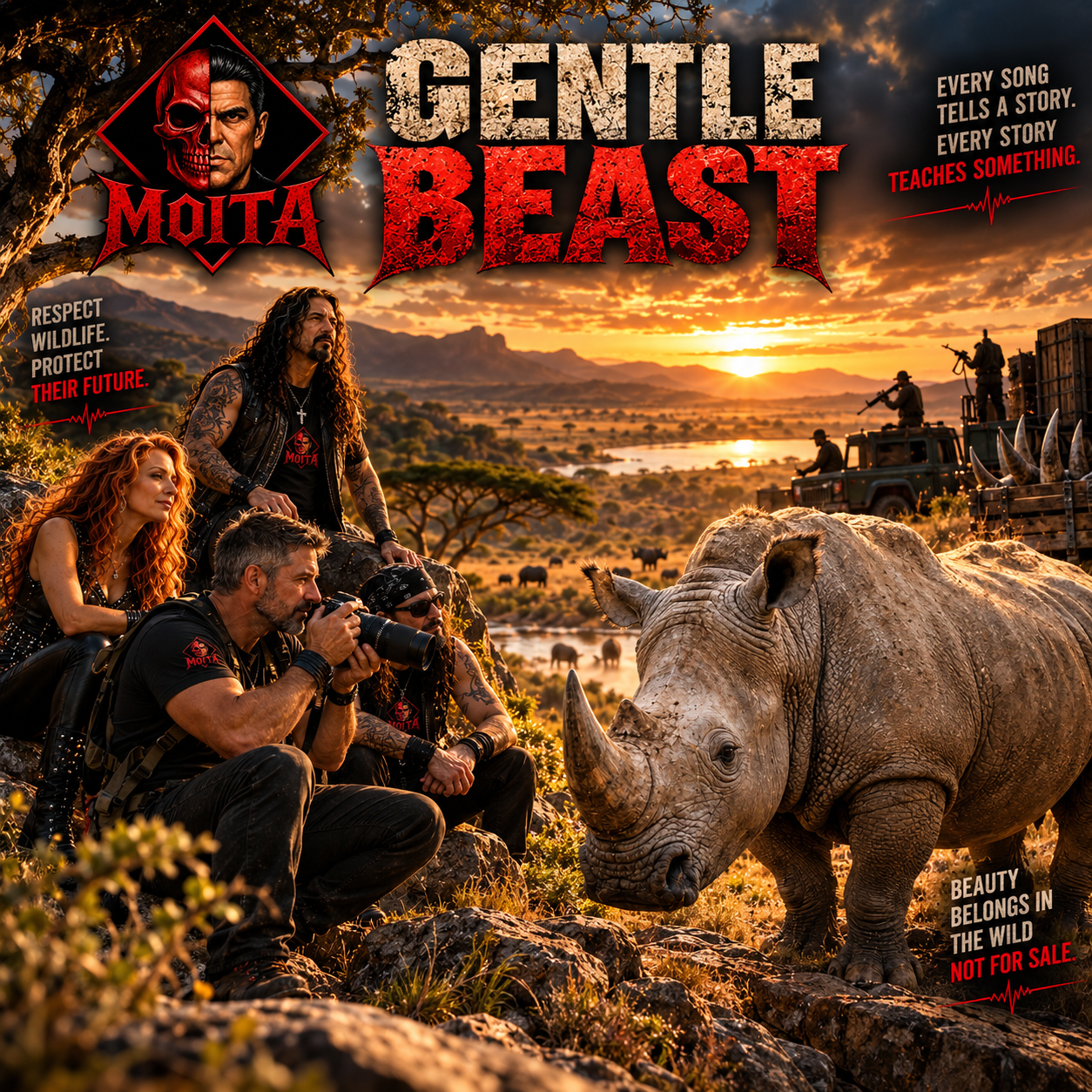
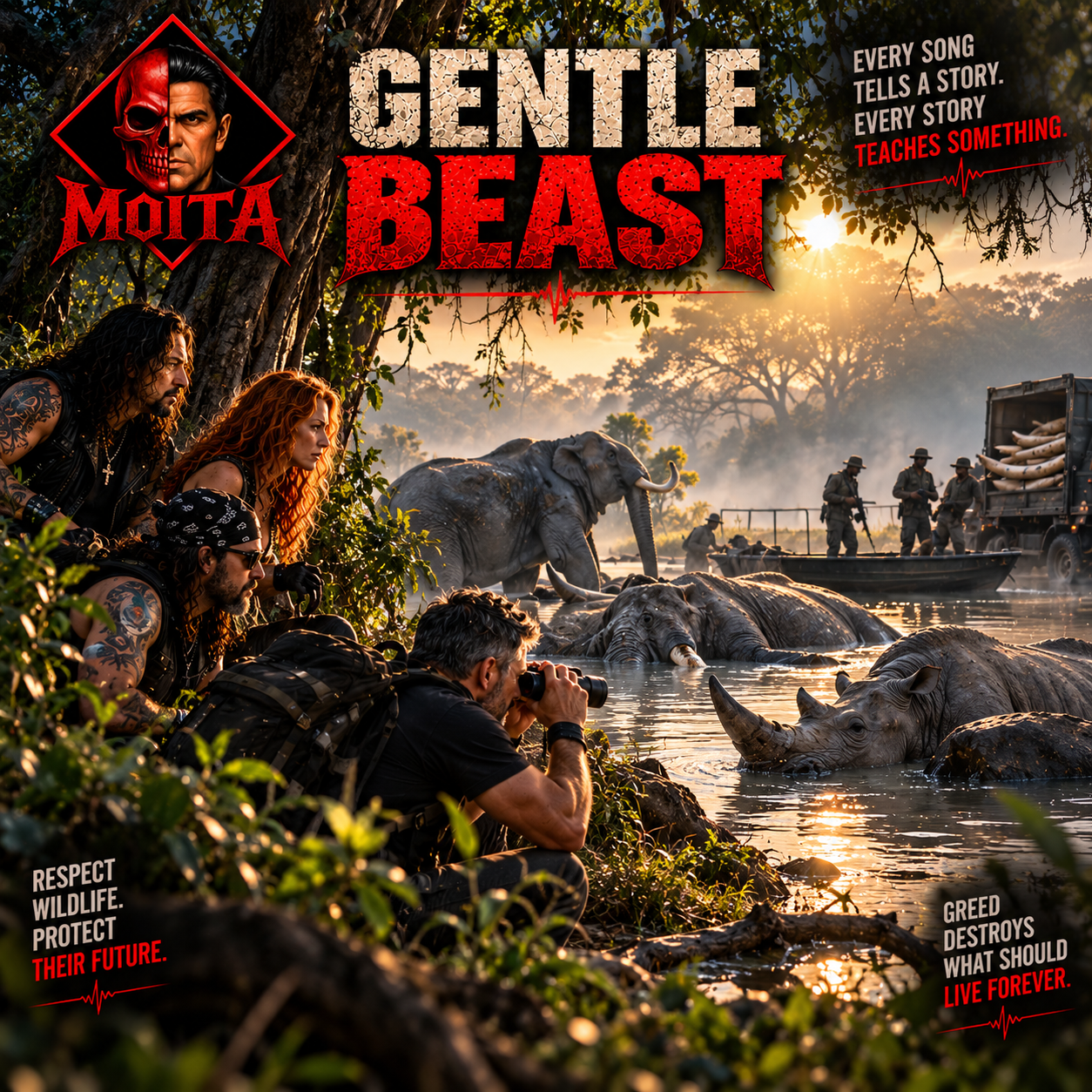


Description
SONG TITLE
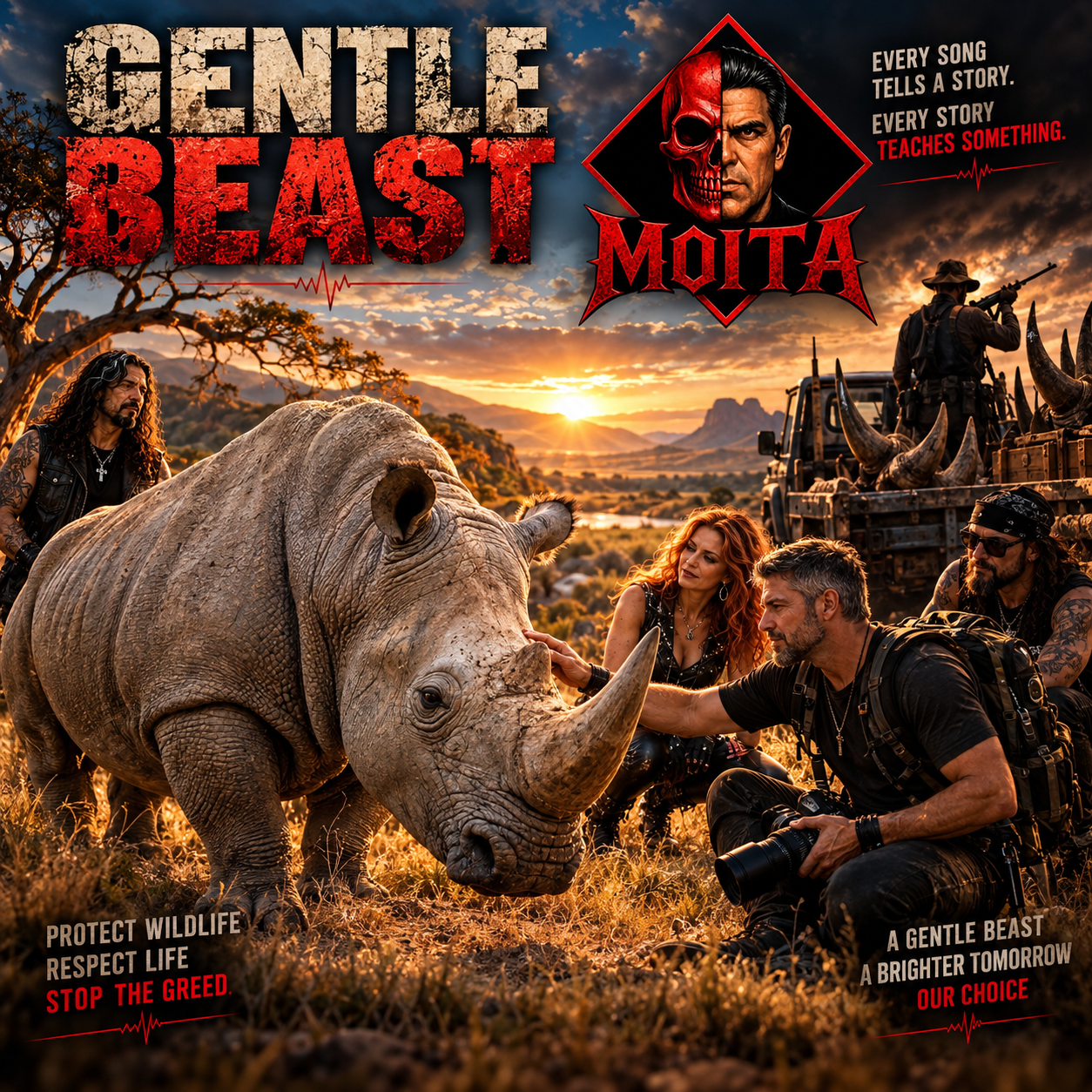
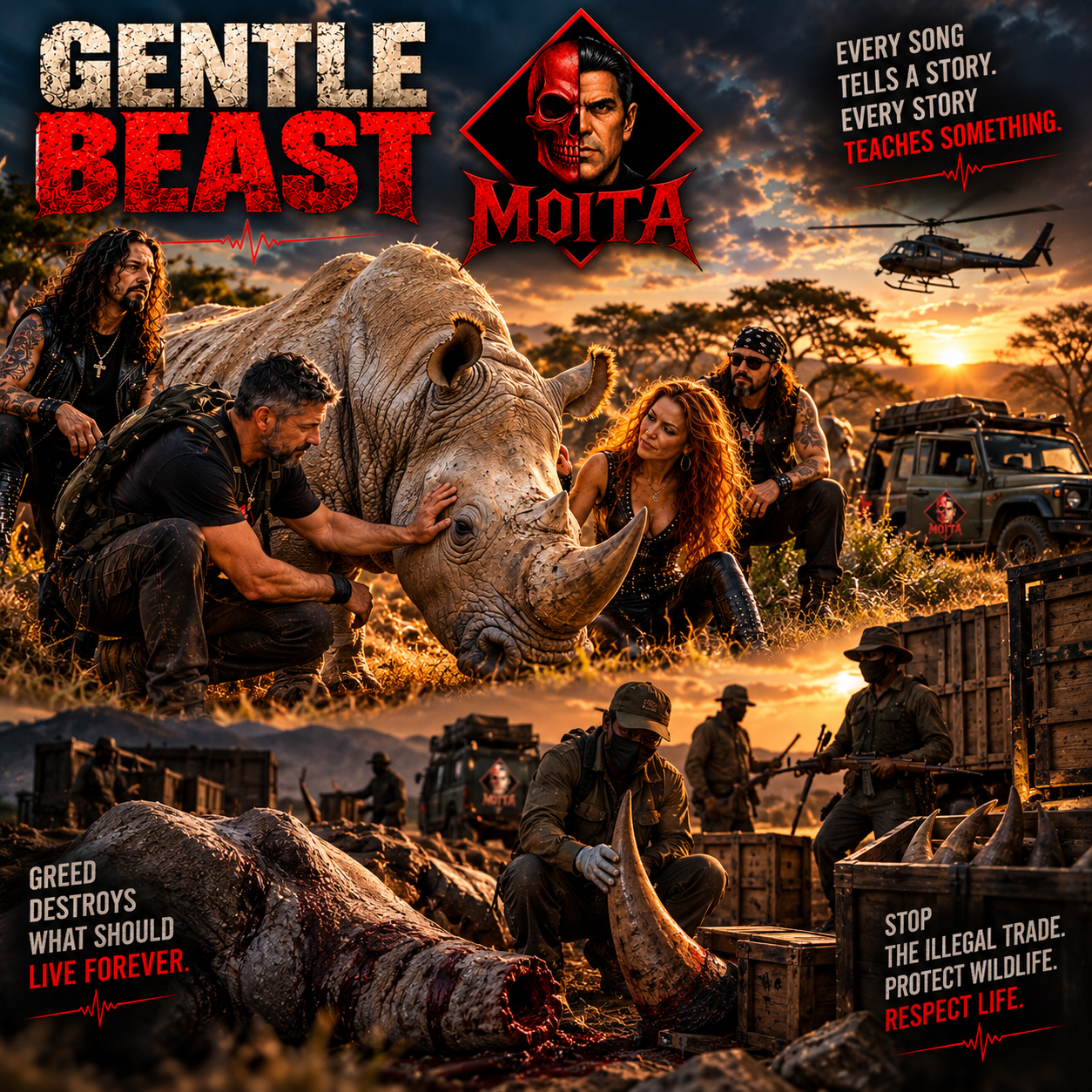
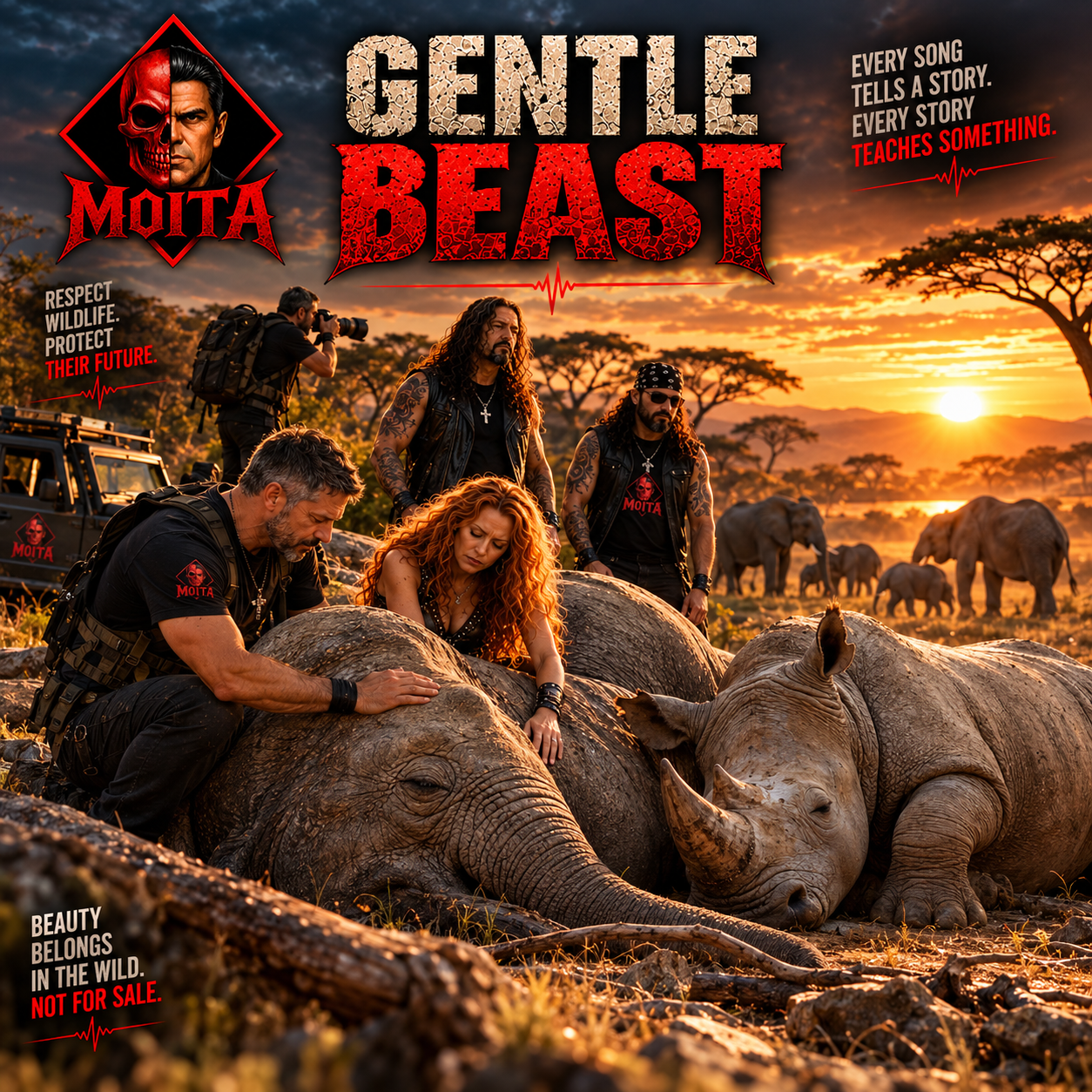
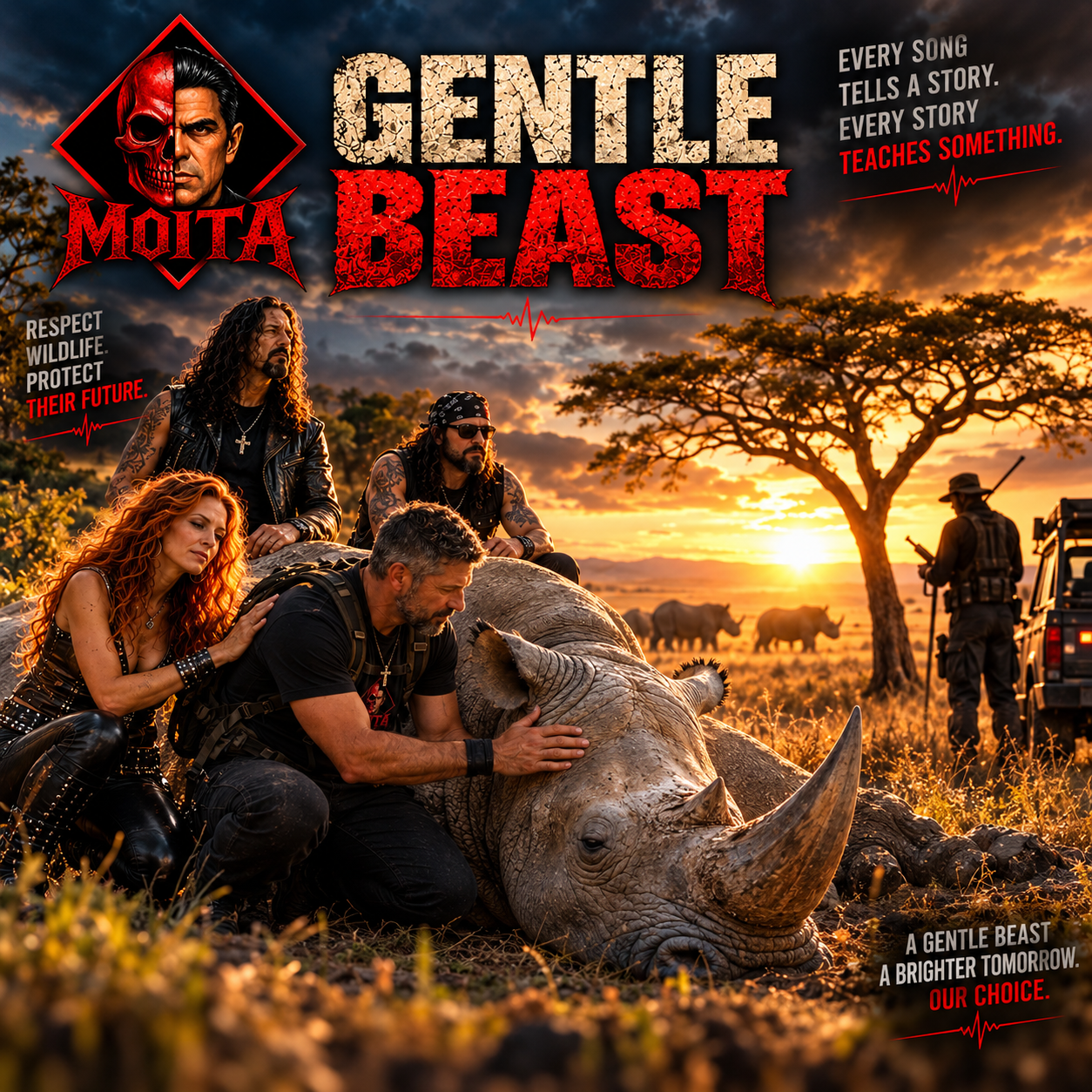
GENTLE BEAST
CATEGORY
Wildlife / Human Consequence / Environmental Reflection
PRIMARY EMOTION
Sorrow
ALSO FITS
Anger / Greed / Extinction / Wildlife Conservation / Human Responsibility / Reflection / Environmental Awareness
WHAT THIS SONG IS ABOUT
GENTLE BEAST is about the northern white rhino, but the deeper story is about us.
I wrote this song around the time Sudan, the last male northern white rhino, died. I remember hearing about it and thinking how sad it was that something that had existed on this earth for so long had reached the point where there wasn’t another male left.
But the more I thought about it, the more sadness turned into anger.
How does humanity allow something like that to happen?
How do we put a value on a horn, an elephant’s ivory, an animal’s body, or anything else that somebody can sell, and somehow convince ourselves that the money is worth more than the life?
That’s where this song came from.
It isn’t only asking what happened to the rhino.
It’s asking what is happening to us.
THE STORY BEHIND THE SONG
Sudan died on March 19, 2018. He was the last known male northern white rhino. Today, only two known northern white rhinos remain, Najin and Fatu, both females, living under protection at Ol Pejeta Conservancy in Kenya. The northern white rhino is considered extinct in the wild.
When I heard about Sudan, I didn’t just see the death of one animal.
I saw a warning.
That’s really where GENTLE BEAST begins.
There was something about knowing that this enormous animal needed armed guards to protect him from human beings that bothered me. Here was this creature that wasn’t hunting us, wasn’t trying to destroy us, wasn’t building weapons against us, and wasn’t putting a price on our bodies.
We were the danger.
That stayed with me.
And it made me think beyond Sudan.
Rhinos have been slaughtered for their horns. Elephants have been killed for ivory. Animals disappear because somewhere along the line somebody decides that what can be taken from them is worth more than keeping them alive.
That is where I started looking at the human race itself.
We call animals beasts.
Sometimes I wonder if we’ve got that backwards.
WHY I WROTE THIS SONG
I wrote GENTLE BEAST because I couldn’t understand the greed behind destroying something that can never be replaced.
Money gets spent.
Things get bought and sold.
But when the last animal of a species is gone, you can’t buy another one.
You can’t manufacture thousands of years of life.
You can’t go backwards and say we made a mistake.
That bothered me enough to write about it.
The song eventually became bigger than the northern white rhino because the question became bigger.
If greed can make us destroy animals even when we know they’re disappearing, where does that greed stop?
What happens when we do the same thing to the forests, the oceans, the land, and eventually ourselves?
I don’t believe humanity is somehow separate from nature. We’re part of it. If we continue destroying everything around us for profit, eventually we’re destroying the world we depend on too.
That’s why the last line of this song matters so much to me:
“Man did not just kill an animal
Man buried a warning”
That is GENTLE BEAST.
WHY THIS MATTERS TO ME
I have always questioned things.
Sometimes those questions become songs.
This one started with a rhino and ended with me questioning humanity.
I don’t pretend to have the answer for why people can become so greedy or selfish that another living thing becomes nothing more than something with a dollar value attached to it.
But I know I don’t like what that says about us.
There is a line in the song:
“A fallen seed
A dying breed
What does that say about we”
The grammar isn’t supposed to be perfect.
The question is.
What does it say about us?
And then I take it one step further:
“What does that say about you and me
What does that say about our future
And our destiny”
Now I’m no longer talking about somebody else.
I’m talking about all of us.
Including myself.
That’s important because it is easy to point at a poacher or somebody buying illegal wildlife products and say, “They’re the problem.”
The bigger question is what kind of world human beings are creating together and what we are willing to destroy to get what we want.
WHY THIS SONG FITS MOITA
GENTLE BEAST fits MOITA because this is exactly what I mean when I say every song tells a story and every story teaches something.
You can listen to this as a song about a rhinoceros.
That’s the doorway.
But walk farther inside and it becomes a conversation about extinction, greed, wildlife trafficking, responsibility, conservation, human behaviour, and what kind of planet we’re leaving behind.
It also asks something I think is worth asking.
When we call an animal a beast, what exactly do we mean?
Sudan wasn’t responsible for the situation that brought his subspecies to the edge of extinction.
Human actions played an enormous part in getting it there.
So maybe GENTLE BEAST isn’t only the title of the song.
Maybe it’s a contradiction we’re supposed to notice.
The enormous animal we call a beast can be peaceful.
The intelligent species that calls itself civilized can be destructive.
That is a conversation worth having.
And that belongs inside MOITA.
READ THIS FIRST
Before reading these lyrics, don’t think of GENTLE BEAST simply as a song about an endangered animal.
Picture an animal standing there that doesn’t know what money is.
It doesn’t know what its horn is worth.
It doesn’t understand an illegal market.
It doesn’t understand why somebody thousands of kilometres away might be willing to pay for part of its body.
It only knows how to live.
Then picture human beings deciding that isn’t enough.
That is the uncomfortable place where this song begins.
But listen carefully to where it ends.
Because by the final line, the song isn’t really asking you to look at the rhino anymore.
It’s asking you to look at us.
FULL LYRICS
GENTLE BEAST
Through the hills
Through the trees
Across the wide open plains
Came the movement of the beast
He lived wild
He lived free
A giant made of silence
A creature made of peace
But danger followed close
For the horn upon his face
For the lies of human value
For the hunger of disgrace
Mass destruction
Lonely company
A life surrounded
By humanity’s disease
The fate of a life
Was broken by man
By the greed in his heart
And the blood on his hands
Who wiped out the rhinos
Who is killing the elephants
Who is hunting down the gentle beast
All for greed
All for greed
Man is the predator
Why must we be this way
To target the innocent
And call it the price we pay
Do we not care about life
Do we not care what we destroy
Do we not see the beauty
We keep turning into noise
Who is wiping out the gentle beast
The creature made of peace
Now the earth remembers him
As another soul deceased
A fallen seed
A dying breed
What does that say about we
What does that say about you and me
What does that say about our future
And our destiny
Hundreds of thousands
Once walked the earth
With no real enemy
Until man gave death its worth
Disappearing in a savage way
Left bleeding in the sun
Bodies with no faces
For a war they never won
No horn
No ivory
Just misery in the dirt
Another gentle giant
Destroyed for what it’s worth
Cold hearted killers
All for greed
The fate of a life
And a falling destiny
He stood as the last male
With the weight of the world in his eyes
Protected by guns
From the hands that made him die
A beast with no hatred
A beast with no crime
But man still found a reason
To erase him from time
And when he fell
The silence screamed
The earth lost more
Than what the world could see
Through the hills
Through the hills
Through the hills
Through the beast
Through the hills
Through the hills
Through the trees
across the wide open plains, came the movement of the beast
Repeats
MY NOTES
SUDAN
The last male northern white rhino
Died March 19 2018
Man did not just kill an animal
Man buried a warning
SECTION ONE
LYRIC JOURNEY
PART 1
“Through the hills
Through the trees
Across the wide open plains
Came the movement of the beast”
I wanted this song to begin with the rhino alive.
Not endangered. Not surrounded by guards. Not dying. Not as a photograph of something we almost lost.
Alive.
I wanted you to see him moving through the world where he belonged.
There is something important about beginning there because before we can understand what was taken away, we have to understand what existed.
The hills, the trees and the open plains establish that immediately. There are no people in these opening lines. There is no money. There is no horn trade. There is no greed.
There is simply an animal moving through its natural habitat.
Then I use the word “beast.”
“Came the movement of the beast”
At this point, you don’t know what I’m going to do with that word.
A beast can sound dangerous. It can sound threatening. It can make you picture something powerful coming through the landscape.
The rhino certainly has that appearance.
It is massive.
It is strong.
It has a horn sitting right there on its face.
But I’m setting something up.
Because very soon the song is going to make you question which creature deserves to be called the beast.
“He lived wild
He lived free
A giant made of silence
A creature made of peace”
This is the rhino before we interfered with his life.
Wild.
Free.
Those two words don’t need much explanation.
They describe something that should have been ordinary.
The animal belonged there.
It wasn’t asking us for anything.
It wasn’t threatening our economy.
It wasn’t trying to take something from us.
It was living.
“A giant made of silence”
I like that image because it puts two completely different things together.
The size is enormous.
The sound I give it is silence.
Then I follow it with:
“A creature made of peace”
Now the word “beast” from the opening starts changing.
I’m not introducing some monster.
I’m introducing a gentle giant.
That’s where the heart of the title GENTLE BEAST begins.
Something can be physically powerful without being cruel.
Something can look dangerous without being the danger in the story.
And something that calls itself civilized can still behave brutally.
We haven’t reached humanity yet, but we’re about to.
“But danger followed close
For the horn upon his face”
Here comes the first change in the song.
We leave freedom and enter danger.
And look at the reason.
His horn.
Something completely natural to the animal becomes the thing that puts him in danger.
That is one of the things about this story that bothered me when I wrote it.
The rhino didn’t choose the horn.
He didn’t put a price on it.
He didn’t decide it was a status symbol.
He didn’t create myths around it.
He didn’t create an illegal market for it.
Human beings did that.
So the animal is carrying something on its own body that another species has decided is worth killing for.
When you really stop and think about that, it’s pretty fucked up.
“For the lies of human value
For the hunger of disgrace”
This is where I start getting angry.
What is value?
We use that word constantly.
This is worth this much.
That is worth that much.
Somebody will pay this much for it.
But who decided?
Human beings.
We can take something that had absolutely no monetary value to the animal carrying it and create a market around it.
Then we can make that market so valuable that people are willing to kill for it.
That’s what I mean by “the lies of human value.”
I’m not saying value itself is a lie.
I’m saying human beings can create a value that becomes completely disconnected from the real value of what is being destroyed.
A horn can be sold.
But what was the living rhino worth?
How do you calculate that?
How do you calculate the value of an animal being able to live wild and reproduce and continue its species?
How do you calculate the value of something that took nature an enormous amount of time to create?
You can’t put that back together after you’ve destroyed it.
That’s why “hunger” belongs in the next line.
“For the hunger of disgrace”
Greed behaves like hunger.
It keeps wanting.
More money.
More possessions.
More status.
More of whatever somebody believes has value.
And the danger is that hunger doesn’t always know when to stop.
“Mass destruction
Lonely company
A life surrounded
By humanity’s disease”
The song has moved a long way already.
We started with an animal crossing open plains.
Now that freedom is being surrounded.
“Mass destruction” takes the story beyond one rhino.
This isn’t one isolated animal being killed.
Rhino populations were devastated.
Elephants have been slaughtered for ivory.
Other animals have been pushed toward extinction because somebody wanted something from them.
Then I wrote:
“Lonely company”
There is something almost contradictory about those two words.
Company should mean you’re not alone.
But what kind of company surrounds an animal being hunted by humans?
The company itself becomes part of the loneliness.
Then comes:
“A life surrounded
By humanity’s disease”
I’m not talking about a virus.
I’m talking about something inside human behaviour.
Greed.
Selfishness.
The ability to know that something is disappearing and still take another one.
That’s the disease I’m talking about.
We have intelligence.
We have education.
We have science.
We can understand extinction.
We can understand consequences.
And somehow understanding something doesn’t always stop us from doing it.
That’s what scares me.
“The fate of a life
Was broken by man
By the greed in his heart
And the blood on his hands”
Now I put responsibility directly into the song.
I don’t hide behind complicated language.
“By man.”
When I use “man” in this song, I mean mankind.
Humanity.
Us.
The rhino’s situation wasn’t simply some strange accident of nature.
Human actions were part of what brought the northern white rhino to the edge.
And I wanted the lyric to carry that responsibility.
“By the greed in his heart”
That’s the motive.
“And the blood on his hands”
That’s the consequence.
Those two lines belong together.
One is inside.
One is outside.
Greed begins as a human desire.
The blood is what happens when that desire is allowed to become more important than life.
Then we reach the first chorus.
“Who wiped out the rhinos
Who is killing the elephants
Who is hunting down the gentle beast
All for greed
All for greed”
Now I start asking questions.
But these aren’t questions where I don’t have any idea what happened.
They’re questions meant to make us look at ourselves.
Who wiped out the rhinos?
Who is killing elephants?
Who is hunting the gentle beast?
Human beings.
Not every human being.
That’s important.
There are people risking their lives to protect these animals.
There are scientists trying to save them.
There are conservationists, veterinarians, rangers and communities doing everything they can.
But the species creating the demand and carrying out the killing is also our species.
That’s the contradiction.
We are capable of being the destroyer and the protector.
Then I repeat:
“All for greed
All for greed”
I didn’t need a complicated ending to the chorus.
I wanted the motive sitting there where nobody could miss it.
Greed.
Money.
Human value.
The same idea that entered the song with the horn has now expanded to rhinos and elephants.
And we’re not finished.
“Man is the predator
Why must we be this way”
This is where I deliberately reverse the picture.
When people hear the word predator, they usually think about animals.
A lion.
A wolf.
A shark.
Something hunting something else because that’s how it survives.
But what happens when a human being kills an animal not because we need to survive, but because a piece of that animal can be sold?
Who is the predator then?
That’s why I wrote it plainly.
“Man is the predator”
Then comes the question that matters more to me:
“Why must we be this way”
I don’t have a perfect answer.
That’s one of the reasons I wrote the song.
There are parts of human nature I don’t understand.
I don’t understand how somebody can know an animal is disappearing and still see an opportunity to make money from killing another one.
“To target the innocent
And call it the price we pay”
The animal didn’t do anything.
That’s what I mean by innocent.
It didn’t create the situation.
It didn’t participate in the market.
It didn’t choose to become valuable to somebody.
It simply existed.
Yet somehow the animal pays the price for something human beings created.
That is completely backwards.
“Do we not care about life
Do we not care what we destroy
Do we not see the beauty
We keep turning into noise”
This is where I stop asking only about poachers and start asking about all of us.
Do we care about life?
Of course people will say yes.
Most people probably do care.
But then I ask the harder question.
Do we care enough to change what we’re doing?
Because saying we care and behaving like we care are two different things.
“Do we not see the beauty”
There is beauty in an animal simply existing where it belongs.
You don’t have to own it.
You don’t have to touch it.
You don’t have to get anything from it.
You don’t have to make money from it.
You can simply allow it to exist.
“We keep turning into noise”
That line can mean more than one thing to me.
We turn nature into noise through destruction.
But we can also turn the warnings into noise.
Another animal endangered.
Another habitat destroyed.
Another species disappearing.
Another report.
Another documentary.
Another photograph.
Another warning.
Eventually people hear so much of it that they stop listening.
It becomes background noise.
That’s dangerous.
Because the moment we stop hearing the warning doesn’t mean the warning has disappeared.
It means we’ve become used to it.
“Who is wiping out the gentle beast
The creature made of peace
Now the earth remembers him
As another soul deceased”
Now the animal that was moving at the beginning of the song has become something remembered.
That’s intentional.
Go back to where we started.
“Through the hills
Through the trees
Across the wide open plains”
Movement.
Life.
Freedom.
Now:
“The earth remembers him”
That’s the journey extinction creates.
Something that once existed becomes something we talk about in the past tense.
There used to be.
They once lived here.
They once walked this land.
They once existed.
I hate the idea of those words becoming normal.
“As another soul deceased”
I wanted the animal to remain more than a statistic.
When we talk about wildlife loss, numbers are necessary.
Populations matter.
Science matters.
But every number represents a living animal.
That’s easy to forget when the numbers become enormous.
Then the song reaches one of the places where it starts turning back toward us.
“A fallen seed
A dying breed
What does that say about we”
A fallen seed is something that should have represented continuation.
Life creating more life.
The next generation.
But now that continuation is breaking.
“A dying breed”
And then:
“What does that say about we”
I know exactly how that line is written.
I could have written “What does that say about us?”
I didn’t.
The line stays the way I wrote it because that’s the way it belongs in the song.
And the question matters more than perfect grammar.
What does it say about we?
Humanity.
All of us standing together as one species looking at what another species has suffered because of human behaviour.
Then I make it even more personal.
“What does that say about you and me
What does that say about our future
And our destiny”
Now there is nowhere comfortable to stand outside the song.
I said you.
I said me.
I said our.
That’s important.
I’m not writing GENTLE BEAST from some position where I’m pretending I’m separate from humanity.
I’m part of it.
So are you.
We inherit what human beings have done.
We also have some responsibility for what happens next.
And that’s where the song is about to become much bigger.
Because once I ask about our future and our destiny, I’m no longer talking only about whether the rhino survives.
I’m beginning to ask what happens to a species like ours when greed keeps winning over responsibility.
That’s where the next part of the journey begins.
SECTION ONE
LYRIC JOURNEY
PART 2
“Hundreds of thousands
Once walked the earth
With no real enemy
Until man gave death its worth”
This is where I wanted the song to pull back and look at the size of what had happened.
We had just reached:
“What does that say about our future
And our destiny”
Now I go backwards.
Before we can think about the future, look at what was here before us.
“Hundreds of thousands
Once walked the earth”
I’m talking about the enormous numbers of rhinos that once existed compared with what human pressure eventually reduced some populations to.
I’m not trying to turn the lyric into a scientific population count for one particular rhino subspecies. Different rhino species and populations have their own histories.
The point of the lyric is the scale of the loss.
There was a time when these animals weren’t something most people would have imagined disappearing.
They were there.
Generation after generation.
Living their lives.
Reproducing.
Moving through their habitats.
Then something changed.
“With no real enemy
Until man gave death its worth”
Those are the words I wanted to land on.
“Man gave death its worth.”
Think about that for a minute.
The animal is worth something alive.
It is part of nature.
It reproduces.
It occupies its place in an ecosystem.
It has its own life.
Then human beings create another kind of value.
Now somebody can make money when that animal is dead.
That’s when everything becomes twisted.
Death acquires a price.
Once there is enough money attached to killing something, there will always be somebody willing to take the chance.
That’s one of the ugliest things greed can do.
It can take something alive and make somebody believe it is more valuable dead.
“Disappearing in a savage way
Left bleeding in the sun
Bodies with no faces
For a war they never won”
I didn’t want to make this part pretty.
There isn’t anything pretty about it.
But I also wasn’t interested in creating graphic detail simply for shock.
The reality itself is disturbing enough.
“Left bleeding in the sun”
The animal that had value moments earlier because of what somebody could take from it can suddenly become worthless to the person who killed it once that part is removed.
That says something terrible about the kind of value I have been questioning since the beginning of the song.
Then comes:
“Bodies with no faces”
That is one of the hardest images in GENTLE BEAST.
An animal has stopped being seen as an animal.
It has become parts.
Horn.
Ivory.
Money.
Product.
The living creature disappears behind the commodity.
That’s what I mean by losing the face.
When you stop seeing the life, it becomes easier to justify what you’re doing to it.
“For a war they never won”
Actually, they never asked to fight it.
That’s what makes the word “war” so strange here.
Normally two sides understand that they’re in conflict.
The rhino doesn’t understand the illegal wildlife trade.
The elephant doesn’t understand international trafficking.
It doesn’t know why somebody wants what is attached to its body.
It doesn’t understand money.
There is no negotiation.
There is no choice.
There is simply a human being deciding that something on that animal is worth taking.
How does an animal win that war?
“No horn
No ivory
Just misery in the dirt”
Now everything people wanted is gone.
The horn is gone.
The ivory is gone.
Whatever somebody believed had value has been removed.
And what’s left?
“Just misery in the dirt”
That’s the part that doesn’t enter the transaction.
Somebody makes money somewhere.
Somebody buys something somewhere.
Somebody displays it or uses it somewhere.
But the consequence remains where the animal fell.
That separation matters.
People buying illegal wildlife products can be thousands of kilometres away from the animal that died.
They don’t necessarily see the blood.
They don’t see the body.
They don’t see what had to happen before the product reached them.
Maybe if everybody had to see the entire chain from the living animal to the finished product, some people would think differently.
“Another gentle giant
Destroyed for what it’s worth”
There is that word again.
Worth.
I’ve been following it through the whole song because it keeps changing meaning.
What was the horn worth?
What was the ivory worth?
What was the animal worth?
What was the species worth?
What is a living thing worth when it is the last of its kind?
Those aren’t the same questions.
Money can answer the first one.
Money cannot answer the others.
That is one of the biggest problems I have with the way human beings sometimes think.
If we can’t put a price on something, we can start acting as though it has no value.
Some of the most valuable things in existence don’t come with a price tag.
“Cold hearted killers
All for greed
The fate of a life
And a falling destiny”
The anger returns here.
“Cold hearted killers”
I’m not talking about the conservationists.
I’m not talking about the rangers.
I’m not talking about people trying to survive while protecting wildlife around them.
I’m talking about the people who knowingly participate in killing these animals for profit.
And again I come back to:
“All for greed”
The same words from the chorus.
The song has travelled farther now, so those words carry more with them.
The first time we heard “all for greed,” we had the horn, the rhino and the elephant in front of us.
Now we’ve walked past the bodies.
We’ve looked at what remains after the valuable pieces have been taken.
So when “all for greed” returns, it isn’t just an accusation anymore.
We’ve seen the consequence.
“The fate of a life
And a falling destiny”
At first that destiny belongs to the animal.
But by now, because of the earlier lines about “our future and our destiny,” it also belongs to us.
That’s intentional.
There are two destinies moving through this song.
The destiny of the wildlife we’re destroying.
And the destiny of the species doing the destroying.
I don’t think those two things are completely separate.
If our relationship with the natural world is simply to keep taking whatever has value until it’s gone, eventually that way of thinking reaches us too.
Repeat Chorus
When the chorus returns here, I don’t need to explain every question again.
But it doesn’t sound exactly the same anymore.
“Who wiped out the rhinos
Who is killing the elephants
Who is hunting down the gentle beast
All for greed
All for greed”
The first time, those questions introduced the accusation.
Now we’ve seen what the accusation means.
We’ve walked past the animal left behind.
We’ve seen how a living creature becomes a commodity.
We’ve followed the money back to death.
So the chorus carries more weight.
And then the song changes.
Until now, I’ve been talking about rhinos, elephants and the gentle beast in a larger sense.
Now one animal steps forward.
One name.
One life.
Sudan.
“He stood as the last male
With the weight of the world in his eyes”
This is where GENTLE BEAST becomes very personal for me.
The phrase “last male” is difficult to get past.
You can read it quickly.
Don’t.
Stop there.
Last male.
There would never be another male northern white rhino born naturally from the population that remained.
Sudan was standing there as the final known male representative of his subspecies.
That’s an enormous thing for us to understand.
But I have to be careful with the next line.
“With the weight of the world in his eyes”
I don’t know what Sudan was thinking.
Nobody does.
I don’t know whether he understood anything about being the last male.
I don’t want to pretend the lyric is some scientific statement about what was happening inside his mind.
It’s songwriting.
It’s what I saw when I thought about him.
The weight was really ours.
We understood what he represented.
We knew what “last male” meant.
We knew how the northern white rhino had reached that point.
Sudan didn’t need to understand the tragedy for the tragedy to be real.
“Protected by guns
From the hands that made him die”
This is one of the most important lines to understand properly.
Sudan was protected by people.
The guards were not the enemy.
They represented the opposite.
Human beings were standing there trying to protect an animal from other human beings.
That image says almost everything about the contradiction inside our species.
We create the danger.
Then some of us dedicate our lives to stopping it.
We destroy.
We protect.
We exploit.
We conserve.
We kill.
We heal.
All of that can exist inside humanity at the same time.
So when I wrote:
“From the hands that made him die”
I’m talking about human hands in the larger sense.
Human activity.
Human greed.
Human poaching.
Human decisions.
Not the people who stood beside Sudan protecting him.
Those people deserve respect.
And there is something sad about the fact that they were necessary.
Think about it.
A rhinoceros needed armed human beings to protect him from human beings.
If that doesn’t make us question ourselves, I don’t know what will.
“A beast with no hatred
A beast with no crime”
Now we return directly to the title.
Beast.
What did this beast do?
What was his crime?
Nothing.
He was born a northern white rhino.
He lived the life available to him.
He carried a horn because that’s what a rhinoceros does.
He didn’t hate us.
He didn’t create this conflict.
He didn’t decide another species needed to disappear.
So I repeat the word “beast” deliberately.
“A beast with no hatred
A beast with no crime”
Then look at the other side of the picture.
The species calling him a beast is the species that nearly erased his kind.
That’s where the title GENTLE BEAST turns completely around for me.
Maybe appearance doesn’t tell us who the beast is.
Maybe behaviour does.
“But man still found a reason
To erase him from time”
There is something frightening about the words “erase him from time.”
Sudan himself died from age-related health problems.
I want that understood.
The lyric isn’t saying a poacher walked up and killed Sudan.
That’s not what happened.
The larger point is what human actions had already done to the northern white rhino population before Sudan reached the end of his life.
By the time he died, there was no other known male to take his place.
That’s the erasing I’m talking about.
Not one individual murder.
The destruction of continuity.
“And when he fell
The silence screamed”
This is where I wanted the song to become quiet without actually saying, “Now everything becomes quiet.”
Sudan dies.
And I write:
“The silence screamed”
Those words contradict each other.
That’s why they work for me.
There are moments when silence can say more than sound.
Imagine something that existed on Earth for generation after generation reaching the point where the last male is gone.
There isn’t some giant noise from nature announcing what happened.
The world keeps moving.
Cars keep driving.
People go to work.
People eat dinner.
People watch television.
Life continues.
But something is missing.
That’s the scream.
The absence.
“The earth lost more
Than what the world could see”
Sudan was one animal.
But the meaning of his death was larger than one animal.
That’s what I’m trying to say here.
If you looked only at his body, you saw one rhinoceros.
If you understood what he represented, you saw the last known male northern white rhino.
You saw history reaching a point it should never have reached.
You saw a warning.
And we’re almost at the place in the song where I stop using poetry and tell you exactly who he was.
SECTION ONE
LYRIC JOURNEY
PART 3
The chorus returns one last time after Sudan falls.
By this point, it can’t sound the same as it did at the beginning.
“Who wiped out the rhinos
Who is killing the elephants
Who is hunting down the gentle beast
All for greed
All for greed”
The first time I asked those questions, the song was looking at the destruction in a wider sense.
The second time, we had seen the bodies left behind after horn and ivory were taken.
Now we’ve met Sudan.
That changes the chorus.
The word “rhinos” isn’t just a word anymore.
There is a face attached to it.
There is an animal we’ve followed.
There is a last male.
There is a life that ended.
That’s one reason repetition can become powerful in a song. The words don’t necessarily change, but everything surrounding them does.
You hear the same chorus with more knowledge than you had the first time.
“Who wiped out the rhinos”
Now you understand where that question can eventually lead.
To the last ones.
“Who is killing the elephants”
The song reminds us that Sudan’s story isn’t isolated.
Other animals continue facing human pressure because parts of their bodies have been given monetary value.
“Who is hunting down the gentle beast”
At the beginning of the song, “gentle beast” was an idea.
Now we’ve met one.
Sudan.
And then for the final time:
“All for greed
All for greed”
I don’t add anything to those words.
I don’t need to.
By now, the entire song is sitting behind them.
The horn upon his face.
The lies of human value.
The blood on human hands.
The bodies left behind.
The horn.
The ivory.
The last male.
The armed protection.
The silence after he fell.
All of that is now contained inside those four words.
All for greed.
Then the song does something different.
It stops being a song for a moment.
“Sudan”
Just his name.
I wanted that name standing by itself.
Not “a rhino.”
Not “the beast.”
Not “the last one.”
Sudan.
Once you give somebody a name, it becomes harder to reduce the story to a statistic.
That was important to me.
The entire song has talked about humanity putting value on animals according to what can be taken from them.
At the end, I wanted to do the opposite.
I wanted to give the animal his identity back.
Sudan.
“The last male northern white rhino”
There is no metaphor here.
There is nothing hidden.
I tell you exactly who he was.
And I think those words are powerful enough without decorating them.
The last male northern white rhino.
When I first heard about that, those words stayed with me.
How does something reach that point?
How do we allow an animal population to fall so far that one individual can carry a description like that?
Last male.
There is something final about it.
At the same time, I want the truth of the story understood properly.
Sudan wasn’t the last white rhino.
He wasn’t even the last northern white rhino.
Two females remained, Najin and Fatu.
But he was the last known male northern white rhino.
That distinction matters.
The truth is already powerful enough.
I don’t need to make it bigger than it was.
“Died March 19 2018”
Then I give you the date.
Again, no metaphor.
No poetry.
No dramatic language.
March 19, 2018.
A real day.
That’s important because GENTLE BEAST isn’t some imaginary environmental story I created to make a point.
There was a Sudan.
There was a last male northern white rhino.
And there was a day when he died.
The song was written because hearing about that real event made me think about everything that had to happen before the world reached that moment.
I could have stopped there.
Sudan.
Last male northern white rhino.
March 19, 2018.
That would have been a sad ending.
But sadness wasn’t the only reason I wrote GENTLE BEAST.
I was angry.
I was questioning humanity.
I was thinking about greed.
I was thinking about what we destroy.
And most of all, I was thinking about what Sudan’s story should teach us.
That’s why there are two final lines.
“Man did not just kill an animal”
This line has to be understood in the context of the whole song.
I’m not saying somebody murdered Sudan on March 19, 2018.
Sudan was old and suffered serious age-related health problems. He was euthanized after his condition deteriorated.
That’s the individual animal’s death.
The lyric is talking about the much larger story.
Human activity helped devastate the northern white rhino population long before Sudan died.
Poaching.
Human conflict.
Loss of protection.
The demand that made rhino horn profitable.
By the time Sudan reached old age, he was the last known male.
So when I say:
“Man did not just kill an animal”
I’m talking about what humanity had done to the future of the northern white rhino.
There is a difference between the death of one animal and the destruction of a population.
Every individual eventually dies.
A healthy species continues.
Another generation comes behind the one that was lost.
That’s the natural continuation of life.
The real tragedy begins when that continuation starts disappearing.
If one old rhino dies in a healthy population, life continues.
When the last male dies with only two females remaining, the meaning is completely different.
That’s why the final line exists.
“Man buried a warning”
This is where GENTLE BEAST ends.
Not with Sudan.
With us.
That’s exactly where I wanted it to end.
Sudan’s story is the warning.
The northern white rhino is the warning.
The greed that helped create this situation is the warning.
And the warning is bigger than wildlife.
If human beings can see something disappearing and continue taking from it anyway, what does that say about the way we think?
If profit can become more important than survival, where does that thinking eventually take us?
If we believe everything on Earth exists only to be used, sold, consumed or turned into money, what happens when we finally run out of things to take?
Those are the questions underneath the last line.
I don’t believe we’re separate from nature.
We depend on it.
We need functioning ecosystems.
We need water.
We need land.
We need air.
We need other forms of life.
We can build cities and machines and technology and convince ourselves that we’re above nature, but we’re still living on the same planet as everything else.
That’s why I see greed as something that can eventually become self-destructive.
The same mentality that says take it while it’s valuable, take it while it’s available, take it before somebody else does, doesn’t automatically stop at a rhinoceros.
That’s the part of human behaviour GENTLE BEAST is really challenging.
I know there are good people.
I know there are people who care deeply about wildlife.
Sudan himself was surrounded by people trying to protect him.
Scientists are still trying to prevent the northern white rhino from disappearing completely.
That matters.
It means the song isn’t saying humanity is incapable of anything better.
Actually, it proves the opposite.
We know how to protect.
We know how to conserve.
We know how to study.
We know how to repair some of the damage.
We know how to cooperate.
We know how to care.
The problem is that we also know how to destroy.
Those two sides of humanity exist together.
Maybe that’s the real choice sitting underneath the song.
Which one do we feed?
Greed or responsibility?
Profit at any cost or protection?
Taking everything we can or understanding that some things should simply be allowed to exist?
When I go back now to the beginning of GENTLE BEAST, the opening feels different.
“Through the hills
Through the trees
Across the wide open plains
Came the movement of the beast”
The first time through, that’s simply an image.
After reaching the end, it becomes something else.
It becomes what we are trying not to lose.
An animal living where it belongs.
Wild.
Free.
Alive.
That’s all.
It shouldn’t be an extraordinary idea.
But once you’ve followed this song all the way to Sudan, you understand how extraordinary those simple things can become when they’re taken away.
“He lived wild
He lived free”
Those might be some of the quietest words in the entire song.
After walking through everything that follows, they may also be some of the most important.
Because conservation isn’t really about keeping animals alive just so human beings can say we saved them.
The greater hope is that animals can continue being animals.
Living.
Breeding.
Moving through their world.
Existing without needing armed guards because somebody wants a piece of their body.
That is what was lost in Sudan’s story.
And that is what other species still have a chance to keep.
So when I call this song GENTLE BEAST, I’m not only describing a rhinoceros.
I’m leaving a question behind.
We looked at this enormous animal and called it a beast.
But the animal lived without hatred.
It committed no crime.
It didn’t create greed.
It didn’t create the market.
It didn’t put a price on death.
We did.
That doesn’t mean every human being is bad.
It means we’re capable of behaviour that deserves to be questioned.
And I think we should have the courage to question ourselves.
That’s what I was doing when I wrote this song.
I wasn’t standing outside humanity.
I’m part of it.
That’s why I wrote:
“What does that say about you and me”
Not them.
You and me.
And then:
“What does that say about our future
And our destiny”
That is the question I want to leave exactly where the song leaves it.
Because I don’t know what our destiny will be.
Nobody does.
But I do believe our choices help create it.
Sudan’s story has already happened.
We can’t change it.
What we can change is whether stories like his keep happening.
We can decide whether another animal becomes valuable only after it is almost gone.
We can decide whether another species has to reach its last few members before enough people care.
We can decide whether the word extinction remains something we read about or something we work harder to prevent.
That’s why the last line isn’t:
Man buried the warning.
I wrote:
“Man buried a warning”
Because Sudan isn’t the only warning.
There have been others.
There will be others.
The question is how many warnings humanity needs before we listen.
For me, that’s where the journey through GENTLE BEAST ends.
Not at the grave of one rhinoceros.
At the feet of humanity.
With a warning sitting there.
And a choice about what we do with it.
SECTION TWO
THE STORY
WHEN ONE DEATH BECAME SOMETHING BIGGER
GENTLE BEAST started with the death of Sudan, the last male northern white rhino.
I wrote the song around that time because hearing about his death bothered me. At first, it was simply sad. There was something difficult about hearing the words “last male.”
Think about what those two words actually mean.
Last male.
There isn’t another one somewhere waiting to be discovered. There isn’t another population wandering freely somewhere else. You have reached a point where one animal represents the end of an entire male bloodline.
That alone was enough to make me think.
But the longer I thought about it, the more the sadness started turning into something else.
I became angry.
Not at nature.
At us.
HOW DID WE GET HERE?
The northern white rhino didn’t suddenly arrive at this situation overnight.
Human activity played a major role in pushing it there. Poaching was devastating, and armed conflict and instability in parts of its historic range made protection even more difficult.
That matters because GENTLE BEAST isn’t about some unavoidable natural event.
The song is asking what happens when human beings become part of the reason something disappears.
That’s what bothered me.
We are supposed to be the intelligent species.
We study animals.
We photograph them.
We make documentaries about them.
We put them in books and teach children their names.
Then somehow, at the same time, human beings can put a price on pieces of those same animals and kill them for profit.
I couldn’t make those two things fit together.
THE VALUE WE INVENT
One of the lines I wrote was:
“For the lies of human value”
That gets very close to what was going through my mind.
A rhino doesn’t know its horn has monetary value.
An elephant doesn’t know somebody wants its ivory.
Those values are human inventions.
We create the market.
We create the demand.
We create the price.
Then an animal can end up paying for that invented value with its life.
There is something completely backwards about that to me.
Take away the money and the status people attach to these things and a horn is simply part of a living animal.
It belongs on the animal.
That should be simple.
Somehow humanity has managed to make it complicated.
THE ANIMAL WE CALL A BEAST
The title GENTLE BEAST came to mean more to me as the song developed.
A rhinoceros looks powerful.
It is enormous.
It has a horn.
If you didn’t know anything about the animal and simply looked at it, you could understand why somebody might use the word “beast.”
But that’s where the title starts turning around.
I began looking at what the animal was doing and what human beings were doing.
The rhino was trying to live.
Human beings were the ones hunting it.
The rhino wasn’t interested in profit.
We were.
The rhino didn’t create a market for pieces of another species.
We did.
So who exactly is the beast?
I don’t have to answer that question for somebody reading this page.
I’d rather leave the question sitting there.
WHO IS THE PREDATOR?
One of the most direct lines in the song is:
“Man is the predator”
I wasn’t trying to be clever with that line.
I meant it.
In this story, the danger wasn’t some larger animal stalking the rhino across the plains.
The danger was us.
That is what makes the story difficult.
Human beings have an extraordinary ability to protect life when we decide it matters. We create conservation programs. Rangers risk their lives protecting wildlife. Scientists spend careers trying to save species. Veterinarians work to keep individual animals alive. Communities protect habitat.
So GENTLE BEAST isn’t saying every human being is cruel.
That wouldn’t be true.
Some of the very people standing between these animals and extinction are human beings too.
That contradiction actually makes the story more interesting to me.
We can be the species causing destruction and the species desperately trying to stop it.
The question is which side of ourselves we choose to strengthen.
SUDAN
Sudan became the animal at the centre of my song because his life represented something enormous.
By the end of his life, he was being protected at Ol Pejeta Conservancy in Kenya.
Think about the strange reality of that.
An animal needs human protection from other human beings.
That image stayed with me enough that it became part of the lyrics:
“He stood as the last male
With the weight of the world in his eyes
Protected by guns
From the hands that made him die”
The line isn’t meant to say that the particular people guarding Sudan caused his death. Quite the opposite. They were protecting him.
The “hands” in that lyric represent the larger human actions that helped drive the northern white rhino to that point.
I think that distinction matters.
There were people trying desperately to protect what remained.
There still are.
THE LAST MALE
Sudan died on March 19, 2018, after suffering from age-related health complications. His death did not mean that every white rhino on Earth had disappeared, and I want to be clear about that.
Sudan was the last known male northern white rhino.
The northern white rhino is a subspecies of white rhino.
Two known northern white rhinos remained after Sudan’s death: his daughter Najin and granddaughter Fatu. Both are female.
That left the northern white rhino functionally extinct, with scientists pursuing assisted-reproduction efforts in an attempt to preserve the subspecies.
That scientific effort is an extraordinary story by itself.
But emotionally, Sudan’s death carried a simple message for me.
We had reached the last male.
Whatever scientific possibilities might remain, humanity had allowed an animal population to reach a point where those words could even be spoken.
That should bother us.
FROM ONE RHINO TO SOMETHING MUCH LARGER
While writing GENTLE BEAST, I couldn’t stay only with Sudan.
My mind went to elephants.
Ivory.
Other rhinos.
Other endangered animals.
Habitat being destroyed.
Animals being reduced to whatever somebody can sell.
That is why the chorus asks:
“Who wiped out the rhinos
Who is killing the elephants
Who is hunting down the gentle beast
All for greed
All for greed”
The repetition matters.
All for greed.
Because underneath everything else, that’s what I kept coming back to.
What is enough?
How much money does somebody need before a living animal becomes worth more alive than dead?
How much land do we need?
How many resources do we consume?
How many warnings do we need before we understand that there are consequences to constantly taking?
Those questions took the song beyond wildlife.
THE PART THAT SCARES ME
This is where GENTLE BEAST became a song about humanity.
I started thinking that if we don’t respect the other life sharing this planet with us, why should we assume we’re going to respect the conditions that keep us alive either?
Greed doesn’t necessarily know when to stop.
Neither does selfishness.
We can keep taking until something disappears.
We can keep damaging something until it can’t recover.
And sometimes we don’t understand what we’ve lost until it’s gone.
That’s the part that scares me.
I don’t believe we’re only capable of destroying animals.
I believe human beings are perfectly capable of creating our own destruction if we refuse to learn where our limits are.
That isn’t me predicting exactly how humanity ends.
It’s me looking at our behaviour and asking where that behaviour eventually leads if nothing changes.
A FALLING DESTINY
I use the word “destiny” more than once in the song.
That was deliberate.
At first, the fate seems to belong to the animal.
The rhino is disappearing.
The elephant is being hunted.
The gentle beast is dying.
Then I turn the question around:
“What does that say about our future
And our destiny”
Now the destiny belongs to us.
That’s the shift I wanted.
Because extinction shouldn’t only make us feel sorry for an animal.
It should make us think about ourselves.
What kind of species are we becoming?
What do we value?
What are we willing to destroy?
What do we leave behind?
And what happens when there is nothing left to take?
THE IMAGE I COULDN’T SHAKE
There is something especially powerful to me about imagining Sudan near the end of his life.
Not because I know what he was thinking. I don’t.
I would never pretend that I do.
But as a songwriter, I could look at that animal and understand what he represented.
The last known male.
One living creature carrying an enormous human story around him without ever asking to become part of it.
That is why I wrote:
“And when he fell
The silence screamed”
Silence obviously cannot scream.
That’s exactly why I wanted those words together.
Sometimes the absence of something says more than noise ever could.
When something disappears forever, there isn’t necessarily some enormous sound announcing it.
There is simply one less voice in nature.
One less animal.
One less species or subspecies continuing the journey it had been making long before any of us arrived.
Eventually, if enough things disappear, that silence becomes impossible to ignore.
MAN BURIED A WARNING
I could have ended GENTLE BEAST with Sudan’s name.
I could have ended it with the date.
But neither one finished what I was trying to say.
The song needed one more thought:
“Man did not just kill an animal
Man buried a warning”
That is where the entire song finally comes together for me.
The warning isn’t that one particular animal died.
Every living thing eventually dies.
The warning is how close human actions helped bring an entire kind of animal to disappearing.
Sudan became a symbol of what can happen when we wait too long.
That’s why I didn’t want GENTLE BEAST to become only a sad song about a rhinoceros.
Sadness eventually passes.
A warning is supposed to stay with you.
WHAT THIS SONG REALLY LEFT WITH ME
Writing GENTLE BEAST didn’t give me some magical answer to human greed.
I still don’t understand how somebody can look at a magnificent living animal and see only money.
Maybe I never will.
But the song helped me put the question somewhere permanent.
That’s one of the reasons I write.
There are things in life that bother me enough that I can’t simply shrug my shoulders and move on.
Sometimes I put them into a song because a song can keep asking a question long after I’ve stopped speaking.
GENTLE BEAST asks one of the biggest questions I’ve ever put into music.
It starts with Sudan.
It starts with the northern white rhino.
But it doesn’t end there.
It ends with us.
Because if we can watch another living thing disappear and learn absolutely nothing from it, then the greatest warning isn’t what happened to the rhino.
The greatest warning is what that says about humanity.
SECTION THREE
LYRIC EXPLORATION
THE SONG BEGINS WITH LIFE
GENTLE BEAST doesn’t begin with death.
That matters.
It begins with movement.
“Through the hills
Through the trees
Across the wide open plains
Came the movement of the beast”
Before I talk about poaching, extinction, greed, or Sudan, I wanted the animal alive.
Moving.
Free.
Part of the landscape.
That gives the reader something to lose later.
If I had started immediately with death, you would understand that something terrible happened. But by beginning with an animal moving through its natural world, you first get a glimpse of what existed before human greed entered the picture.
Then I wrote:
“He lived wild
He lived free
A giant made of silence
A creature made of peace”
Those last two lines are important to the entire song.
“A giant made of silence.”
There is enormous physical power in a rhinoceros. But I wasn’t interested in writing about power as aggression.
Then comes:
“A creature made of peace.”
Now the title GENTLE BEAST starts making sense.
Something can look intimidating and still not be the villain of the story.
THE HORN CHANGES EVERYTHING
“But danger followed close
For the horn upon his face”
The horn is part of the animal.
It should never have needed to become anything more than that.
But humans gave it another meaning.
“For the lies of human value
For the hunger of disgrace”
When I say “human value,” I’m talking about the value we decide to attach to something.
The rhino didn’t decide its horn was valuable.
People did.
Once money enters the picture, something that belongs naturally to a living animal can become the reason somebody wants that animal dead.
That’s the insanity I’m attacking.
We created the value.
The animal paid the price.
HUMANITY’S DISEASE
Then the song becomes harsher:
“Mass destruction
Lonely company
A life surrounded
By humanity’s disease”
“Humanity’s disease” isn’t referring to a medical disease.
It’s greed.
It’s selfishness.
It’s the part of human behaviour that can look at something living and calculate what can be taken from it.
I wanted that phrase to be uncomfortable because I find the behaviour uncomfortable.
When greed becomes more important than life, something is diseased in the way we’re thinking.
THE BLOOD MOVES TO OUR HANDS
“The fate of a life
Was broken by man
By the greed in his heart
And the blood on his hands”
This is where I stop circling around responsibility.
I put it directly on humanity.
But there’s something important about the word “man” throughout GENTLE BEAST.
I’m using it in the older general sense of mankind or humanity.
I’m not talking specifically about men rather than women.
I’m talking about us.
The human race.
THE CHORUS DOESN’T LET US HIDE
“Who wiped out the rhinos
Who is killing the elephants
Who is hunting down the gentle beast”
Those are questions, but they’re not comfortable questions.
They expand the song beyond Sudan.
Now the rhino isn’t alone.
The elephant enters the story.
And behind both of them is the same problem: human beings killing wildlife for things we have decided are valuable.
Then comes the simplest accusation in the song:
“All for greed
All for greed”
I repeat it because I don’t want to dress it up.
Sometimes a complicated subject has a very simple part sitting at its centre.
When an animal is killed because somebody can profit from its body, greed is part of that story.
WHO IS REALLY THE PREDATOR?
“Man is the predator
Why must we be this way”
That line flips the traditional image of predator and prey.
The rhinoceros looks like the dangerous animal.
But in this story, who needed protection from whom?
That question becomes even stronger later when Sudan appears under armed protection.
“To target the innocent
And call it the price we pay”
The animal doesn’t understand the transaction.
It isn’t participating in our economy.
It doesn’t understand why somebody has decided a piece of its body has value.
It simply becomes the victim of a human decision.
WHAT ARE WE TURNING INTO NOISE?
“Do we not care about life
Do we not care what we destroy
Do we not see the beauty
We keep turning into noise”
I like the word “noise” here because destruction can become so constant that people almost stop hearing it.
Another endangered species.
Another habitat disappearing.
Another animal killed.
Another warning.
Another statistic.
After a while, terrible things can become background noise.
I didn’t want Sudan to become background noise.
I wanted people to stop for a moment and actually think about what “last male” meant.
THE EARTH REMEMBERS
“Who is wiping out the gentle beast
The creature made of peace
Now the earth remembers him
As another soul deceased”
There is grief in this part of the song, but there is also an accusation.
The animal has gone from moving across the landscape at the beginning of the song to being remembered.
That’s a huge distance to travel in only a few verses.
Life becomes memory.
And once that happens, there is no easy way backwards.
A FALLEN SEED
“A fallen seed
A dying breed
What does that say about we”
That line is deliberately written the way I wrote it.
I know people might expect “What does that say about us?”
But I wanted:
“What does that say about we”
I’m not interested in correcting it into something more grammatically conventional because the lyric belongs to the song exactly as it was written.
For me, the important part is the question.
Then I expand it:
“What does that say about you and me
What does that say about our future
And our destiny”
This is one of the most important transitions in GENTLE BEAST.
Until this point, somebody could listen from a safe distance.
Poor rhino.
Terrible poachers.
What a tragedy.
Then I bring the listener into it.
You and me.
Our future.
Our destiny.
Now the song isn’t allowing us to stand outside humanity and judge it.
We’re part of the species being questioned.
WHEN DEATH ACQUIRES VALUE
“Hundreds of thousands
Once walked the earth
With no real enemy
Until man gave death its worth”
The historical numbers behind northern white rhinos and African rhino populations are complicated, and different species and subspecies should not be casually combined. The lyric is expressing the enormous scale of rhino loss rather than presenting a scientific population table.
But the final line is where I wanted the attention:
“Until man gave death its worth”
Again, human value enters the story.
An animal becomes financially valuable because it is dead.
That’s a terrible equation.
The living animal carries the horn.
The dead animal becomes the source of somebody’s profit.
When death becomes economically useful, protecting life becomes much harder.
BODIES WITH NO FACES
“Disappearing in a savage way
Left bleeding in the sun
Bodies with no faces
For a war they never won”
“Bodies with no faces” is one of the harder images in the song.
I didn’t write it for shock.
It represents what happens when an animal stops being seen as a complete living creature and becomes valuable only for one part of its body.
Take what somebody wants.
Leave the rest.
The individuality of the animal disappears.
It becomes remains.
That’s what makes the image disturbing.
This isn’t a war the animals chose.
They never declared it.
They never understood it.
Yet they suffer the consequences.
NO HORN. NO IVORY.
“No horn
No ivory
Just misery in the dirt”
Those lines deliberately strip everything down.
The things people wanted are gone.
What’s left?
The animal.
Dead.
The profit has moved somewhere else.
The consequence stays behind.
“Another gentle giant
Destroyed for what it’s worth”
Again the song returns to value.
Worth to whom?
That’s the question underneath it.
Because there are two completely different ideas of worth fighting each other throughout GENTLE BEAST.
There is the monetary worth humans place on horn and ivory.
Then there is the worth of a living creature existing in its own right.
Those values should never have been competing.
THE SONG ARRIVES AT SUDAN
Then everything becomes personal.
“He stood as the last male
With the weight of the world in his eyes”
I don’t claim to know what Sudan thought or felt when people looked at him.
That line is songwriting.
It’s the human emotion I felt looking at what he represented.
He couldn’t understand that human beings had given him a title:
The last male northern white rhino.
But we could understand it.
That’s why the weight belongs partly to us.
“Protected by guns
From the hands that made him die”
This is one of the lines that needs context.
The people protecting Sudan were not the people responsible for driving northern white rhinos toward extinction. His guards were there because people were trying to protect what remained.
The line is about humanity’s contradiction.
Human hands helped create the crisis.
Other human hands were desperately trying to protect him from it.
That’s one of the strangest things about our species.
We can cause enormous destruction.
We can also dedicate our lives to repairing it.
A BEAST WITH NO CRIME
“A beast with no hatred
A beast with no crime”
Those lines return directly to the title.
What crime did the animal commit?
None.
It happened to possess something human beings wanted.
That’s it.
“But man still found a reason
To erase him from time”
The language is deliberately severe because extinction is severe.
Once something disappears completely, there isn’t another generation waiting behind it.
Time continues.
The species doesn’t.
WHEN SILENCE SCREAMS
“And when he fell
The silence screamed”
This is probably one of my favourite contradictions in the song.
Silence can’t scream.
But sometimes silence says everything.
When the last voice disappears, the absence becomes the message.
“The earth lost more
Than what the world could see”
That reaches beyond one individual animal.
Sudan’s death mattered because of what he represented.
He was the last known male of his subspecies.
The world wasn’t simply losing one rhino.
We were witnessing how dangerously close an entire branch of life had come to disappearing.
THE NAME AND THE DATE
At the end, I stop writing poetically.
“Sudan
The last male northern white rhino
Died March 19 2018”
I wanted the name there.
Not simply “the rhino.”
Sudan.
I wanted the date there too.
March 19, 2018.
Because suddenly this isn’t symbolism.
It’s history.
There was an animal.
He had a name.
There was a day when he died.
And humanity was left with the meaning of those words:
The last male.
THE FINAL WARNING
Then comes the last thought:
“Man did not just kill an animal
Man buried a warning”
The song could have ended with blame.
I wanted it to end with consequence.
Because the biggest question isn’t only what we did yesterday.
It’s what we learn from it tomorrow.
The northern white rhino forces us to look at what can happen when exploitation, instability, poaching, demand and human behaviour are allowed to push wildlife toward the edge.
But the warning goes farther than wildlife for me.
If human beings believe everything exists only for us to consume, sell, use or destroy, eventually that way of thinking comes back to us.
We depend on the same planet we’re changing.
That’s why the destiny in this song isn’t only the rhino’s destiny.
It’s ours.
GENTLE BEAST begins with an animal walking freely through the landscape.
It ends with humanity standing in front of a warning.
What happens between those two moments is the reason I wrote the song.
SECTION FOUR
REFLECTION
WHAT REMAINS AFTER GENTLE BEAST?
When I reach the end of this song, I don’t really feel like celebrating anything.
I feel like asking questions.
Sudan is gone.
We can’t change that.
We can’t go back to March 19, 2018, and create a different history.
But we can decide whether that history teaches us anything.
That’s what remains with me after GENTLE BEAST.
Not simply sadness.
Responsibility.
THE LAST ONE SHOULD NEVER BE NORMAL
There is something about the words “the last” that should bother us.
The last male.
The last breeding pair.
The last population.
The last animal.
Those words should never become ordinary language.
By the time we’re talking about the last one, we’ve already arrived incredibly late.
That’s one of the lessons I take from Sudan.
Conservation shouldn’t begin when there are only a handful left.
Caring shouldn’t begin when the loss becomes famous.
Respect for life has to exist while that life is still plentiful enough that nobody is worried about losing it.
Because once we reach the last one, hope becomes much more difficult.
WHAT IS SOMETHING REALLY WORTH?
GENTLE BEAST keeps coming back to value.
That’s because I keep coming back to it myself.
What is a rhino worth?
I don’t mean the horn.
I don’t mean what somebody will illegally pay for it.
I mean the animal.
What is an elephant worth while it’s alive?
What is a forest worth before somebody calculates the price of the timber?
What is clean water worth before it becomes polluted?
What is a species worth before there are almost none left?
Human beings are very good at putting prices on things.
We’re not always as good at understanding value.
There is a difference.
Some things become more valuable precisely because they should never have been for sale in the first place.
GREED HAS NO NATURAL FINISH LINE
The anger behind this song comes from something I have trouble understanding.
How much is enough?
If somebody is willing to kill an animal that is disappearing because there is money to be made, what stops that thinking?
Another animal?
Another forest?
Another resource?
Another generation?
Greed doesn’t automatically wake up one morning and say, “That’s enough. I’ll stop now.”
Somebody has to draw the line.
Sometimes society has to draw it.
Sometimes governments have to draw it.
Sometimes conservationists draw it.
Sometimes ordinary people draw it by refusing to participate in the demand that makes exploitation profitable.
But somewhere, somebody has to say enough.
WE ARE PART OF THIS STORY
It would be easy for me to write this entire page pointing at somebody else.
The poacher.
The trafficker.
The buyer.
The criminal organization.
And those people should absolutely be held responsible for what they do.
But GENTLE BEAST asks a larger question.
What does this say about humanity?
That includes me.
It includes you.
It includes everybody reading this.
Not because every one of us is personally responsible for killing endangered wildlife.
We’re not.
But because we’re all members of a species capable of both extraordinary destruction and extraordinary protection.
That’s the contradiction I can’t get away from.
Human beings helped push the northern white rhino toward extinction.
Human beings also stood guard protecting Sudan.
Human beings are now using science in an attempt to preserve what remains of his subspecies.
Those are completely different sides of us.
Which side becomes our future depends on what we choose to value.
THE WORD “BEAST”
When I called this song GENTLE BEAST, I was talking about the rhino.
But by the end, the title starts asking another question.
What makes something a beast?
Appearance?
Strength?
Size?
Or behaviour?
The rhino looks powerful.
But it wasn’t creating an illegal market.
It wasn’t hunting another species for status or profit.
It wasn’t deciding that somebody else’s body parts were valuable.
Human beings did that.
So maybe the word “beast” deserves a little more thought.
Sometimes the creature we fear isn’t the one doing the greatest damage.
THE WARNING IS STILL HERE
The final line says:
“Man buried a warning”
But maybe “buried” isn’t completely right anymore.
Because if we’re still talking about Sudan, the warning isn’t buried.
It’s still here.
Every photograph of him carries it.
Every discussion about the northern white rhino carries it.
Every conservation effort carries it.
And now, in my own small way, this song carries it.
That is one of the things music can do.
A song can’t bring Sudan back.
It can’t restore everything that has already been lost.
But it can keep somebody from forgetting.
It can make somebody curious.
It can make somebody learn.
It can make somebody care about something they didn’t know about five minutes earlier.
Sometimes that’s where change starts.
WHAT WILL WE LEAVE BEHIND?
There is another reason this story reaches beyond wildlife for me.
We aren’t going to be here forever either.
Every generation inherits something and leaves something behind.
So what are we leaving?
More empty spaces?
More species that exist only in photographs?
More stories beginning with “there used to be”?
Or can we leave something better?
I don’t expect one song to answer that.
I don’t expect one person to solve it.
But I do believe questions matter.
Sometimes the first step toward changing anything is refusing to accept that the way things are is the way they have to remain.
YOU DON’T HAVE TO LOVE RHINOS
You don’t have to be an animal expert to understand GENTLE BEAST.
You don’t even have to care particularly about rhinoceroses before arriving here.
Maybe this is the first time you’ve ever thought seriously about the northern white rhino.
That’s enough.
Go look at Sudan.
Learn his story.
Learn what happened to the northern white rhino.
Learn what people are trying to do now.
Then look beyond Sudan.
Look at elephants.
Look at other rhino species.
Look at endangered wildlife where you live.
Ask what is disappearing while most of us aren’t paying attention.
You might discover something that matters to you.
That’s what I hope happens with this song.
NOT EVERYTHING HAS TO BELONG TO US
Maybe the simplest thing GENTLE BEAST leaves me with is this:
Not everything on Earth has to exist for human beings.
A rhinoceros doesn’t need to justify its existence to us.
Neither does an elephant.
Neither does a whale.
Neither does a bird, an insect, a forest or anything else simply trying to occupy its place in the world.
Sometimes something should be allowed to exist simply because it exists.
There is humility in understanding that.
We share this place.
We don’t own every living thing in it.
THE QUESTION I LEAVE WITH YOU
When I wrote:
“What does that say about you and me
What does that say about our future
And our destiny”
I wasn’t pretending I had the answer.
I still don’t.
I know what I hope the answer becomes.
I hope we’re capable of learning before “the last one” becomes a phrase we hear over and over again.
I hope intelligence eventually means more than finding increasingly efficient ways to take things.
I hope progress includes knowing when something deserves protection.
And I hope greed isn’t the final thing humanity becomes known for.
Sudan’s story is already written.
Ours isn’t.
THANK YOU FOR SPENDING THIS TIME WITH ME
If you came here because you heard GENTLE BEAST and wanted to know what was behind it, thank you for going farther than the music.
This isn’t an easy subject.
But I think it’s worth our time.
If this page made you think about Sudan, wildlife, extinction, greed, or even your own relationship with the natural world a little differently, then the song has done more than simply play for a few minutes.
It started a conversation.
That’s one of the reasons MOITA exists.
Some songs entertain.
Some songs remember.
Some songs question.
And once in a while, a song points toward something we shouldn’t ignore.
For me, GENTLE BEAST is one of those songs.
Sudan was the last male northern white rhino.
But the final question doesn’t belong to Sudan.
It belongs to us.
What will we do with the warning?
MOITA
WHERE EVERY SONG TELLS A STORY
EVERY STORY TEACHES SOMETHING
SECTION FIVE
MOITA DOCUMENTARY & LEARNING CENTRE
THE WORLD SURROUNDING GENTLE BEAST
The main story of GENTLE BEAST ends with a warning.
The Learning Centre begins with a question:
How did we ever reach the point where there were only two northern white rhinos left on Earth?
That question takes us beyond the song.
It takes us into conservation, poaching, illegal wildlife trade, human behaviour, science, extinction and one of the most extraordinary attempts ever made to prevent a large mammal from disappearing completely.
There is tragedy in this story.
But there is also something else worth understanding.
Human beings helped create this problem.
Human beings are also fighting to repair it.
THE NORTHERN WHITE RHINO AND THE SOUTHERN WHITE RHINO
One distinction is important immediately.
The white rhino has two subspecies: the northern white rhino and the southern white rhino.
Sudan was a northern white rhino.
His death did not mean that every white rhino on Earth had disappeared.
According to the International Union for Conservation of Nature, there were an estimated 15,752 white rhinos in Africa at the end of 2024. That broader population consists overwhelmingly of southern white rhinos.
The northern white rhino is the one in the extraordinary situation described in GENTLE BEAST.
Only two remain.
Najin and Fatu.
Both are female.
They live at Ol Pejeta Conservancy in Kenya under intensive protection. In 2026, Ol Pejeta described them as the world’s last two northern white rhinos.
That distinction matters because conservation stories deserve accuracy.
The song is built around a real tragedy.
It doesn’t need exaggeration.
WHAT DOES “FUNCTIONALLY EXTINCT” MEAN?
The northern white rhino is often described as functionally extinct.
That doesn’t mean there are literally zero animals alive.
Najin and Fatu are alive.
The problem is natural reproduction.
There is no surviving male northern white rhino, and the two remaining females cannot naturally restore the population.
BioRescue, the international scientific project working to preserve the subspecies, describes the northern white rhino as functionally extinct from a natural breeding standpoint.
Normally that would seem to leave nowhere for the story to go.
Scientists are trying to write another chapter.
THE SCIENCE TRYING TO CHANGE THE ENDING
This is where the story becomes remarkable.
Researchers are attempting to produce northern white rhino offspring through advanced assisted reproduction.
The basic idea is extraordinary.
Egg cells have been collected from Fatu. Scientists have used preserved sperm from deceased northern white rhino males to create embryos in the laboratory. Because the remaining northern white rhinos cannot carry the pregnancies needed to restore the population, southern white rhino females are being prepared as surrogate mothers.
This isn’t science fiction.
The work is already happening.
In 2024, BioRescue announced the first successful rhinoceros pregnancy achieved through embryo transfer. That experiment involved a southern white rhino embryo and southern white rhino surrogate, demonstrating that the basic technique could work in rhinos.
Then the researchers moved toward what they had been working for all along: transferring northern white rhino embryos.
WHERE THE SCIENCE STANDS IN 2026
The story is still unfolding.
In the second half of 2025, scientists carried out three transfers of northern white rhino embryos into southern white rhino surrogate mothers. None resulted in a long-term pregnancy.
That could easily sound like failure.
Science doesn’t always work that way.
Experiments teach researchers what to change next.
At the beginning of 2026, another egg-cell collection from Fatu produced a new northern white rhino embryo.
That brought the number of pure northern white rhino embryos produced by the project to 39.
Thirty-nine tiny possibilities.
No guarantee.
No reason to pretend the northern white rhino has been saved.
But also no reason to say the story is completely over.
That is an important difference.
WHAT IF ONE IS BORN?
Imagine what a successful pregnancy would represent.
A northern white rhino could potentially be born after the last male of its subspecies had already died.
Sudan would never see it.
But genetic material preserved from northern white rhinos could contribute to another generation.
That would be an extraordinary scientific achievement.
It would also create another question.
Saving a species isn’t simply producing an animal.
A species needs genetic diversity.
It needs healthy animals.
It needs habitat.
It needs protection.
It needs enough individuals to create a sustainable population.
It needs somewhere in the world where its descendants can continue living.
So even a successful birth would not be the end of this story.
It would be a beginning.
POACHING DIDN’T DISAPPEAR WITH SUDAN
GENTLE BEAST was inspired by something that happened in 2018.
The problem did not end in 2018.
The IUCN reported that 22,540 rhinos remained across Africa at the end of 2024: 15,752 white rhinos and 6,788 black rhinos.
Poaching rates had fallen to their lowest level since 2011, which is encouraging.
But the same report warned that progress remains fragile. White rhino numbers had fallen 11.2 percent between 2023 and 2024, and poaching continued in several range states.
That’s important because conservation stories shouldn’t contain only bad news.
When protection works, we should say so.
When numbers improve, we should say so.
And when danger remains, we should say that too.
THE ILLEGAL TRADE BEHIND THE HORN
Rhino poaching isn’t simply one person deciding to kill an animal.
Behind much of it is a larger illegal supply chain.
CITES documentation examining rhino-horn trafficking from 2012 through 2021 described more than 50 countries and territories as being implicated in trafficking routes during that period. Investigators examined 674 seizure incidents involving more than 7.5 tonnes of seized rhino horn. The assessment also described the involvement of organized criminal networks.
That changes the picture.
The person physically killing an animal may be only one part of the chain.
There can be buyers.
Middlemen.
Traffickers.
Transport networks.
Illegal sellers.
Consumers.
And money moving through all of it.
That is why stopping wildlife crime isn’t as simple as putting one fence around an animal.
THE STRANGE VALUE OF A HORN
Rhino horn is made primarily from keratin, the same general structural protein found in human hair and fingernails.
Yet humans have attached enormous monetary and cultural value to it.
Once demand creates a profitable illegal market, the animal carrying that horn becomes a target.
That brings us directly back to one of the central ideas in GENTLE BEAST:
“For the lies of human value”
Nature created the horn.
Human beings created the market.
Those are not the same thing.
THE PEOPLE STANDING BETWEEN LIFE AND EXTINCTION
There is another side of this story that deserves attention.
Rangers.
Veterinarians.
Scientists.
Conservationists.
Local communities.
Researchers.
People who dedicate years of their lives to protecting animals most of the world will never meet.
At Ol Pejeta, rangers protect the last two northern white rhinos as part of their wider conservation work. In July 2026, the conservancy reported that it had gone more than nine years without losing a rhino to poaching.
That is worth recognizing.
GENTLE BEAST criticizes humanity.
But humanity isn’t one thing.
For every person willing to destroy wildlife for money, there are people willing to spend their lives protecting it.
That doesn’t erase the damage.
It proves we’re capable of choosing differently.
CONSERVATION CAN WORK
There is another reason not to tell this story as though everything is hopeless.
Rhino conservation has produced genuine successes.
Southern white rhinos were once reduced to a very small surviving population in southern Africa. Protection and management allowed their numbers to recover dramatically.
Today, despite serious continuing threats, southern white rhinos still exist in the thousands.
Other rhino populations have also responded to conservation efforts.
The IUCN reported that black rhino numbers increased by 5.2 percent from 2023 to 2024 even while overall African rhino numbers declined.
That tells us something important.
Human beings can destroy.
Human beings can also protect.
Extinction is not always inevitable when people act early enough.
WHY BIODIVERSITY MATTERS
There is a temptation to ask:
Why should it matter if one kind of rhino disappears?
The answer reaches beyond whether somebody personally likes rhinos.
Life on Earth developed through enormous networks of relationships between animals, plants, microorganisms, climate, water and landscapes.
Species participate in ecosystems.
Large herbivores can influence vegetation and landscapes simply through the way they eat, move and interact with their environment.
But there is another answer that doesn’t require an ecological calculation.
Maybe another living species shouldn’t have to prove its usefulness to humanity before we allow it to survive.
That idea sits quietly underneath GENTLE BEAST.
Does everything need to benefit us before it deserves to exist?
THE SIXTH EXTINCTION QUESTION
Scientists studying biodiversity have documented unusually rapid losses and declines across many groups of organisms.
That has created discussion around what is often called a sixth mass extinction.
The phrase can sound dramatic, and the scientific details deserve careful treatment. Extinction rates, population declines and risks differ greatly among species and regions.
But the broader warning is real:
Human activity can change habitats and wildlife populations on enormous scales.
Habitat loss.
Overexploitation.
Illegal wildlife trade.
Pollution.
Invasive species.
Climate change.
Different species face different combinations of those pressures.
The northern white rhino represents one particularly severe example of what can happen when several pressures collide and conservation arrives too late to maintain a naturally reproducing population.
WHAT EXTINCTION ACTUALLY MEANS
Extinction is an unusually final word.
If a building disappears, another can be built.
If a machine breaks, another can be manufactured.
If money is lost, more can sometimes be earned.
A species is different.
When the final member dies, an evolutionary history disappears with it.
There is no warehouse containing replacements.
That finality is part of what gives the word so much weight.
And it is why preventing extinction before a population reaches its final few individuals matters so much.
THE LESSON OF SUDAN
Sudan became famous partly because he represented an ending.
But maybe the deeper lesson isn’t about endings.
Maybe it’s about timing.
When should we care?
When there are 100,000?
10,000?
1,000?
100?
Ten?
Two?
One?
The cheapest and most successful conservation effort is rarely the desperate attempt made when virtually nothing remains.
By then, every possibility becomes harder.
The population is smaller.
Genetic diversity is reduced.
Reproduction becomes difficult.
Protection becomes intensive.
Science may have to attempt things that would never have been necessary if the decline had been stopped earlier.
Sudan’s story asks us to notice animals before they become famous for being almost gone.
THE WARNING BEYOND THE RHINO
This is where the Learning Centre returns to the heart of GENTLE BEAST.
The song isn’t arguing that humanity will definitely destroy itself in exactly the same way that wildlife populations have been destroyed.
It’s asking whether the behaviour underneath those losses should worry us.
Take without limits.
Profit without responsibility.
Ignore warnings.
React only when something becomes scarce.
Try to repair the damage at the last possible moment.
That pattern can apply to more than wildlife.
That’s why the final warning reaches beyond Sudan.
It asks what kind of relationship humanity wants with the world that keeps us alive.
WHAT CAN ONE PERSON ACTUALLY DO?
Most people reading this will never patrol a wildlife reserve.
Most will never perform embryo-transfer research on a rhinoceros.
That doesn’t mean they are powerless.
Learn where wildlife products come from.
Don’t purchase products derived from illegally traded endangered wildlife.
Support reputable conservation organizations if you choose to contribute.
Learn about threatened species where you live.
Be careful about spreading wildlife claims without checking them first.
Teach children that wild animals have value alive, not merely as objects, trophies or commodities.
And perhaps most importantly, stay curious.
People protect things they understand far more readily than things they never think about.
FROM SUDAN TO THE FUTURE
When I wrote GENTLE BEAST, Sudan’s death felt like an ending.
Years later, scientists are still refusing to accept that the northern white rhino’s story must end there.
They may succeed.
They may not.
Nobody should pretend the outcome is guaranteed.
But there is something powerful about the attempt.
Human intelligence helped create technologies capable of exploiting the natural world on an enormous scale.
Now human intelligence is being used in an extraordinary attempt to rescue something we nearly lost.
Maybe that is another warning inside this story.
Technology can help.
Science can help.
Money can help.
Protection can help.
But preventing destruction in the first place is better than desperately trying to reverse it afterward.
RELATED MOITA SONGS
GENTLE BEAST belongs naturally beside other MOITA songs that question humanity’s relationship with the world around us.
MY WORLD IS GONE continues that conversation through environmental destruction, fires, smoke, floods, loss and human responsibility.
The subjects are different.
The underlying question is similar.
What happens when humanity keeps receiving warnings and continues behaving as though consequences belong to somebody else?
One song looks into the eyes of the last male northern white rhino.
The other looks at the world around us.
Both eventually turn the question back toward us.
CONTINUE EXPLORING
If GENTLE BEAST made you want to learn more, start with the people closest to the story.
Ol Pejeta Conservancy in Kenya is home to Najin and Fatu, the world’s last two northern white rhinos, and provides information about their care, conservation and the scientific effort surrounding them.
Ol Pejeta Conservancy
BioRescue documents the international scientific effort using assisted reproduction and stem-cell technologies in an attempt to preserve the northern white rhino.
BioRescue
The International Union for Conservation of Nature provides broader scientific information about rhino populations, conservation status and threats around the world.
International Union for Conservation of Nature
From there, continue exploring.
Learn about the world’s five living rhino species.
Learn about wildlife trafficking.
Learn how conservation rangers work.
Learn how scientists preserve genetic material from endangered animals.
Learn about habitat restoration.
Learn about species that have recovered because humans intervened before it was too late.
And maybe choose one endangered animal you’ve never heard of before.
Learn its name.
Learn where it lives.
Learn why it’s disappearing.
Because somewhere on this planet right now, another species may be approaching its own version of “the last one.”
It shouldn’t have to become the subject of a song before we notice.





Reviews
There are no reviews yet.