
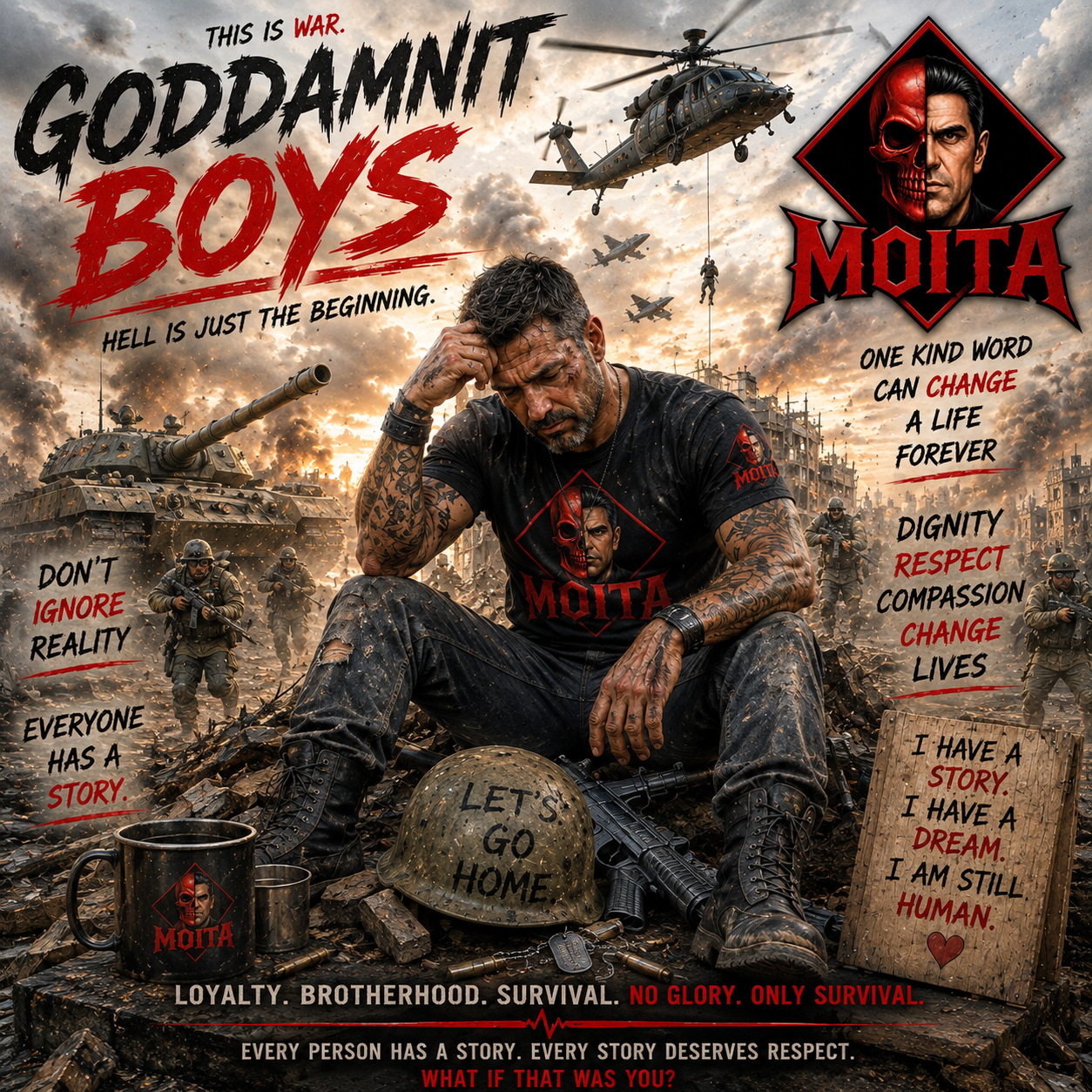
Description
About the Song
GODDAMMIT BOYS
CATEGORY
War, Military, Human Nature, Survival and Psychological Conflict
PRIMARY EMOTION
Relentless Intensity
ALSO FITS
Courage, fear, brotherhood, leadership, history, sacrifice, trauma, moral injury, responsibility, survival, civilian suffering, the cost of war and the value of peace.
WHAT THIS SONG IS ABOUT
War is often explained through numbers.
How many soldiers were deployed.
How many people were killed.
How many battles were won.
How much territory changed hands.
Those numbers matter, but they never tell the whole story.
Behind every statistic is a human being who woke up that morning with memories, worries, plans and people waiting for them back home. Some returned carrying wounds everyone could see. Others returned with wounds nobody could see. Many never returned at all.
GODDAMMIT BOYS is not about choosing a political side or deciding which country was right. It does not try to justify war, excuse it or turn it into entertainment.
The song puts the listener inside the pressure of combat, where decisions happen in seconds, fear becomes part of the air and survival may depend on the people standing beside you.
The repeated words “Goddammit boys” become more than a title.
They become a warning.
A command.
A release of frustration.
A desperate push to keep moving when everyone is tired, frightened and surrounded by destruction.
This song is about what war sounds like after the speeches are finished and ordinary people are left to deal with the reality.
THE STORY BEHIND THE SONG
People sometimes imagine that a song begins with a complete idea.
Most of mine do not.
Sometimes a song begins with a memory.
Sometimes with a question.
Sometimes with something I see or hear.
Sometimes it begins with one sentence that catches my attention and refuses to leave.
That is what happened with GODDAMMIT BOYS.
I was reading a true-crime book about a murder that had happened decades earlier. The crime took place in a cornfield, and the investigation continued many years later. While reading, one expression kept appearing:
“Goddammit boys.”
It was not the title of the book.
It was not the subject I wanted to write about.
There was simply something about those words that stayed with me.
I could hear the urgency in them.
I could hear frustration.
Pressure.
Determination.
They sounded like words that would be shouted when there was no time for a polished speech.
I could have written about the murder investigation.
I did not.
My imagination took the phrase somewhere else.
Instead of investigators searching a cornfield for answers, I began imagining soldiers trying to survive a battlefield.
The setting changed completely.
The story changed completely.
The only thing that remained was the spark.
The phrase became a command shouted through artillery, gunfire, fear and confusion.
That is how creativity sometimes works.
One small line opens a door.
The mind decides where that door leads.
WHY I WROTE THIS SONG
I wrote GODDAMMIT BOYS because war is often discussed from a distance.
We hear speeches.
We see maps.
We watch leaders standing behind microphones.
We hear about strategy, territory, victory and defeat.
The people doing the fighting experience something very different.
They experience noise.
Mud.
Heat.
Cold.
Exhaustion.
Confusion.
Fear.
They see people injured or killed in front of them. They make decisions they may carry for the rest of their lives. They follow orders while trying to protect the people beside them and somehow make it home.
I wanted the song to feel immediate.
There is almost no room to breathe because war does not stop simply because somebody is frightened, tired or overwhelmed.
The aggression in the music belongs there.
The violent images belong there.
Not because violence should be celebrated, but because pretending war is clean would be dishonest.
WHY THIS MATTERS TO ME
I have always been interested in the real human story behind major events.
History often remembers leaders, dates, weapons and victories.
I find myself thinking about the person standing in the middle of it.
What was going through that person’s mind?
Were they terrified?
Were they thinking about home?
Were they trying to protect someone beside them?
Did they believe in the war, or were they simply trying to survive it?
I have never had to stand on a battlefield, and I do not pretend to know exactly what that experience feels like.
What matters to me is recognizing the human being inside the uniform.
A soldier can be brave and afraid at the same time.
A person can survive a battle and still carry it for the rest of their life.
A country may declare that a war has ended while the people who lived through it continue fighting memories nobody else can see.
That human cost is what matters to me.
WHY THIS SONG FITS MOITA
MOITA has never been about writing songs only to entertain.
Some songs celebrate life.
Some explore grief.
Some challenge injustice.
Some begin with humour.
Others ask questions that do not have comfortable answers.
GODDAMMIT BOYS examines one of humanity’s oldest and most destructive realities.
War.
Throughout history, ordinary people have been pulled into extraordinary circumstances.
Farmers became soldiers.
Teachers became medics.
Mechanics became tank crews.
Students became pilots.
Parents became prisoners.
Children became refugees.
Families waited while decisions made far away changed their lives forever.
Most of us experience war through television, photographs, documentaries and history books.
This song does not claim to recreate what soldiers and civilians have truly lived through.
It tries to capture some of the pressure, fear, confusion and relentless movement they have described.
Weapons change.
Technology changes.
The battlefield changes.
Human emotion does not change nearly as much.
Fear still feels like fear.
Loss still feels like loss.
People still depend on one another.
Families still wait.
Survivors still remember.
That is why this song belongs inside MOITA.
It looks beyond the machinery of war and asks us to see the people trapped inside it.
READ THIS FIRST
This song contains graphic military imagery because war is graphic.
Nothing here is written to glorify violence.
Nothing here celebrates suffering.
Nothing here suggests that killing is heroic simply because it happens during war.
The song places the listener inside a brutal environment where people are forced to act quickly, live with fear and witness things no human being should have to see.
When war is studied, attention often goes toward battles, weapons, strategies, political decisions and victories.
This song asks the reader to look somewhere else.
Look at the people.
Look at the impossible decisions.
Look at the fear hidden beneath the commands.
Look at the families waiting far away.
Look at the wounds that remain after the gunfire stops.
Every uniform holds a human being.
Every battlefield leaves memories.
Every war changes more than the land where it was fought.
Sometimes the deepest damage is the damage nobody else can see.
FULL LYRICS
GODDAMMIT BOYS
Hell is just the beginning.
Goddammit boys.
Get ready.
Artillery pounding the dirt,
King of battles — watch it work.
Wipeout, devastation,
You don’t like it? No negotiation.
Bodies gone, never seen,
Only scraps where lives have been.
Shredded flesh, erased names,
Goddammit boys — this is war, not games.
Out of sight — through the night,
Lock it in — target light.
Nighthawks up — crosshairs tight,
This is ours.
Get ready to fight.
GODDAMMIT BOYS — MOVE!
Kill or be killed — no truth!
GODDAMMIT BOYS — FIRE!
Blood in the dirt, souls in the wire!
Goddammit boys
You say you’re here to do what’s right,
Save a life in a killing night.
Pray to God, hold the line,
He ain’t answering this time.
Do your job — start to end,
No forgiveness, no amend.
Eye for eye, knife for throat,
Goddammit boys — stay afloat!
GODDAMMIT BOYS — MOVE!
No retreat — just proof!
GODDAMMIT BOYS — FIRE!
Burn it down — feed the pyre!
Goddammit boys
Silent shot — long-range death,
Never hear the final breath.
No prayer said, no face known,
Just another ghost gone cold.
Bombers scream, jungle dies,
Everything burns — nothing cries.
Guns, grenades, flame and gas,
Skin melts fast — nothing lasts.
God — damn — it — BOYS
God — damn — it — BOYS
God — damn — it — BOYS
LET’S GO HOME
GODDAMMIT BOYS
GODDAMMIT BOYS
GODDAMMIT BOYS
GODDAMMIT BOYS
LET’S GO HOME
GODDAMMIT BOYS — MOVE!
No mercy left to lose!
GODDAMMIT BOYS — FIRE!
Innocence buried in wire!
GODDAMMIT BOYS
Hell was just the beginning.
Goddammit boys
Goddammit.
SECTION ONE
LYRIC JOURNEY
PART 1
GODDAMMIT BOYS
The song does not ease anybody into the story.
It starts with a warning.
“Hell is just the beginning.
Goddammit boys.
Get ready.”
That opening tells you immediately what kind of world you are entering.
There is no ceremony.
No speech.
No explanation.
Just pressure.
“Hell is just the beginning” is deliberately extreme because war can become a place where everything people normally understand about daily life suddenly disappears.
At home, people plan.
They think about tomorrow.
They worry about bills.
They argue over ordinary things.
They make coffee.
They go to work.
They complain about traffic.
Then war arrives and the scale of what matters changes almost instantly.
Food matters.
Water matters.
A safe place to sleep matters.
The person beside you matters.
The next ten seconds can matter more than the next ten years.
That is the world the opening is trying to create.
Then comes the phrase that started the whole song.
“Goddammit boys.”
I found those words somewhere completely different.
They came out of a true-crime book I was reading.
The story in that book had nothing to do with the battlefield this song eventually became.
But those words carried something.
Urgency.
Frustration.
Pressure.
They sounded like words someone would shout when there was no time to make them prettier.
That is what caught me.
By the time they entered this song, they no longer belonged to that original setting in my mind.
They had become the voice of someone trying to keep people moving through chaos.
Then comes the last command.
“Get ready.”
Ready for what?
The song answers immediately.
“Artillery pounding the dirt,
King of battles, watch it work.”
The first thing we meet is not a soldier.
It is force.
That choice matters.
Before we know who anyone is, before we know what side anyone belongs to, before we know whether the person in the song is brave or terrified, the ground is already being hit.
War has arrived before the human story has even had time to introduce itself.
Artillery changes the atmosphere because the person being fired upon may not even see where the attack came from.
That is one of the frightening things about modern warfare.
The danger can arrive from beyond sight.
You hear it.
You feel it.
You know what it can do.
But you may never see the person who fired it.
That distance between attacker and victim is part of what technology changed in war.
Human beings once fought almost entirely at close range.
They saw one another.
They heard one another.
As weapons developed, distance increased.
Artillery could reach farther.
Aircraft could strike from above.
Missiles could travel enormous distances.
The person making the decision and the person receiving the consequences could become separated by kilometres, sometimes much more.
But for the person standing where the shell lands, none of that distance matters.
The explosion is right there.
“King of battles” is a phrase historically associated with artillery because of the enormous influence artillery fire can have over the battlefield.
I liked using it because there is something disturbing about calling any weapon a king.
A king usually suggests authority.
Power.
Control.
Here that power belongs to something designed to destroy.
“Watch it work” is intentionally cold.
Machines work.
Tools work.
Engines work.
But what does it mean when the thing working is artillery?
That is where the next lines take us.
“Wipeout, devastation,
You don’t like it? No negotiation.”
The song has no interest in making war sound reasonable.
“Wipeout, devastation” removes the distance.
The artillery is not impressive technology anymore.
Now we are seeing what it does.
And “no negotiation” tells us something else.
Once people are inside the battle, many decisions that should have happened earlier are already gone.
Diplomacy belongs before the artillery starts.
Negotiation belongs before people begin dying.
Once people are pinned down and trying to survive, the political arguments that created the war may feel very far away.
That is something I kept thinking about while writing this.
A soldier on the ground does not control the entire political situation.
A civilian trapped inside a war certainly does not.
Yet both can pay the price for decisions made somewhere else.
That is one of the things that bothers me most about war.
The people who suffer the consequences are not always the people who created the conditions.
The song keeps moving because there is no time to stop.
“Bodies gone, never seen,
Only scraps where lives have been.”
These are ugly lines.
They are supposed to be.
War is ugly.
There is no responsible way to write a song this aggressive about combat and then pretend the human body somehow remains untouched.
Weapons do exactly what they were designed to do.
They destroy.
That can be difficult to read.
It should be.
If language makes war slightly harder to romanticize, then the language is doing its job.
“Bodies gone, never seen” also brings another kind of loss into the song.
Not every family gets a body back.
Not every family gets certainty.
Throughout history, wars have left people missing.
A name may exist on a military record or memorial while the family has no grave to visit.
That creates a different kind of grief.
There is death.
Then there is disappearance.
The mind wants something definite.
A place.
A body.
An answer.
War does not always provide one.
“Only scraps where lives have been.”
The important word for me is “lives.”
Not bodies.
Lives.
Because before the destruction, there was a person.
Someone had a name.
Someone had memories.
Someone laughed at something.
Someone worried about someone.
Someone had plans.
Maybe somebody was waiting for them.
That is the thing numbers can erase.
A casualty figure can become one line in a report.
Ten killed.
Fifty killed.
A thousand killed.
The number grows and eventually the mind struggles to understand what it represents.
But every single number was one entire human life.
That is why the next line is:
“Shredded flesh, erased names,
Goddammit boys, this is war, not games.”
“Erased names” is one of the lines that matters most to me in this opening movement.
War can reduce people to numbers very quickly.
Casualty totals.
Units.
Prisoners.
Missing.
Dead.
Wounded.
Displaced.
But people are not categories.
A name reminds us there was an individual.
That is why memorials often use names.
You can look at a number and understand scale.
You look at thousands of names and understand people.
The difference is enormous.
Then the title returns.
“Goddammit boys, this is war, not games.”
That line is doing two things.
It is pushing the soldiers forward.
It is also pushing the listener away from any fantasy that this is entertainment.
War appears constantly in movies, television, video games and music.
There is nothing automatically wrong with telling stories about war.
Some of the greatest films and books ever made have done exactly that.
The danger comes when destruction becomes detached from consequence.
Real people do not respawn.
Real families do not reset the game.
A destroyed town does not rebuild itself when the screen goes black.
That is why “this is war, not games” needed to be there.
The song may be aggressive.
The delivery may be brutal.
But the subject is not a toy.
Now the pace tightens again.
“Out of sight, through the night,
Lock it in, target light.”
We have moved from artillery into targeting.
The language becomes shorter because the situation becomes faster.
There is less room for thought.
“Out of sight” continues something that began with artillery.
Distance.
You may be acting against someone you cannot properly see.
That changes warfare psychologically.
When the enemy becomes a target instead of a face, killing can become easier to describe in technical language.
Coordinates.
Targets.
Threats.
Objectives.
Neutralization.
Those words have practical military purposes.
But behind them are still human consequences.
“Through the night” adds another layer.
Darkness changes everything.
Visibility drops.
Uncertainty increases.
Fear has more room to work.
What did I hear?
What moved?
Was that someone?
Was it nothing?
The mind becomes part of the battlefield.
Then comes:
“Lock it in, target light.”
The person on the other end may now exist only as a point in a sight.
That is one of the strange contradictions of modern weapons.
Technology can make a weapon extraordinarily precise.
Precision can reduce some unintended harm when used responsibly.
It can also create an emotional distance between the act and its consequence.
A person may see a target through optics, a screen, thermal imaging or another system.
The technology becomes extremely advanced.
The result remains ancient.
One human being may die because another human being made a decision.
Then the song looks upward.
“Nighthawks up, crosshairs tight,
This is ours.
Get ready to fight.”
The battlefield is expanding.
It began beneath us with artillery pounding dirt.
Now the threat and the response include the sky.
“Nighthawks up” creates the image of aircraft moving through darkness.
“Crosshairs tight” brings us back to focus.
Everything is narrowing.
When people are under extreme stress, attention can narrow dramatically.
That can be useful.
It can help someone focus on an immediate threat.
It can also become dangerous because other information can disappear from awareness.
The body is trying to survive.
Heart rate rises.
Breathing changes.
Muscles prepare for action.
Time can feel distorted.
Some people later describe events as happening incredibly fast.
Others remember certain seconds as though they lasted forever.
This is one reason military training repeats actions again and again.
Under severe pressure, people cannot depend entirely on calm reflection.
Training has to become something they can reach almost automatically.
That helps explain the command structure inside the song.
Short phrases.
Clear direction.
Move.
Fire.
Get ready.
There is no time for a paragraph.
“This is ours” is deliberately ambiguous.
It can mean this position.
This ground.
This moment.
This responsibility.
It has the language of possession that appears so often in war.
Our territory.
Their territory.
Our side.
Their side.
Lines drawn across maps eventually become places where people die.
Then comes:
“Get ready to fight.”
The warning from the introduction has become reality.
And now the chorus arrives.
“GODDAMMIT BOYS, MOVE!”
This is where the phrase becomes physical.
Before, “Goddammit boys” was a warning.
Now it has an action attached to it.
Move.
That may be the most basic survival command in the song.
Do not freeze.
Do not stay exposed.
Do not remain where the danger is landing.
Move.
Fear can freeze people.
That is one of the natural human responses to danger.
We often talk about fight or flight, but freezing is part of that same survival system.
Sometimes the body hesitates because the brain is trying to understand a threat too quickly.
In ordinary life, hesitation may not matter much.
In combat, seconds can matter.
So “MOVE” is not inspirational language.
It is survival language.
Then comes one of the hardest lines.
“Kill or be killed, no truth!”
This is where war becomes morally ugly.
People like clear categories.
Good.
Bad.
Right.
Wrong.
War can destroy that simplicity very quickly for the person inside it.
A soldier may believe deeply in the mission.
Another may question it.
Another may not understand the politics at all.
Another may simply know that someone is shooting at them and they want to survive.
“Kill or be killed” represents that terrible compression of morality that can happen in combat.
A person who would never kill anyone in ordinary life may suddenly be placed in a situation where hesitation can mean their own death or the death of someone beside them.
That does not make killing simple.
It makes war morally complicated.
The words “no truth” push against the certainty that usually surrounds war from a distance.
Every side has a story.
Every government has language.
Every military has objectives.
Every population hears explanations.
But the soldier on the ground may experience a much simpler reality.
Incoming fire does not arrive with a political essay attached to it.
The next command comes immediately.
“GODDAMMIT BOYS, FIRE!”
Move becomes fire.
Defence becomes response.
The person who was trying to survive is now also capable of killing someone else who may be trying to survive.
That is one of the tragedies inside war.
Human beings who might have had nothing against one another under different circumstances can become mortal enemies because history placed them on opposite sides of a line.
Then the chorus ends with one of the ugliest images in the song.
“Blood in the dirt, souls in the wire!”
The dirt from the opening is no longer just being hit by artillery.
Now it has blood in it.
The progression is intentional.
First the weapon.
Then the destruction.
Then the body.
Then the blood.
The song keeps bringing us closer to consequence.
“Souls in the wire” can bring up several images.
Barbed wire.
Defensive positions.
People caught inside systems larger than themselves.
Lives trapped between orders, borders and machinery.
The word “souls” matters because it restores humanity after all the technical language.
Targets.
Crosshairs.
Artillery.
Fire.
Then suddenly, souls.
Whatever someone believes spiritually, the word asks us to recognize something beyond the uniform.
There is a person in there.
The first chorus has now established the central tension of the song.
Move or freeze.
Fire or be fired upon.
Survive or die.
Nothing about it feels clean.
That is exactly where I wanted the listener to be before the second verse begins.
Because the second verse brings something even harder into the battlefield.
The question of whether anyone can still believe they are doing what is right.
SECTION ONE
LYRIC JOURNEY
PART 2
“You say you’re here to do what’s right,
Save a life in a killing night.”
This is where the song turns inward.
Up to this point, most of the pressure has been physical.
Artillery.
Targets.
Movement.
Gunfire.
Bodies.
Now another kind of pressure enters.
Moral pressure.
“You say you’re here to do what’s right” sounds almost like a challenge.
Most people do not go to war believing they are the villain.
They are told they are defending something.
Protecting something.
Stopping something.
Saving something.
That belief may be sincere.
Sometimes it may even be necessary for a person to function inside the situation.
But war has a way of putting moral language beside terrible actions.
That contradiction is what interests me here.
“Save a life in a killing night.”
Those two ideas should not belong together.
Saving life.
Killing.
Yet war places them side by side all the time.
A medic may be trying desperately to keep one person alive while people are dying metres away.
A soldier may fire at someone because they believe doing so will protect the person beside them.
A pilot may be told that destroying one target will prevent greater loss somewhere else.
War creates situations where moral choices can become brutally compressed.
People may have seconds to act and years afterward to think about what they did.
That is where this verse becomes more than another combat scene.
It starts asking what happens inside the person making those decisions.
Then comes faith.
“Pray to God, hold the line,
He ain’t answering this time.”
I knew this line could be uncomfortable.
It is supposed to be.
This is not me saying God does not exist.
It is not me attacking religion.
It is the voice of somebody inside the moment.
That distinction matters.
People say things under pressure they might never say while sitting peacefully at home.
Fear changes the conversation.
Grief changes it.
Desperation changes it.
A person who has believed all their life may still reach a moment where they ask why nothing seems to be happening.
Where is God?
Why this?
Why them?
Why now?
Those questions are old.
Human beings have asked them during wars, disasters, illness, famine and personal loss for thousands of years.
The song does not answer them.
I do not think the song should.
Sometimes the honest thing is to leave the question where it was asked.
“Hold the line” sits beside the prayer because duty does not stop while the question is being asked.
That may be one of the hardest things about extreme circumstances.
You can doubt and still have to act.
You can be afraid and still have responsibility.
You can feel abandoned and still have people depending on you.
The line keeps the spiritual question and the practical command in the same breath.
Then the verse hardens again.
“Do your job, start to end,
No forgiveness, no amend.”
“Do your job” sounds ordinary.
People say it everywhere.
Construction.
Hospitals.
Factories.
Offices.
Emergency services.
But in war, the job can include things most people would never face in civilian life.
That is where the phrase becomes heavy.
A person may have trained for years to perform under pressure.
Orders need to be followed.
Positions need to be defended.
People need to be protected.
But what happens when doing the job conflicts with something inside the person?
That is where moral injury can begin.
A person does not need to believe an action was illegal to be deeply troubled by it.
Sometimes the wound comes from participating in something that violated their own understanding of who they were.
Sometimes it comes from witnessing something and being unable to stop it.
Sometimes from surviving when somebody else did not.
Sometimes from making a decision with no good option available.
“No forgiveness, no amend” captures that feeling of being trapped inside consequence.
You cannot always repair what happened.
There is no edit button.
No second version.
No way to return to the exact moment and choose again with the knowledge you have now.
That can be difficult enough in ordinary life.
In war, the consequence can be permanent.
Then the language becomes deliberately vicious.
“Eye for eye, knife for throat,
Goddammit boys, stay afloat!”
This is retaliation stripped down to its ugliest form.
An eye for an eye is one of humanity’s oldest expressions of revenge and reciprocal punishment.
The danger is obvious.
One injury answers another.
Then another answers that one.
Eventually nobody remembers where the original wound began.
That is how cycles of violence can survive for generations.
A family remembers what another family did.
A community remembers.
A nation remembers.
Each side carries its dead.
Each side has reasons.
Each side has anger.
Then another generation inherits the argument.
“Knife for throat” pushes that cycle into brutal physical imagery.
The song is not recommending it.
It is showing what happens when revenge replaces restraint.
And then, right in the middle of all of that brutality, the title returns.
“Goddammit boys, stay afloat!”
I like “stay afloat” because it does not sound like victory.
It sounds like survival.
Nobody is talking about glory here.
Nobody is talking about medals.
Just do not go under.
That can mean physically surviving the battle.
It can also mean psychologically surviving what the battle is doing to you.
Sometimes people come home alive but spend years trying to understand the person who came home.
That is why survival cannot be measured only by whether the heart is still beating.
The second chorus arrives harder.
“GODDAMMIT BOYS, MOVE!
No retreat, just proof!”
The first chorus established the survival command.
Now the pressure has increased.
“No retreat” suggests the choices are narrowing.
There may be no way back.
That is one of the terrifying things about momentum in war.
Once enough decisions have been made, people can become committed to paths they never would have chosen at the beginning.
Then comes “just proof.”
Proof of what?
That you were there.
That you survived.
That someone else did not.
That the objective was taken.
That the cost was real.
The word remains open because war produces many kinds of proof.
Scars.
Photographs.
Medals.
Missing limbs.
Names on memorials.
Nightmares.
Letters sent home.
Places on maps that still carry the names of battles decades later.
Then comes the command again.
“GODDAMMIT BOYS, FIRE!
Burn it down, feed the pyre!”
By now, “fire” has changed from a command to an image of destruction spreading.
“Burn it down” is one of those phrases that can sound exciting in music.
Inside this song, I do not want it to sound exciting.
Burning something down means somebody has to live with what is gone afterward.
A house.
A village.
A field.
A school.
A forest.
A piece of infrastructure.
Destruction is immediate.
Rebuilding can take years.
Sometimes generations.
“Feed the pyre” makes the battlefield feel almost ritualistic.
A pyre consumes.
The more it is fed, the more it burns.
That can become a metaphor for war itself.
Violence creates anger.
Anger creates retaliation.
Retaliation creates more loss.
Loss creates more anger.
The fire keeps being fed.
Eventually people may forget what peace even looked like before it began.
That is where the song reaches the breakdown.
“Silent shot, long-range death,
Never hear the final breath.”
After all the noise, the song suddenly becomes quieter.
That contrast matters.
War is not always loud.
Sometimes the most frightening moment makes almost no sound at all.
A sniper shot can come from far away.
The person being targeted may never know the shot was fired.
That is what “never hear the final breath” is getting at.
There may be no warning.
No confrontation.
No chance to react.
One second someone is alive.
The next second everything has changed.
That silence creates a different kind of fear.
Artillery announces itself through force.
A hidden shooter creates uncertainty.
Where did it come from?
Is there another shot coming?
Who is exposed?
Can anyone move?
The mind becomes trapped inside questions it cannot answer quickly enough.
“No prayer said, no face known,
Just another ghost gone cold.”
This is one of the coldest parts of the song because anonymity enters completely.
“No prayer said.”
There was no time.
“No face known.”
The person who fired may never know who died.
The person who died may never have known who was watching.
Two human beings become connected by one terrible moment without ever truly knowing each other.
That is one of the strangest things about war.
People can kill people they would never have hated if they had met under different circumstances.
Maybe they would have shared a coffee.
Maybe they would have argued about sports.
Maybe they would have had nothing in common.
Maybe they would have become friends.
War makes those possibilities irrelevant.
Uniform.
Position.
Threat.
Target.
Then comes:
“Just another ghost gone cold.”
“Just another” is intentionally disturbing.
Because repeated death can numb people.
The first body may be unforgettable.
After enough exposure, the mind can start protecting itself by creating distance.
Another casualty.
Another body.
Another ghost.
That emotional numbing can help someone function during extreme circumstances.
But what protects the mind during the event may become difficult afterward.
The song does not stop there.
It drops even deeper.
“Bombers scream, jungle dies,
Everything burns, nothing cries.”
The battlefield expands again.
Now destruction is no longer focused on one person.
The environment itself is being destroyed.
“Jungle dies” brings the natural world into the consequences of war.
Forests do not choose sides.
Animals do not understand borders.
Land does not vote for war.
Yet all of them can be destroyed by it.
Bombing.
Fire.
Chemicals.
Mines.
Contamination.
Destroyed water systems.
War can continue affecting land long after the people who fought it have left.
That is something history repeatedly shows us.
Battlefields do not always stop being dangerous when peace is declared.
Unexploded weapons can remain.
Landmines can remain.
Pollution can remain.
Destroyed infrastructure can leave people without clean water, healthcare or stable food supplies.
“Everything burns, nothing cries.”
The line sounds almost impossible because of course people cry.
Animals cry out.
People scream.
What I mean here is something darker.
When destruction becomes large enough, it can feel as though the world itself has stopped reacting.
The scale overwhelms language.
Then the song reaches its most graphic sequence.
“Guns, grenades, flame and gas,
Skin melts fast, nothing lasts.”
I would never write lines like these if the purpose were simply to shock.
The purpose is consequence.
Weapons are often discussed by capability.
Range.
Accuracy.
Power.
Rate of fire.
Payload.
Those descriptions can make them sound almost mechanical.
The human body experiences them differently.
The body burns.
Bleeds.
Breaks.
Breathes chemicals.
Loses limbs.
That is the reality hidden beneath technical language.
The line “nothing lasts” is doing more than describing destruction.
It breaks the illusion of permanence.
Buildings do not last.
Bodies do not last.
Positions do not last.
Victories do not last forever.
Empires do not last.
Even the reasons wars were fought can become difficult for later generations to understand.
That makes the cost even harder to accept.
People can die for something that, decades later, is reduced to a paragraph in a history book.
Then something unexpected happens.
After all the brutality, the song begins chanting the title.
“Goddammit boys
Goddammit boys
Goddammit boys”
The phrase has changed again.
At the beginning it was a warning.
In the chorus it became a command.
Here it becomes almost exhaustion.
The repetition feels like somebody trying to hold the group together by whatever words are left.
Then comes the line that changes the entire emotional direction.
“LET’S GO HOME”
Three words.
Nothing in the song is more human.
After artillery.
Gunfire.
Prayer.
Fear.
Targets.
Bodies.
Fire.
Gas.
Death.
Nobody asks for glory.
Nobody asks for another battle.
Nobody asks for a medal.
They want to go home.
Home becomes everything war is not.
Home is ordinary.
That is exactly why it matters.
A bed.
A kitchen.
A familiar voice.
Someone asking how your day was.
A door that does not need to be defended.
A night where a loud sound is just a loud sound.
The things people complain about during normal life can become the very things they dream about when normal life disappears.
That is why “LET’S GO HOME” may be the emotional heart of the entire song.
The brutality before it gives those words their weight.
And now the final chorus is coming.
The commands are still there.
The aggression is still there.
But after hearing someone beg to go home, we cannot hear the chorus exactly the same way again.
SECTION ONE
LYRIC JOURNEY
PART 3
“GODDAMMIT BOYS, MOVE!
No mercy left to lose!”
By the time we reach this final chorus, “MOVE” does not sound the way it did the first time.
At the beginning of the song, movement meant entering the fight.
Now it feels like getting through it.
That is an important difference.
We have already travelled through artillery, bodies, orders, prayer, retaliation, snipers, bombers, fire and the desperate words “LET’S GO HOME.”
So when “GODDAMMIT BOYS, MOVE!” returns, I hear exhaustion inside the aggression.
Keep moving.
Do not stop here.
Do not become another body on this ground.
Get through the next minute.
Then the next one.
Then whatever comes after that.
“No mercy left to lose” is deliberately ugly.
War can strip people down emotionally.
At the beginning, someone may still believe there are clear boundaries between what they would and would not do.
Then survival takes over.
Friends die.
Fear becomes anger.
Anger becomes revenge.
The enemy stops being seen as an individual person.
That is one of the most dangerous things war can do.
It can make another human being easier to kill by making them harder to see as human.
That does not happen only through weapons.
Language can do it.
Propaganda can do it.
Repeated hatred can do it.
Once people are reduced to labels, killing them can become easier to justify.
History has shown that many times.
That is why “no mercy left to lose” is not a proud statement.
It is a warning about what can disappear from a person when violence continues long enough.
Mercy is not weakness.
Sometimes mercy is one of the last things protecting people from becoming completely consumed by what is happening around them.
Then the command comes again.
“GODDAMMIT BOYS, FIRE!”
The word has been repeated throughout the song, but we are no longer hearing it from the same place.
Earlier, it belonged to immediate survival.
Now it carries everything that came before it.
Every time someone fires, there is a consequence somewhere.
Maybe the consequence is necessary to survive that moment.
Maybe somebody believes it is justified.
Maybe somebody has no time to think about any of that.
The bullet does not care.
Once it leaves, the decision cannot be called back.
That is one of the things about weapons that separates them from most decisions we make in ordinary life.
Many mistakes can be corrected.
Many words can be apologized for.
Many broken things can be repaired.
A fired round cannot be unfired.
A life taken cannot be restored.
The song has been moving too quickly for anyone inside it to sit with that thought.
The Lyric Journey gives us that chance.
Then comes the line that tells us what the entire song has really been costing.
“Innocence buried in wire!”
Not victory.
Not territory.
Innocence.
That word matters.
Innocence can belong to the soldier who arrived believing war would be something different.
It can belong to the child whose home became a battlefield.
It can belong to the civilian who learned to recognize weapons by sound.
It can belong to families who once believed their neighbourhood would always be safe.
It can belong to an entire generation that grew up too quickly because adults could not stop fighting.
“Innocence buried in wire” takes us back to the physical battlefield.
Barbed wire.
Defensive positions.
Obstacles.
Boundaries.
But the burial is larger than the wire itself.
Something inside people can be buried there too.
A young person can leave home with one understanding of humanity and return with another.
That does not mean every veteran loses compassion.
It does not mean every soldier becomes damaged beyond repair.
I would never make that claim.
People respond differently.
Some return and rebuild their lives.
Some find purpose.
Some become extraordinary advocates for peace.
Some rarely speak about what happened.
Some carry memories privately for decades.
Some struggle.
Some heal.
Many do several of those things at different times.
The point is that nobody can experience extreme events and simply erase them.
The person who returns may look exactly like the person who left.
Inside, something may have changed.
That is why I used “innocence.”
It is one of the things war can take without leaving a visible wound.
Then the fighting ends.
At least the song stops fighting.
“Hell was just the beginning.”
We heard those words before the first verse.
Back then, we did not know what they meant yet.
Now we do.
That is why I wanted them to return.
At the beginning, “Hell is just the beginning” sounds like somebody preparing the soldiers for what is coming.
At the end, “Hell was just the beginning” looks backward.
One word changes.
“Is” becomes “was.”
The battle happened.
They went through it.
But that does not mean the story is finished.
For some people, surviving combat begins another fight.
Coming home.
Sleeping.
Trusting.
Adjusting to ordinary life.
Being around crowds.
Hearing sudden noises.
Trying to explain experiences to people who were not there.
Trying to become a husband, wife, father, mother, friend or coworker again when part of the mind is still somewhere else.
Trying to understand why you survived when somebody beside you did not.
Trying to live with decisions made in seconds.
Trying to accept that everyone around you has continued living while part of you may still be standing in one particular moment.
That is why the final version says “was.”
The battlefield is behind them.
The consequences may not be.
I think this is where people sometimes misunderstand the phrase “the war is over.”
A government can sign an agreement.
A ceasefire can begin.
Troops can leave.
Flags can come down.
News cameras can move to the next story.
For the people who lived through the war, ending it can take much longer.
The body can come home before the mind does.
Families can be reunited and still have to learn one another again.
Communities can be rebuilt while graves remain.
Children can grow into adults carrying memories they never should have had.
Land can recover slowly.
Trust can take generations.
That is why peace is more complicated than simply stopping the shooting.
Stopping the shooting is essential.
But real peace also means rebuilding what the shooting destroyed.
Homes.
Hospitals.
Schools.
Families.
Communities.
Trust.
And sometimes people themselves.
Then the title returns one final time.
“Goddammit boys”
It is no longer shouted with the same force.
There is no “MOVE” after it.
No “FIRE.”
No target.
No instruction.
Just the words.
After everything we have walked through, they almost sound tired.
The phrase that originally gave me the idea for the entire song has finally run out of commands.
That matters to me.
Because commands are useful while something is happening.
Move.
Fire.
Hold the line.
Stay afloat.
Get ready.
Those words can keep people functioning.
But eventually the commands stop.
Then the person is left with themselves.
That can be the moment when everything they did not have time to feel begins arriving.
Fear that was pushed aside.
Grief that had to wait.
Anger.
Relief.
Guilt.
Confusion.
Exhaustion.
The mind can postpone things when survival demands it.
It cannot always postpone them forever.
Then comes the final word.
“Goddammit.”
That is where I wanted to leave the song.
Not with victory.
Not with defeat.
Not with a flag.
Not with a speech.
Not with an answer.
Just frustration.
One human word after everything else has been stripped away.
To me, that final “Goddammit” can mean a hundred things.
Goddammit, we lost them.
Goddammit, look what happened.
Goddammit, I survived.
Goddammit, I wish I could forget.
Goddammit, I wish we were home.
Goddammit, why did this have to happen?
Goddammit, when will people learn?
I do not want to choose one meaning for the reader.
The whole song has been filled with commands.
The final word is not a command.
It is a reaction.
That is exactly where I think the song should end.
When I first came across the phrase “Goddammit boys” in that true-crime book, none of this existed.
There was no battlefield.
No artillery.
No soldier trying to hold the line.
No sniper.
No bomber.
No desperate chant asking to go home.
It was simply a phrase that caught my attention.
That still amazes me about writing.
Four words can sit in your head until your imagination finds a completely different world for them.
The phrase gave me the doorway.
Once I stepped through it, the song became about something much larger.
It became about what happens when human beings are placed under pressure most of us will never experience.
It became about how quickly morality can become complicated when survival enters the room.
It became about faith being questioned without necessarily being abandoned.
It became about people depending on one another because there may be nobody else.
It became about violence without pretending violence is glorious.
It became about the difference between surviving a battle and being free from it.
Most importantly, it became about the human being inside the uniform.
That is the person I never want us to lose while listening.
Not the weapon.
Not the machinery.
Not the strategy.
Not the flag.
The person.
The person who is frightened.
The person who is exhausted.
The person who is trying to do their job.
The person who may be carrying somebody wounded.
The person who just watched a friend die.
The person questioning God.
The person following an order.
The person wondering whether the next shot is coming for them.
The person thinking about home.
And on the other side of that battlefield there may be another person thinking many of the same things.
That may be one of the hardest truths about war.
The people trying to kill each other can sometimes have more in common with each other than they do with the people who decided the war should happen.
They may both have families.
Both have fear.
Both want to survive.
Both have somebody waiting.
Both may believe they are protecting something.
Both may pray.
Both may hate what is happening.
Both may want to go home.
None of that makes the political causes of war irrelevant.
It does not mean every side is morally equal.
It means that human beings remain human beings even when history places them on opposite sides of a battlefield.
That is the part I wanted this song to remember.
War can be studied through maps.
It can be studied through weapons.
It can be studied through politics, economics, strategy and history.
All of those things matter.
But if we study war and forget the people, we have missed the most important lesson.
Somebody has to stand where the bombs land.
Somebody has to receive the order.
Somebody has to make the decision.
Somebody has to carry the wounded.
Somebody has to identify the dead.
Somebody has to write the letter.
Somebody has to tell the family.
Somebody has to return home.
Somebody has to live afterward.
That is why “LET’S GO HOME” remains the line I keep returning to.
It cuts through everything.
All the politics disappear for a moment.
All the strategy disappears.
All the machinery disappears.
There is just a person wanting an ordinary life back.
Maybe that is one of the greatest things peace gives us.
Ordinary life.
The right to complain about traffic.
The right to argue about something stupid at the dinner table.
The right to sleep through the night.
The right to send children to school without wondering whether the building will still be there tomorrow.
The right to hear an airplane and not be afraid of it.
The right to walk outside without looking for danger.
We rarely call those things freedom when we have them.
Lose them, and suddenly we understand.
GODDAMMIT BOYS was never meant to make war look powerful.
War already knows how to look powerful.
The explosions do that.
The machines do that.
The uniforms do that.
The photographs do that.
I wanted to look underneath all of it.
Underneath the noise is fear.
Underneath the command is responsibility.
Underneath the aggression is survival.
Underneath the uniform is a person.
And underneath the final word is the question the song never answers.
After everything humanity has learned about war, why do we keep finding new ways to do it again?
SECTION ONE
LYRIC JOURNEY
PART 4
There is one more place I want to stay before leaving this song, because that final question is not separate from the lyrics. The entire journey has been leading us toward it.
After everything humanity has learned about war, why do we keep finding new ways to do it again?
I do not have an answer that can fit inside a song.
I do not think anyone does.
People have fought over land, power, religion, resources, borders, revenge, security, ideology, independence and survival for thousands of years. Sometimes people fought because they believed they had no other choice. Sometimes they fought because someone else attacked them. Sometimes they fought against oppression. Sometimes they were sent into wars created by people far away from the battlefield.
Every war has its own history.
That matters.
I never wanted GODDAMMIT BOYS to flatten all wars into one simple explanation.
But once the fighting begins, there are human experiences that keep returning.
Fear.
Loss.
Confusion.
Brotherhood.
Anger.
Survival.
Grief.
The desire to go home.
That is the territory this song stays inside.
When we return mentally to the opening words, “Hell is just the beginning,” they now carry the entire song behind them.
We know what came after.
“Artillery pounding the dirt.”
The ground itself becomes unstable.
“Bodies gone, never seen.”
People disappear so violently that even the normal rituals of death can be taken away from families.
“GODDAMMIT BOYS, MOVE!”
There is no time to process what just happened.
“GODDAMMIT BOYS, FIRE!”
Survival demands another decision.
“Pray to God, hold the line.”
Faith enters the battlefield because fear has reached somewhere deeper than training.
“He ain’t answering this time.”
Certainty cracks.
“Silent shot, long-range death.”
A person can die without ever seeing where death came from.
“Bombers scream, jungle dies.”
The destruction spreads beyond the people fighting.
“Skin melts fast, nothing lasts.”
The human body is shown for what it really is in war.
Vulnerable.
Then, after all that brutality:
“LET’S GO HOME.”
Those words change everything.
They remind us why the soldiers have been moving at all.
Not because war is where they belong.
Because home is somewhere else.
Then the final chorus gives us “Innocence buried in wire.”
And finally:
“Hell was just the beginning.”
“Goddammit boys”
“Goddammit.”
When I walk through the lyrics from beginning to end, I realize how much the meaning of the title changes.
At first, “Goddammit boys” sounds aggressive.
Then it sounds urgent.
Then desperate.
Then exhausted.
By the final time, I almost hear grief inside it.
The words never changed.
The journey changed them.
That is something music can do better than almost anything else.
A repeated phrase can carry a different weight simply because of everything we have experienced since the last time we heard it.
The first “Goddammit boys” sends us toward the battlefield.
The last one leaves us standing in what remains.
That difference is the song.
I also think there is something important in the fact that nobody inside these lyrics is given a name.
There is no Sergeant Smith.
No Corporal Jones.
No named enemy.
No country.
No flag.
No year.
No specific war.
I wanted it that way.
The moment I named a particular conflict, the listener could begin stepping outside the human experience and into an argument about history or politics.
Those discussions have their place.
This song has another job.
I wanted the soldier to remain unnamed because an unnamed soldier can belong to almost any generation.
He could be standing in a trench.
He could be moving through a jungle.
He could be inside an armoured vehicle.
He could be crossing a ruined city.
The technology changes around him.
The human nervous system does not suddenly become something different.
A frightened person thousands of years ago still knew fear.
A grieving parent thousands of years ago still knew grief.
A soldier missing home centuries ago still understood what it meant to want to return.
That human continuity matters to me.
It is easy to look at an old black-and-white photograph and forget that the people inside it once saw the world in colour.
They laughed.
They complained.
They loved people.
They worried about money.
They told jokes.
They had favourite foods.
They had plans for next year.
Then history happened to them.
We know the ending.
They did not.
That is something worth remembering whenever we study war.
The people inside history never knew they were history.
They were simply trying to make it through another day.
That is why I do not want to turn the people in GODDAMMIT BOYS into symbols and leave them there.
The soldier is not only courage.
He can also be fear.
He is not only sacrifice.
He can also be anger.
He is not only duty.
He can also question what he is doing.
He can follow an order and still hate the situation that made the order necessary.
Human beings are complicated.
War does not make them simpler.
It can make every contradiction more intense.
A person can be terrified and still move forward.
A person can want peace and still fire a weapon.
A person can love humanity and still hate the person shooting at them.
A person can believe in God and still ask where God is.
A person can survive and still feel guilty for surviving.
Those contradictions are part of the human story of war.
That is why the line “Kill or be killed” is so uncomfortable.
It should be.
If that line ever becomes comfortable, we have stopped hearing what it actually means.
It means a human being has reached a situation where another person’s death may become connected to their own survival.
There is nothing clean about that.
There should not be.
The same is true of “Eye for eye, knife for throat.”
The words show how quickly retaliation can become its own momentum.
You hurt us.
We hurt you.
You answer.
We answer again.
At some point, people can forget where the first wound began because everyone is now carrying another one.
That pattern exists far beyond warfare.
Families can do it.
Communities can do it.
Countries can do it.
One injury becomes permission for the next injury.
Then the next generation inherits the anger without personally remembering the event that created it.
That is how old hatred survives.
Someone teaches it.
Someone repeats it.
Someone refuses to question it.
Eventually people can inherit enemies the same way they inherit surnames.
That is a frightening thought.
It is also one reason history matters.
If we do not understand where hatred came from, we become easier to recruit into carrying it forward.
The song does not solve that problem.
It cannot.
But it can make us uncomfortable enough to think about it.
That is valuable.
I never believed every song needed to give people an answer.
Sometimes a song should leave a question sitting beside you.
GODDAMMIT BOYS leaves several.
What happens to morality when survival takes over?
What does fear do to judgement?
What does repeated violence do to compassion?
How much can one human mind witness before something changes inside it?
What responsibility do leaders carry when they send other people into danger?
What responsibility do societies carry when those people return?
And perhaps the largest question:
What do we owe peace while we still have it?
That last one matters because peace can become invisible when we live inside it long enough.
People complain during peace.
Of course we do.
Life does not become perfect simply because bombs are not falling.
People still lose jobs.
Relationships fail.
Families argue.
Illness happens.
Money becomes tight.
Life remains difficult.
But there is a difference between difficulty and war.
If your children can sleep safely tonight, that matters.
If you can turn on the lights without wondering whether the power station was destroyed, that matters.
If an ambulance can reach a hospital, that matters.
If food can arrive at a grocery store, that matters.
If you can disagree with somebody without expecting artillery to arrive, that matters.
Peace contains thousands of ordinary privileges that become visible only when they disappear.
Maybe that is another reason I wanted the song to be so violent.
Not because I enjoy violence.
Because contrast teaches.
Sometimes we understand quiet only after hearing noise.
Sometimes we understand safety only after seeing danger.
Sometimes we appreciate home more deeply after imagining what it would mean to lose it.
That takes us back again to “LET’S GO HOME.”
By now those words have become larger than soldiers leaving a battlefield.
Home becomes everything war interrupted.
A kitchen table.
A familiar bed.
A dog waiting at the door.
Children running toward someone they have not seen in months.
A partner trying to recognize the person who returned.
A mother hearing a voice she feared she might never hear again.
A father seeing his child walk through the door.
Ordinary things.
That is what people fight to return to.
But coming home physically does not guarantee that everything returns to the way it was.
That is where the final “Goddammit” stays with me.
Because what do you say when you finally reach the place you wanted to return to and realize part of you is still somewhere else?
There may not be a perfect sentence.
Sometimes there is only frustration.
Sometimes silence.
Sometimes anger.
Sometimes tears.
Sometimes nothing happens for years, and then one sound, smell or memory opens a door that was never completely closed.
That does not make someone weak.
It makes them human.
The mind remembers danger because remembering danger helped human beings survive.
The problem is that sometimes the danger ends and the alarm keeps ringing.
That is one of the cruel contradictions of survival.
The same system that helped keep someone alive can make ordinary life difficult afterward.
Understanding that should change the way we look at veterans and anyone who has survived extreme events.
We should not expect people to walk through hell and return untouched simply because we want the story to have a clean ending.
Real lives rarely give us clean endings.
Neither does this song.
That is why I left “Goddammit” sitting there by itself.
There is no speech after it.
There should not be.
The song has said enough.
The battlefield has said too much.
At some point, the noise has to stop.
And when it does, I want the listener to hear what remains.
Not victory.
Not glory.
A human being.
That is where GODDAMMIT BOYS ends for me.
The phrase that began as something I noticed while reading a completely unrelated book travelled all the way to a battlefield, through everything that battlefield could take from a person, and finally returned as one exhausted word.
Goddammit.
Sometimes that is how a song finds its truth.
Not where it begins.
Where it leaves you.
SECTION TWO
THE STORY
Every song has a beginning.
Sometimes it starts with a guitar riff.
Sometimes it starts with a title.
Sometimes it begins with a life experience that refuses to leave your mind.
This one began with four words.
“Goddammit boys.”
Those words were not mine.
I came across them while reading a true-crime book about a murder investigation that stayed with me for reasons I wasn’t expecting. It wasn’t the murder that followed me. It wasn’t the investigation. It wasn’t even the people involved.
It was one simple expression that kept appearing.
“Goddammit boys.”
I finished the book.
The phrase never left.
That’s something I’ve learned about songwriting over the years. Inspiration rarely arrives wearing a name tag. It usually sneaks in through the smallest crack. A sentence. A photograph. A conversation. A memory. Something catches your attention, and before you realize it, your imagination has already taken it somewhere completely different.
I could have written a song about that investigation.
I never wanted to.
The moment those four words settled into my mind, I could hear them somewhere else.
Not in a cornfield.
On a battlefield.
Everything changed.
The murder investigation disappeared.
The detectives disappeared.
The soldiers arrived.
Suddenly those words weren’t spoken by investigators anymore. They became the voice of someone trying to keep people alive while everything around them was falling apart.
That is how Goddammit Boys was born.
I think people sometimes believe songwriting is about copying life.
It isn’t.
At least it isn’t for me.
Life gives me the spark.
My imagination builds the fire.
That’s an important difference.
Some of my songs come directly from experiences I’ve lived.
Others come from questions I’ve asked.
Others begin with history.
Others begin with imagination.
This one began with a phrase that refused to leave me alone until it found the right home.
Once I knew the setting was war, the song almost wrote itself.
I wasn’t interested in writing about medals.
I wasn’t interested in writing about politicians.
I wasn’t interested in deciding who was right or who was wrong.
I wanted to write about pressure.
About fear.
About the speed at which life can change.
About people making impossible decisions while explosions are shaking the ground beneath them.
War has always fascinated me for one reason.
Not because of the weapons.
Because of the people.
History usually remembers the generals.
It remembers the battles.
It remembers the dates.
I’ve always found myself thinking about the ordinary person standing in the middle of it all.
The nineteen-year-old who suddenly finds himself thousands of kilometres from home.
The medic trying to save someone while shells are still falling.
The pilot who hopes this mission isn’t his last.
The family waiting for a knock on the door they pray never comes.
Those are the people I was thinking about while writing this song.
The title sounds aggressive.
The music is aggressive.
The lyrics are aggressive.
But underneath all of that noise is something much quieter.
Human beings trying to survive.
One thing I was determined not to do was turn war into entertainment.
Heavy music has the power to create incredible energy, and I wanted this song to hit hard. But there is a difference between showing the brutality of war and celebrating it.
Those are not the same thing.
When the opening verse begins with artillery pounding the ground, I want listeners to feel overwhelmed.
Not excited.
When the chorus shouts “GODDAMMIT BOYS — MOVE!”, I don’t hear heroes charging into glory.
I hear panic.
Urgency.
Responsibility.
The sound of someone trying to keep everyone alive for one more minute.
That changes how I hear the entire song.
People often ask where songs come from.
Sometimes I honestly don’t know.
Sometimes I can point to one exact moment.
This is one of those songs.
Without those four words in that book, Goddammit Boys probably never would have existed.
Yet if someone read that same book after hearing this song, they would discover that the song isn’t about the investigation at all.
The phrase was only the key.
It unlocked a completely different door.
Looking back, I think that’s one of the things I enjoy most about writing.
You never know where the next song is hiding.
It might be inside a conversation.
A memory.
A newspaper headline.
A joke.
A question.
Or four words that refuse to leave your mind until they become something entirely their own.
Sometimes inspiration whispers.
Sometimes it shouts.
This time, it shouted:
“Goddammit boys.”
SECTION THREE
Every song has lyrics.
Not every song invites you to step inside them.
Goddammit Boys was never written to explain war.
It was written to make you feel the pressure that exists inside it.
The lyrics move quickly because war moves quickly.
There is very little time to think.
Very little time to hesitate.
Very little time to wonder if the next decision is the right one.
That pace is intentional.
The song begins with a sentence that immediately removes any illusion of safety.
“Hell is just the beginning.”
Most people think of hell as the worst place imaginable.
The opening line suggests something even more unsettling.
For the people inside this song, the nightmare has only begun.
Before a single verse starts, listeners already understand they are entering a world where normal rules no longer exist.
That one sentence prepares the listener emotionally for everything that follows.
“Artillery pounding the dirt”
The first verse doesn’t introduce characters.
It introduces force.
Artillery has often been called the King of Battle because of its ability to strike from great distances with devastating effect. Soldiers may never even see the people firing at them.
That is exactly why the song begins there.
The enemy is already present.
The danger is already real.
The battlefield is already alive.
The opening doesn’t allow listeners to ease into the story.
It throws them directly into it.
That is how many veterans have described combat.
There is no countdown.
No dramatic introduction.
One moment life feels normal.
The next moment everything has changed.
“Bodies gone, never seen”
These lines are blunt because war is blunt.
There is no attempt to soften what happens when modern weapons meet the human body.
The lyric isn’t trying to shock people.
It is reminding us that war doesn’t end with explosions.
It ends with empty chairs around family tables.
With names carved into memorials.
With lives that never become the future they were supposed to have.
Sometimes the greatest tragedy of war is not only who dies.
It is everything they never had the chance to become.
“Goddammit boys”
This is the heartbeat of the entire song.
The phrase isn’t polished.
It isn’t inspirational.
It isn’t something prepared for a speech.
It sounds spontaneous because that’s exactly what attracted me to it in the first place.
In moments of extreme pressure, people don’t stop to compose beautiful sentences.
They shout whatever gets people moving.
That is why the title works.
It carries urgency without needing explanation.
Every time those words return, they become another push forward.
Not because anyone knows they will survive.
Because standing still is no longer an option.
“MOVE!”
The shortest command in the song may be its most important.
Movement means survival.
Movement means action.
Movement means refusing to freeze when fear takes over.
Combat training teaches people to keep functioning under impossible circumstances.
Life teaches a similar lesson.
There are moments outside the battlefield when standing still can become its own danger.
Grief.
Illness.
Failure.
Loss.
Sometimes the hardest thing we ever do is take the next step.
That is why this single word reaches beyond war.
It becomes a reminder that progress often begins before confidence returns.
“Kill or be killed”
This is one of the harshest lines in the song.
It is also one of the easiest to misunderstand.
The lyric does not celebrate violence.
It reflects the brutal reality soldiers may face when survival leaves almost no room for ideal choices.
One of the reasons war has haunted humanity for thousands of years is because it forces ordinary people into extraordinary moral situations.
Many veterans have spoken about decisions they never imagined having to make.
Some carried those memories for the rest of their lives.
The lyric asks listeners to confront that reality rather than ignore it.
“Pray to God, hold the line, He ain’t answering this time.”
This may be the most emotionally difficult moment in the song.
It is not an attack on faith.
It is the cry of someone trapped inside overwhelming circumstances.
History is filled with soldiers who prayed.
Some survived.
Some did not.
People from every religion—and people with no religion at all—have asked difficult questions during moments of suffering.
Why me?
Why them?
Why today?
The lyric captures that moment when fear becomes so overwhelming that certainty disappears.
It isn’t providing an answer.
It is expressing the question.
Sometimes questions are the most honest words a songwriter can write.
“Silent shot — long-range death”
War is often imagined as loud.
Sometimes it is terrifying because of its silence.
A sniper may never be heard.
A single shot can change dozens of lives in an instant.
Families lose fathers.
Children lose mothers.
Friends lose friends.
The lyric reminds us that not every battle is fought with constant explosions.
Sometimes one quiet moment changes everything.
“LET’S GO HOME”
After everything that happens in the song, these three words may be the most human.
Nobody says, “Let’s go win.”
Nobody says, “Let’s become heroes.”
The goal becomes much simpler.
Go home.
That is the dream carried by countless soldiers throughout history.
To see family again.
To sleep without fear.
To wake up somewhere that isn’t a battlefield.
The line reminds us that beneath every uniform is someone whose greatest wish may simply be to return to an ordinary life.
“Innocence buried in wire”
The final chorus changes the emotional direction of the song.
It no longer focuses only on combat.
It reminds us that war buries much more than soldiers.
It buries childhoods.
Communities.
Trust.
Dreams.
Generations grow up surrounded by destruction they never created.
Those are often the longest-lasting casualties.
“Hell was just the beginning.”
The ending mirrors the opening.
The circle is complete.
But the meaning has changed.
At the beginning, those words prepare us for battle.
At the end, we understand something much deeper.
For many people, the battlefield is not where the story ends.
It is where another one begins.
Recovery.
Grief.
Memory.
Trauma.
Rebuilding.
Learning to live with experiences that never completely disappear.
That is why the song ends where it began.
The gunfire may have stopped.
The echoes continue.
When I listen to Goddammit Boys, I don’t hear a song celebrating war.
I hear a song asking us to remember the human beings inside it.
The weapons matter because they change history.
The people matter because they carry history.
That is the difference.
That is the song.
That is why Goddammit Boys became part of MOITA.
SECTION FOUR
The older I get, the more I realize that history has a habit of repeating itself.
The uniforms change.
The flags change.
The technology changes.
The reasons change.
The people do not.
Every generation tells itself that this war will somehow be different from all the others. Every generation believes it has finally found the answer. Yet when the smoke clears, families still grieve, survivors still carry memories, and another generation grows up learning names of battles they wish had never happened.
That is one of the reasons I wanted to write Goddammit Boys.
Not to celebrate war.
Not to condemn one nation over another.
Not to pretend I have the answers.
I wrote it because I wanted to remind myself—and anyone willing to listen—that behind every military operation are human beings whose lives will never be exactly the same again.
It is easy to admire a tank.
It is easy to be impressed by a fighter jet.
It is easy to watch explosions on a television screen.
It is much harder to imagine the nineteen-year-old sitting inside that tank.
The pilot wondering if this mission will be his last.
The medic trying to save someone whose name he learned only yesterday.
The mother waiting for a telephone call she hopes never comes.
That is where war becomes real.
The song asks us to look beyond the machinery and see the people.
When I finished writing Goddammit Boys, I kept thinking about one line more than any other.
“LET’S GO HOME.”
Out of every lyric in the song, those three words carry the most hope.
Nobody dreams of spending their life on a battlefield.
Nobody dreams of watching friends disappear.
Nobody dreams of becoming another name carved into stone.
People dream about going home.
Sometimes home is a place.
Sometimes it is a family.
Sometimes it is peace.
Sometimes it is simply the chance to wake up tomorrow.
That line reminds me that even in humanity’s darkest moments, hope refuses to disappear completely.
There is another thought that stayed with me while writing this song.
The biggest battles in life are not always fought with weapons.
Some people fight cancer.
Some fight addiction.
Some fight depression.
Some fight grief.
Some fight loneliness.
Some fight poverty.
Some fight battles so private that nobody around them even realizes they are happening.
Those people may never wear a uniform.
They still deserve respect.
That is why I believe this song reaches beyond war.
The battlefield changes.
The courage required to keep moving forward does not.
If this song leaves you thinking about veterans, then it has done something worthwhile.
If it reminds you to appreciate peace a little more, it has done something worthwhile.
If it encourages you to thank someone who served, to learn more about history, or simply to recognize the human cost behind every conflict, then these few minutes of music have become something much larger than entertainment.
That has always been my hope for MOITA.
I don’t want people to simply hear my songs.
I want them to leave with something they didn’t have before they pressed play.
Sometimes that will be knowledge.
Sometimes it will be a question.
Sometimes it will be a different way of looking at life.
Sometimes it will simply be a reminder that every headline, every photograph, every battlefield and every memorial began with ordinary people whose lives mattered.
Thank you for spending your time with me.
Time is something none of us ever get back, and I never take it for granted when someone chooses to spend part of theirs reading one of my stories.
If Goddammit Boys has made you stop for even a moment to think about the people behind the uniforms instead of only the wars they fought, then this song has accomplished exactly what I hoped it would.
MOITA
WHERE EVERY SONG TELLS A STORY
EVERY STORY TEACHES SOMETHING
SECTION FIVE
MOITA DOCUMENTARY & LEARNING CENTRE
The story behind Goddammit Boys ends with the song, but the conversation does not.
War has shaped every century of human history. It has changed nations, families, technology, medicine, politics and the lives of millions of ordinary people. This Learning Centre is not here to glorify war. It exists to better understand it.
The more we understand the human cost of conflict, the more we appreciate the value of peace.
THE KING OF BATTLE – UNDERSTANDING ARTILLERY
The opening line of the song begins with artillery because artillery has influenced battlefields for centuries. It can strike from great distances, reshape landscapes, and affect soldiers long before they ever see an opposing force.
Continue exploring:
- The history of field artillery.
- How artillery changed warfare during the First and Second World Wars.
- The evolution of modern precision-guided artillery.
- The responsibilities of artillery crews and forward observers.
One of the reasons artillery remains so significant is that it demonstrates how technology can influence the outcome of battles long before opposing soldiers ever meet face to face.
THE HUMAN MIND UNDER EXTREME STRESS
Combat changes the way people think.
When survival becomes the only priority, the brain reacts differently than it does during ordinary life.
Researchers continue studying how fear affects:
- Decision-making.
- Memory.
- Situational awareness.
- Leadership.
- Teamwork.
- Long-term mental health.
Understanding these subjects also helps us better understand firefighters, police officers, emergency medical personnel and others who regularly work under extreme pressure.
PTSD AND MORAL INJURY
One of the greatest lessons modern psychology has taught us is that not every injury can be seen.
Many veterans return home carrying invisible wounds.
PTSD is only one part of that story.
Many also experience what psychologists describe as moral injury—the emotional burden that can follow witnessing or participating in events that deeply conflict with a person’s own values.
Recovery often requires:
- Professional support.
- Family understanding.
- Time.
- Compassion.
- Honest conversation.
Understanding these realities helps remove stigma and encourages people to seek help when they need it.
LEADERSHIP WHEN EVERYTHING GOES WRONG
Good leadership is easy when everything is going well.
Real leadership reveals itself during uncertainty.
Throughout history, military leaders have faced decisions with incomplete information, limited time and enormous responsibility.
The same principles often apply outside the military.
Business.
Construction.
Emergency services.
Medicine.
Families.
Communities.
Leadership is rarely about giving orders.
It is about earning trust before people need it most.
THE EVOLUTION OF BATTLEFIELD MEDICINE
War has brought unimaginable suffering, but it has also accelerated medical innovation.
Many emergency medical techniques used in civilian hospitals today were refined through battlefield experience.
Subjects worth exploring include:
- Trauma care.
- Blood transfusion advances.
- Evacuation procedures.
- Infection control.
- Prosthetic development.
- Rehabilitation medicine.
These advances have helped save countless civilian lives around the world.
THE CIVILIAN COST OF WAR
The people carrying weapons are not the only people affected.
Children.
Parents.
Teachers.
Doctors.
Farmers.
Entire communities.
War often destroys schools, hospitals, homes, businesses and infrastructure long before rebuilding can begin.
Understanding civilian experiences reminds us that conflict reaches far beyond the battlefield.
WHY HISTORY MATTERS
History is not simply a collection of dates.
It is a record of human decisions.
Studying previous wars helps us understand:
- Diplomacy.
- International cooperation.
- Military strategy.
- Human behaviour.
- Political leadership.
- The consequences of conflict.
History cannot change the past.
It can help shape better decisions in the future.
THE LANGUAGE OF SOLDIERS
Every profession develops its own language.
The military is no different.
Short commands save time.
Simple phrases reduce confusion.
Expressions repeated under pressure often become part of military culture because they communicate urgency faster than long explanations ever could.
The title Goddammit Boys reflects that reality.
It captures the emotional urgency of people operating in circumstances where every second matters.
RELATED MOITA SONGS
If this song connected with you, you may also enjoy exploring other songs in the MOITA Library that examine conflict, resilience, courage, responsibility and the human condition from different perspectives.
Each song approaches those ideas differently.
Together they become part of one larger conversation.
CONTINUE EXPLORING
If this subject has sparked your curiosity, these are excellent places to continue learning:
- The Imperial War Museums for first-hand accounts, photographs, oral histories and educational resources.
- The Canadian War Museum to explore Canada’s military history and the personal stories behind it.
- The National Center for PTSD for evidence-based information about trauma, recovery and support.
You may also wish to explore military memoirs, veteran interviews, battlefield archaeology, leadership studies, combat medicine, military ethics and documentaries that focus on the experiences of ordinary soldiers rather than only the battles themselves.
Curiosity is one of the greatest teachers we have.
The more we understand history, the better prepared we are to appreciate peace, recognize sacrifice and understand the people whose lives have been shaped by conflict.


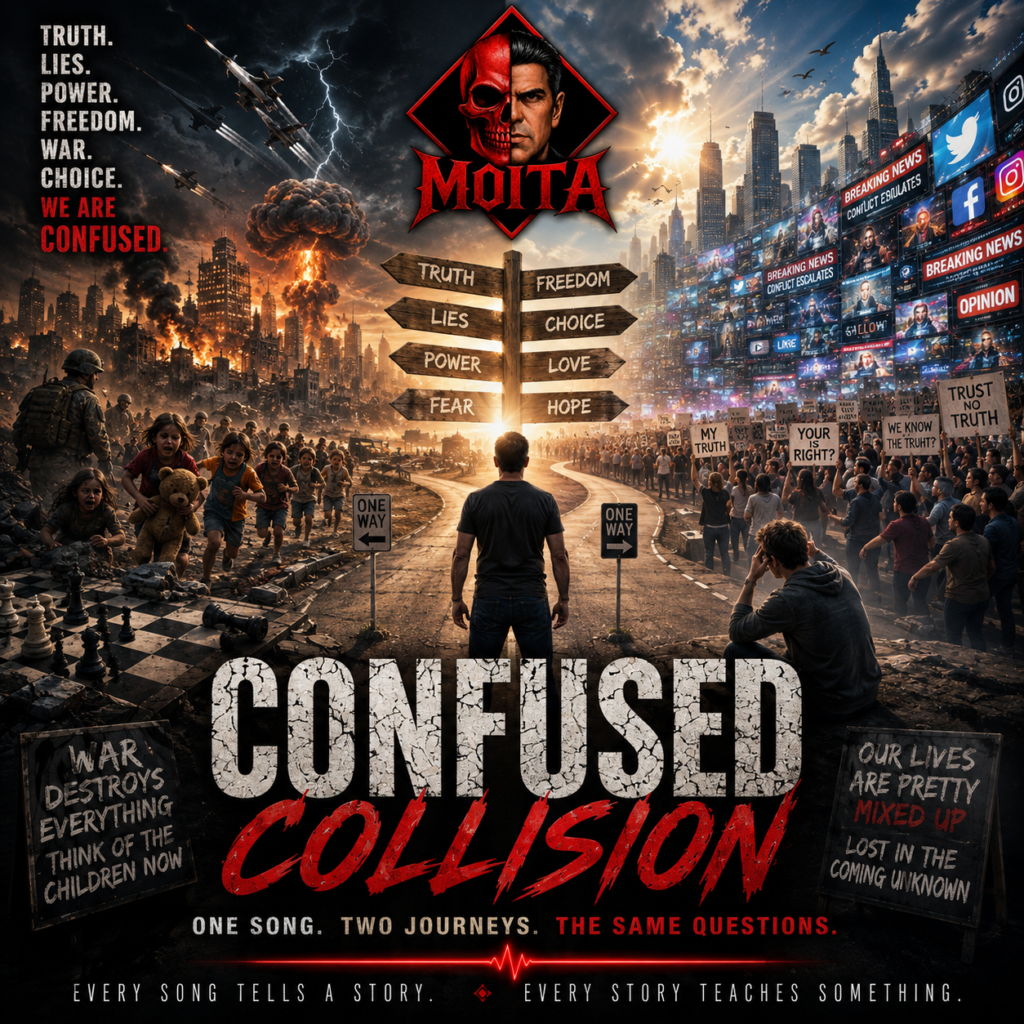




Reviews
There are no reviews yet.