
Description
About the Song
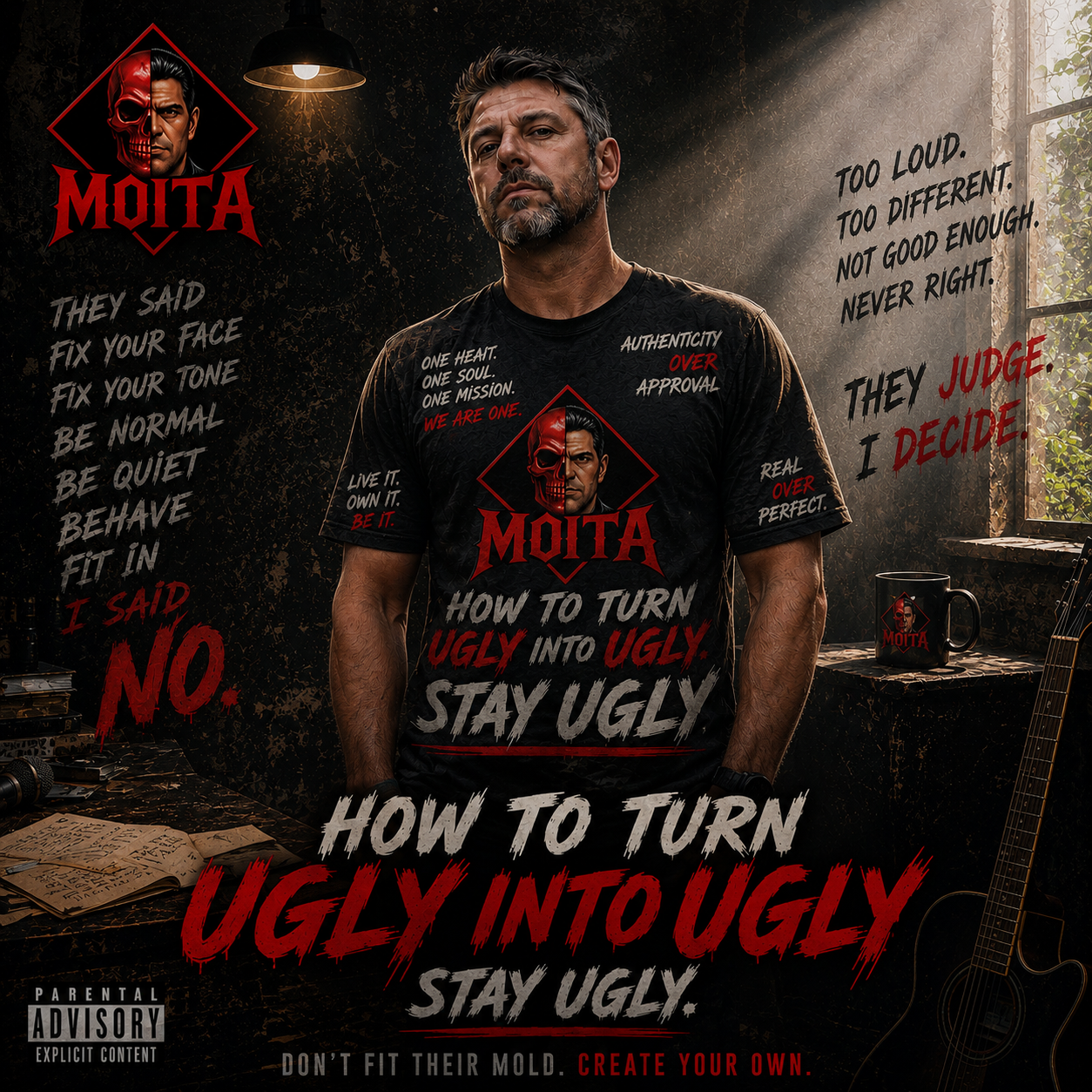
HOW TO TURN UGLY INTOY UGLY
CATEGORY
Identity and Self-Acceptance
PRIMARY EMOTION
Defiance
ALSO FITS
Authenticity, Self-Respect, Individuality, Inner Strength, Resilience, Courage, Freedom, Personal Growth
WHAT THIS SONG IS ABOUT
There comes a point in life when you realize that not everyone wants to see you become the best version of yourself. Sometimes they simply want you to become the version that makes them comfortable.
That lesson rarely arrives all at once. It usually happens a little at a time.
One comment.
One criticism.
One expectation.
One reminder that maybe you should talk differently, think differently, dream differently, dress differently, or become someone easier for everyone else to accept.
Most of us have felt that pressure at some point.
Sometimes it comes from strangers.
Sometimes it comes from friends.
Sometimes it comes from people we love.
Sometimes it even comes from inside us because we have heard the same criticism so many times that we begin repeating it to ourselves.
This song is about reaching the point where that cycle ends.
It is not about becoming cruel.
It is not about celebrating hate.
It is not about refusing to grow.
It is about refusing to surrender your identity simply because someone else has decided it needs fixing.
There is an enormous difference between improving yourself and abandoning yourself.
Growth is healthy.
Learning is healthy.
Admitting when you are wrong is healthy.
Pretending to be somebody else just to earn acceptance is something completely different.
The title may surprise people. At first glance, it sounds as though the answer to ugliness is to become ugly yourself.
That is not what I mean.
The word ugly changes as the song moves forward.
At the beginning, it represents the labels people place on you. It represents the parts of you they criticize, the pieces they want hidden, and the rough edges they keep trying to sand away.
By the end, ugly means something completely different.
It means honesty.
It means authenticity.
It means refusing to apologize for existing.
Sometimes the world calls honesty ugly simply because it cannot control it.
That is where this song lives.
Not in hatred.
Not in revenge.
In freedom.
For anyone who has spent years trying to fit inside somebody else’s expectations, these words may feel familiar.
This song is about the moment approval stops determining your value.
That is one of the hardest victories a person can earn.
THE STORY BEHIND THE SONG
One of the things I have noticed throughout my life is that people often say they want authenticity, but what they really want is predictability.
They want people to be genuine, as long as being genuine never makes anyone uncomfortable.
The moment someone speaks differently, questions something, refuses to follow the crowd, or chooses another direction, the word different can suddenly become a problem.
Different becomes difficult.
Different becomes strange.
Different becomes dangerous.
Eventually, different becomes ugly.
I have watched that happen in many places.
It happens in schools.
It happens inside families.
It happens in workplaces.
It happens between friends.
It happens online, where complete strangers decide who deserves respect and who deserves ridicule.
Sometimes people do not even realize they are doing it.
They honestly believe they are helping.
They believe they are improving someone.
They believe they are offering advice.
That raises a question I think all of us should ask before trying to reshape another human being.
Are we helping them become themselves?
Or are we helping them become easier for us to understand?
Those are not the same thing.
There is nothing wrong with encouraging someone to become kinder, wiser, healthier, more responsible, or more compassionate. Those things help us grow.
There is something very different about trying to erase the parts of someone that simply make them unique.
A person can improve without disappearing.
A person can listen without surrendering.
A person can learn without becoming a copy of everybody else.
This song grew from thinking about the moments when people begin negotiating with their own identity.
They lower their voice because someone complained.
They stop laughing because someone judged them.
They stop creating because criticism became louder than curiosity.
They stop dreaming because somebody called the dream unrealistic.
They stop speaking honestly because staying quiet causes fewer problems.
Little by little, they begin disappearing.
The sad part is that many people do not notice it happening.
They think they are becoming accepted.
In reality, they are slowly becoming invisible.
That thought stayed with me.
Eventually, it became this song.
I did not want to write a polite song about confidence. There are already plenty of songs that tell people to shine, rise, bloom, and become beautiful.
That language works for some people.
This song comes from another direction.
Not everyone feels polished.
Not everyone feels healed.
Not everyone reaches some perfect ending where every wound becomes beautiful and every critic finally understands.
Sometimes the victory is much simpler.
You are still here.
You are still standing.
You are still yourself.
That may not sound graceful, but it is real.
This song is not encouraging people to become rude.
It is encouraging people to become honest.
Those two things should never be confused.
Authenticity makes some people uncomfortable because authenticity cannot always be managed, predicted, or controlled.
That has always been true.
It probably always will be.
Maybe that is exactly why it is worth protecting.
WHY I WROTE THIS SONG
I wrote this song because too many people spend their lives trying to earn permission to be themselves.
They ask permission to speak.
Permission to disagree.
Permission to create.
Permission to say no.
Permission to walk away.
Permission to stop pretending.
The problem is that permission may never come.
Some people will always prefer the quieter version of you.
The smaller version.
The version that never challenges them.
The version that keeps apologizing.
The version that can be controlled with criticism, guilt, shame, or rejection.
I wanted to write about what happens when a person finally stops participating in that arrangement.
Not when they become perfect.
Not when everybody accepts them.
Not when the world suddenly becomes fair.
When they stop begging.
That is why the line about getting teeth matters.
It is not about becoming violent.
It is about developing enough self-respect to stop asking other people whether you deserve to exist as you are.
I also wanted the chorus to avoid the usual language of transformation.
The person in this song does not become shiny.
The person does not become pure.
The person does not suddenly rise above every struggle.
The person simply stops living in disguise.
To me, that is more honest.
Some victories do not look beautiful from the outside.
Sometimes they look like boundaries.
Sometimes they look like walking away.
Sometimes they look like disappointing people who were comfortable with your silence.
Sometimes they look like standing alone for a while.
Sometimes they look ugly to everyone except the person who finally became free.
That is why I wrote this song.
WHY THIS MATTERS TO ME
This matters to me because I have never believed people should have to become copies of one another to deserve respect.
We need differences.
We need people who question.
We need people who create.
We need people who look at something ordinary and ask whether it can be improved.
We need people who refuse to follow a path simply because everybody else is already walking on it.
That does not mean every idea is right.
It does not mean every opinion deserves agreement.
It does mean a person should not be dismissed simply because they are different.
I have always been curious.
I have always wanted to understand how things work.
I have taken things apart, designed things, built things, changed things, and looked for better ways to solve problems.
That kind of thinking does not always fit neatly into somebody else’s expectations.
Creativity rarely does.
When people spend too much time trying to look acceptable, sound acceptable, and behave exactly as expected, they may also begin hiding the very qualities that could have led them somewhere meaningful.
That matters to me.
I do not want people to mistake conformity for goodness.
I do not want them to mistake silence for peace.
I do not want them to mistake control for guidance.
I do not want them to mistake self-respect for arrogance.
There is a difference between refusing to grow and refusing to disappear.
This song stands inside that difference.
WHY THIS SONG FITS MOITA
MOITA contains songs about many different subjects.
Grief.
Faith.
Betrayal.
Homelessness.
Pain.
Prison.
Family.
Dementia.
Courage.
Love.
Justice.
Technology.
Creativity.
At first, some of those subjects may seem far apart.
Underneath them is one common thread.
They all ask questions about what it means to be human.
This song asks one of the oldest questions there is.
How much of yourself are you willing to give away just to be accepted?
Children face that question in school.
Teenagers face it while trying to fit in.
Adults face it in relationships, workplaces, families, neighbourhoods, and friendships.
The pressure changes its appearance, but it never completely disappears.
Some people spend their entire lives trying to become acceptable to everyone around them.
The sad part is that the finish line keeps moving.
Change your appearance and someone criticizes your personality.
Change your personality and someone criticizes your opinions.
Change your opinions and someone criticizes your dreams.
Reach your dreams and someone criticizes your success.
It never ends.
Chasing universal approval may be one of the most exhausting journeys a person can take.
No matter where you stand, somebody will think you are too much of something and not enough of something else.
That realization can feel discouraging.
Then it can become freeing.
Once you stop trying to satisfy everyone, you begin discovering who you are without the audience.
That freedom is quieter than people imagine.
It does not require applause.
It does not require an announcement.
It requires honesty.
That is one of the values running through MOITA.
Honesty does not always make life easier.
Sometimes it costs relationships.
Sometimes it costs opportunities.
Sometimes it costs popularity.
It can also give you something more valuable.
The ability to recognize yourself when you look in the mirror.
To me, success has never been about becoming someone everybody likes.
It is about becoming someone I can respect.
That is harder.
It is also more meaningful.
Confidence and arrogance are often confused.
Arrogance demands attention.
Confidence does not.
Arrogance needs to stand above somebody else.
Confidence can stand alone.
This song is not saying, “Look at me.”
It is saying, “I no longer need permission to be me.”
That is why it belongs inside MOITA.
It does not celebrate ugliness.
It challenges the people who decided they had the right to define it.
READ THIS FIRST
Before reading these lyrics, forget about physical appearance.
Do not think about beauty.
Do not think about being attractive or unattractive.
Think about every label you have been given.
Think about every time someone told you who you were supposed to be.
Think about every moment you stayed quiet because speaking honestly seemed too risky.
Think about every dream you nearly abandoned because somebody laughed.
Then ask yourself one question.
If nobody else’s expectations existed, who would you be?
That is the person these lyrics are speaking to.
If the answer comes easily, you are fortunate.
If it takes time, you are not alone.
Many people spend years trying to separate their own voice from all the voices that have been speaking over them since childhood.
Read these words slowly.
They are not really about becoming ugly.
They are about refusing to lose yourself.
FULL LYRICS
HOW TO TURN UGLY INTO UGLY
They said fix your face, fix your tone,
Fix the way you walk alone.
Sand the edges, bite your tongue,
Act like you were never wrong.
They tried to dress me in their shame,
Call it help, but play a game.
Painted smiles, borrowed skin,
Told me who I should’ve been.
But I learned something they don’t teach:
When you stop begging, you get teeth.
Chorus:
This is how you turn ugly into ugly.
Don’t clean it up, don’t beg for mercy.
Wear it loud, wear it honest,
Let it stare back when they judge it.
I didn’t soften, I didn’t bend.
I doubled down and let it end.
That’s how you turn ugly into ugly
And survive it.
They love you most when you behave,
When you stay small, when you stay safe.
But the cracks they tried to hide
Are the ones that kept me alive.
I stopped chasing their reflection,
Stopped correcting my direction.
If I scare you, good—that’s proof.
I finally stepped into the truth.
They wanted polish, they wanted clean.
I chose real over pristine.
This is how you turn ugly into ugly.
No disguise, no damn apology.
Let it burn, let it stay,
Let it scare the fake away.
I didn’t bloom, I didn’t rise.
I just stopped living in disguise.
That’s how you turn ugly into ugly
And own it.
This isn’t pretty, this isn’t pure.
This is standing when nothing cures.
They wanted grace, I chose nerve.
They wanted change, I chose worse.
Break:
Not everyone’s meant to shine.
Some of us are meant to end illusions.
This is how you turn ugly into ugly.
Not loved, not saved, not lucky.
But solid.
Still breathing.
Still standing ugly.
Still me.
No mirror fixed me,
No name redeemed me.
I didn’t become something else
I became undeniable.
There you have it—raw and unapologetic.
SECTION ONE
LYRIC JOURNEY
PART 1
“They said fix your face, fix your tone,
Fix the way you walk alone.”
That is where the song begins.
Not with confidence.
Not with freedom.
With correction.
Someone has already decided there is something wrong.
Fix your face.
Fix your tone.
Fix the way you move through the world.
Those words may sound simple, but anyone who has heard enough criticism understands how quickly they can get inside you.
It rarely begins with somebody saying, “I want to change who you are.”
Usually it sounds smaller than that.
Maybe you should smile more.
Maybe you should calm down.
Maybe you talk too much.
Maybe you are too quiet.
Maybe you should dress differently.
Maybe you should stop doing that.
Maybe you should be more like everybody else.
One comment does not usually change a person.
A hundred comments can.
Especially when they start arriving from people whose opinions matter to you.
That is where identity can begin getting negotiated away.
The line about fixing the way you “walk alone” matters because being alone makes people nervous.
Not always the person who is alone.
Sometimes everybody watching them.
There is a strange assumption that if someone does not follow the crowd, something must be wrong.
Maybe they are antisocial.
Maybe they think they are better than everyone.
Maybe they are difficult.
Or maybe they simply know where they are going.
There is a difference between loneliness and independence.
The song is already beginning to ask whether the person being corrected is actually broken or simply inconvenient.
“Sand the edges, bite your tongue,
Act like you were never wrong.”
Now the correction goes deeper.
Sand the edges.
Take away the rough parts.
Become easier to hold.
Easier to understand.
Easier to accept.
That can sound like good advice because all of us have edges worth improving.
I certainly do.
There are times when we need to listen.
Times when we need to admit we were wrong.
Times when life teaches us that something in our behaviour needs to change.
That is growth.
But there is another kind of sanding where the goal is not to help somebody grow.
The goal is to make them harmless.
Do not disagree.
Do not question.
Do not challenge.
Do not say what you really think.
That is where “bite your tongue” enters.
Most people have done it.
You know exactly what you want to say.
You know you have a reason to say it.
Then you calculate the consequences.
Will this start an argument?
Will this person leave?
Will I lose the opportunity?
Will somebody call me difficult?
Will everybody turn against me?
So you say nothing.
Sometimes that is wisdom.
Not every thought needs to be spoken.
Sometimes silence prevents unnecessary damage.
But if silence becomes your permanent way of surviving other people, eventually you may stop recognizing your own voice.
Then comes the strange instruction.
“Act like you were never wrong.”
At first, that almost sounds like the opposite of everything else.
If people are trying to correct you, why would they want you to act as if you were never wrong?
Because appearances matter.
People often want change without wanting honesty.
They want the polished version.
Do not show the mistake.
Do not show the uncertainty.
Do not show the struggle.
Fix it quietly and present the finished version.
That is not how real people live.
Real people get things wrong.
I have been wrong.
I have changed my mind.
I have made mistakes.
That does not erase everything else I am.
If we spend our lives pretending we were never wrong, we lose one of the greatest opportunities we have.
Learning.
“They tried to dress me in their shame,
Call it help, but play a game.”
This is where the song begins recognizing what has been happening.
Their shame.
Not mine.
That distinction matters.
People can hand us feelings that never belonged to us.
Someone is embarrassed by the way you speak.
Eventually you become embarrassed.
Someone thinks your dream is ridiculous.
Eventually you stop telling people about it.
Someone dislikes something about your personality.
Eventually you start hiding it before they even ask.
Their discomfort becomes your shame.
That can happen so gradually you do not notice the transfer.
Then comes one of the most complicated parts.
“Call it help.”
Not everybody trying to change us is malicious.
That would be too simple.
Sometimes people genuinely believe they are helping.
Parents can do it because they are afraid their child will be hurt.
Friends can do it because they believe they know better.
A partner can believe they are improving the relationship.
A boss can believe they are making someone more professional.
Intent matters.
Impact matters too.
Good intentions do not automatically make every kind of pressure healthy.
The question becomes whether the advice is helping the person become stronger or helping them become easier to control.
That is not always obvious.
Especially when the person applying the pressure says they are doing it because they care.
“Painted smiles, borrowed skin,
Told me who I should’ve been.”
Now the result becomes visible.
The smile is painted.
It looks real from the outside.
It is not.
Most of us know how to do that.
Someone asks how you are.
Fine.
You smile.
You continue.
There are times when that is simply ordinary life.
We do not need to tell every person everything we are carrying.
The problem is when the painted smile becomes the only face anyone knows.
Then the borrowed skin.
That is one of the central images of the song.
You are still alive inside it.
It simply does not belong to you.
Maybe the personality was borrowed.
Maybe the opinions.
Maybe the clothes.
Maybe the career.
Maybe the whole version of success you were told to chase.
At some point a person can become so good at meeting expectations that everyone around them thinks they are doing wonderfully.
Inside, they feel like they are wearing somebody else’s life.
That is a strange kind of loneliness.
Being surrounded by people who like you while knowing they like a version that is partly invented.
Then the line tells us where the pressure was always heading.
“Told me who I should’ve been.”
Not who I could become.
Who I should have been.
There is judgment inside that.
You missed the standard.
You were supposed to be something else.
That can become a heavy sentence.
Especially when it comes from childhood.
Children often absorb expectations before they know they are allowed to question them.
What career should you have?
What kind of person should you marry?
How much money should you make?
How should you behave?
What should success look like?
Some guidance is necessary.
A child cannot invent every rule for themselves.
But eventually that child becomes an adult.
Then comes the harder question.
Which parts of this life are actually mine?
That is where the first verse has brought us.
The person has been corrected.
Sanded.
Silenced.
Covered in someone else’s shame.
Given a painted smile.
Placed inside borrowed skin.
Then something changes.
“But I learned something they don’t teach”
That line is a turning point because the person begins learning outside the system that was shaping them.
There are lessons people teach us directly.
There are lessons life teaches us because nobody did.
This is one of those lessons.
“When you stop begging, you get teeth.”
That line has bite because it needs it.
Not violence.
Not revenge.
Self-respect.
Begging in this song is not literally being on your knees.
It is asking permission.
Do you like me now?
Am I acceptable now?
Did I change enough?
Can I speak now?
Can I disagree?
Can I be myself without losing you?
That kind of begging can continue for years.
The problem is that approval moves.
You fix one thing.
Another appears.
You become quieter.
Now you are too distant.
You become more confident.
Now you are arrogant.
You stop arguing.
Now you do not communicate.
You speak honestly.
Now you are difficult.
There is no finish line when somebody else owns the definition of who you should be.
So you stop begging.
And you get teeth.
Teeth are boundaries.
The ability to say no.
The ability to defend what matters.
The ability to stop explaining every decision.
The ability to recognize when criticism contains something useful and when it is simply control dressed as concern.
That does not make you cruel.
It makes you harder to consume.
Then the chorus arrives.
“This is how you turn ugly into ugly.”
The title finally speaks.
And at first, it almost sounds ridiculous.
How do you turn something into what it already is?
That contradiction is the point.
The first ugly belongs to them.
The second ugly belongs to me.
The first one is accusation.
The second one is ownership.
Someone says you are ugly because you do not fit their picture.
Eventually you say, fine.
If this is what you call ugly, I will stop running from the word.
That changes who has the power.
“Don’t clean it up, don’t beg for mercy.”
Cleaning it up would mean making the truth presentable again.
Softening the edges so nobody becomes uncomfortable.
This time the person refuses.
No begging.
No asking the jury for another verdict.
That does not mean refusing responsibility.
If you hurt someone, apologize.
If you are wrong, admit it.
If something in you genuinely needs changing, change it.
But do not apologize for your existence.
Those are completely different things.
“Wear it loud, wear it honest,
Let it stare back when they judge it.”
Now ugly has become something worn openly.
The person is not hiding.
That is important because labels survive through shame.
If somebody calls you something and you spend ten years proving you are not, the label is still controlling part of your life.
Sometimes the power changes when you stop running.
You look at the word.
You decide what is true and what is not.
Then you keep living.
“Let it stare back” means the person is no longer looking down.
Judgment arrives.
The person remains.
That can make other people uncomfortable.
Confidence often looks aggressive to someone who preferred your insecurity.
“I didn’t soften, I didn’t bend.”
The song does not promise a graceful transformation.
There is no beautiful moment where every critic understands and everybody hugs.
The person simply stops changing shape for the room.
There is stubbornness in that.
Sometimes stubbornness is a weakness.
Sometimes it saves you.
Knowing the difference matters.
If you are stubborn about a lie, it keeps you trapped.
If you are stubborn about your dignity, it may keep somebody else from taking it.
“I doubled down and let it end.”
Something has to end here.
Maybe the relationship.
Maybe the argument.
Maybe the need for approval.
Maybe the version of the person that kept trying to satisfy everyone.
“Let it end” is important because freedom sometimes requires losing something.
We like stories where choosing yourself causes everybody else to respect you.
Real life does not always work that way.
Some people will leave.
Some will misunderstand.
Some will say you changed.
They may be right.
You did.
The question is whether the change brought you closer to yourself or further away.
Then the chorus lands on the same phrase again.
“That’s how you turn ugly into ugly”
By now the two uglies already feel different.
The word has started changing ownership.
Then comes the part that matters most.
“And survive it.”
Not win.
Not conquer.
Not prove everybody wrong.
Survive it.
There is something much more human in that.
Standing up for yourself does not guarantee life suddenly becomes easy.
Sometimes the immediate result is loneliness.
Conflict.
Doubt.
You may wonder whether you went too far.
You may miss people even when you know the old relationship was unhealthy.
You may question a boundary ten minutes after setting it.
Survival means you stay with the decision long enough to discover who you are without constantly negotiating yourself away.
That is where the first movement of the song leaves us.
The person has not become polished.
They have not become universally loved.
They have not even become completely certain.
But something fundamental has changed.
They are no longer asking the world to tell them whether they deserve to be themselves.
The second verse begins after that decision.
And once a person stops begging for approval, they start noticing just how much of their old life depended on them staying small.
SECTION ONE
LYRIC JOURNEY
PART 2
“They love you most when you behave,
When you stay small, when you stay safe.”
This is where the second verse begins.
And to me, this is one of the most uncomfortable truths in the song.
Some people prefer you when you are easy to manage.
Not because they are monsters.
Not because every relationship is manipulative.
Sometimes they are simply used to a version of you that never pushed back.
You did not argue.
You did not set boundaries.
You did not question the arrangement.
You kept the peace.
You stayed small.
That version of you may have made life easier for everyone around you.
The problem is that it may have made life harder for you.
That is the difference between peace and suppression.
They can look similar from the outside.
One is healthy.
The other slowly erases somebody.
“When you stay safe.”
Safe can be a good thing.
There is nothing wrong with protecting yourself.
But safety can also become another word for never risking rejection.
Never saying what you really think.
Never trying the thing you may fail at.
Never becoming visible.
That kind of safety can become its own prison.
“But the cracks they tried to hide
Are the ones that kept me alive.”
Now the song takes everything that looked like damage and changes its meaning.
The cracks are not beautiful because they are cracks.
I do not believe every wound becomes some magical gift.
Some wounds simply hurt.
Some damage should never have happened.
But sometimes the things we survive become part of what teaches us how to survive the next thing.
The crack can become a place where light gets in.
It can also become a reminder that the structure held.
That matters.
People often want to hide the damaged parts because they think those parts reduce their value.
This line says the opposite.
The cracks became evidence.
You survived.
You learned.
You adapted.
You are still here.
That does not mean the damage deserves credit.
The person deserves the credit.
“I stopped chasing their reflection,
Stopped correcting my direction.”
This is one of the quieter turning points in the song.
Chasing somebody else’s reflection means trying to see yourself through their eyes.
Do they approve?
Do they think I am successful?
Do they think I look right?
Do they think I belong?
That is exhausting.
Because even if one person approves, another may not.
You can spend your whole life correcting direction and never actually move toward yourself.
That is why the second line matters.
“Stopped correcting my direction.”
Not every detour is a mistake.
Sometimes the path that looked wrong to everyone else is the one that finally became yours.
“If I scare you, good—that’s proof.
I finally stepped into the truth.”
This line is sharper.
It is supposed to be.
The fear here is not literal terror.
It is discomfort.
People can become uncomfortable when someone changes the rules of a relationship.
The person who always said yes starts saying no.
The person who apologized for everything stops apologizing for existing.
The person who stayed quiet begins speaking.
That can feel threatening to someone who benefited from the old arrangement.
The change may be healthy.
It can still feel disruptive.
“That’s proof.”
Proof that something real happened.
The person stopped performing.
They stepped into truth.
Not everybody will like that.
Truth is not always socially convenient.
The pre-chorus answers that tension.
“They wanted polish, they wanted clean.
I chose real over pristine.”
Polish is about appearance.
Pristine is untouched.
Perfect.
Controlled.
Real is something else.
Real can be messy.
Real can admit contradiction.
Real can have scars.
Real can be wrong and still honest.
That is why the choice matters.
The person is no longer trying to become flawless.
They are trying to become genuine.
Then the chorus returns.
“This is how you turn ugly into ugly.”
The line now carries more weight than it did the first time.
The first chorus was about refusing the label.
This one is about living inside the decision.
“No disguise, no damn apology.”
The disguise is gone.
The apology is gone too.
Again, that does not mean the person never apologizes for anything.
It means they stop apologizing for being themselves.
That difference matters.
“Let it burn, let it stay,
Let it scare the fake away.”
Now the song allows consequence.
If honesty makes something false fall apart, let it.
If a relationship only survives while one person is pretending, what exactly is being saved?
Sometimes truth destroys an arrangement.
That can be painful.
It can also be necessary.
“I didn’t bloom, I didn’t rise.
I just stopped living in disguise.”
I like these lines because they reject the usual transformation story.
No blooming.
No shining.
No perfect rebirth.
The person does not become some inspiring symbol.
They simply stop lying about who they are.
That is enough.
Sometimes growth is not becoming more impressive.
Sometimes it is becoming less fake.
“That’s how you turn ugly into ugly—
And own it.”
The first chorus ended with survival.
This one ends with ownership.
That is progress.
Survival says, I got through it.
Ownership says, this is mine now.
My face.
My voice.
My life.
My scars.
My choices.
My direction.
The word ugly has almost completely changed by this point.
It began as accusation.
Now it has become a refusal to be edited.
Then the bridge arrives.
“This isn’t pretty, this isn’t pure.”
The song strips away the last attempt to make authenticity look beautiful.
It is not always beautiful.
Sometimes it is awkward.
Sometimes it is expensive.
Sometimes it makes a mess.
Sometimes it costs relationships.
Sometimes people do not forgive you for changing.
That is real.
“This is standing when nothing cures.”
There are problems that do not disappear.
There are wounds that do not fully close.
There are situations where there is no clean solution.
Standing can become the victory.
That line matters to me because too many stories only celebrate complete healing.
Not everyone gets that.
Some people learn how to live with what remains.
That is still courage.
“They wanted grace, I chose nerve.”
Grace is beautiful.
Nerve is tougher.
More stubborn.
More practical.
There are moments when grace is the right response.
There are also moments when you need enough nerve to protect yourself.
The song chooses nerve because the person has spent too long being shaped by other people.
“They wanted change, I chose worse.”
This is probably the line most likely to be misunderstood.
The word “worse” is not saying I chose to become a worse person.
It means worse according to them.
More difficult.
Less compliant.
Less polished.
Less easy to control.
Sometimes becoming healthier makes you look worse to people who benefited from your unhealthy habits.
That is the point.
Then the break arrives.
“Not everyone’s meant to shine.”
I do not hear defeat in that line.
I hear freedom from performance.
Not everyone needs to become inspirational.
Not everyone needs to be admired.
Not everyone needs an audience.
Some people simply need to live honestly.
“Some of us are meant to end illusions.”
That is where the song widens.
An illusion can be a false idea about beauty.
Success.
Love.
Family.
Strength.
Identity.
Any belief that survives mainly because nobody questions it.
Some people enter a room and make things less comfortable because they are willing to ask what everyone else avoids.
That can be valuable.
It can also make them unpopular.
The final chorus begins from there.
“This is how you turn ugly into ugly.”
By now the phrase has become a declaration.
“Not loved, not saved, not lucky.”
The song refuses to hand out rewards.
The person is not automatically loved more because they became honest.
They are not saved by someone else.
They are not simply lucky.
That makes the next words more important.
“But solid.”
Solid means stable enough to stand.
Not perfect.
Not polished.
Not universally approved.
Solid.
“Still breathing.
Still standing ugly.
Still me.”
This is the emotional heart of the ending.
Still breathing.
That is survival.
Still standing.
That is resilience.
Still ugly.
That is ownership.
Still me.
That is identity.
Everything the song has been moving toward fits inside those four short lines.
The person did not win everybody over.
They won themselves back.
Then the outro begins.
“No mirror fixed me”
The mirror represents judgment.
Appearance.
Self-evaluation.
The idea that something outside you can confirm whether you are acceptable.
The mirror did not fix anything because the problem was never the reflection.
“No name redeemed me.”
The label did not save the person either.
Not a compliment.
Not a title.
Not a reputation.
Not somebody else’s approval.
Redemption did not come from being renamed.
“I didn’t become something else”
That line rejects the whole premise people started with.
Fix your face.
Fix your tone.
Become something else.
The person refused.
“I became undeniable.”
That is the final destination.
Not beautiful.
Not approved.
Undeniable.
That does not mean everyone agrees.
It means the person is no longer pretending they do not exist.
They take up their own space.
They know what they believe.
They know what they survived.
They know what parts of themselves need growth and what parts deserve protection.
That is a much stronger place than approval.
Then the song closes with the line:
“There you have it—raw and unapologetic.”
That is exactly what the journey has become.
Raw.
Because nothing was polished for comfort.
Unapologetic.
Because the person finally stopped asking permission to be themselves.
The title sounded like an insult when we began.
By the end, it sounds almost like freedom.
That is the transformation.
Not ugly into beautiful.
Ugly into ownership.
And once the word belongs to you, it stops being a weapon in somebody else’s hand.
SECTION TWO
THE STORY
Every song begins somewhere.
Sometimes it begins with a memory.
Sometimes it begins with a conversation.
Sometimes it begins with something I lived.
Sometimes it begins with watching other people.
This song began with a question that stayed in my mind much longer than I expected.
Why do so many people spend their lives trying to become acceptable instead of becoming themselves?
The more I thought about it, the more I realized it is something almost everyone experiences.
Children learn very early that fitting in often feels safer than standing out.
A child who is different may be laughed at.
A teenager who thinks differently may be ignored.
An adult who refuses to follow the crowd may be criticized.
The setting changes.
The pressure stays remarkably similar.
I have watched people slowly edit themselves to make life easier.
They become quieter because someone said they talked too much.
They stop laughing because somebody thought they were embarrassing.
They stop creating because criticism became louder than encouragement.
They stop asking questions because someone made them feel foolish.
None of those changes happen overnight.
They happen one small compromise at a time.
That is why I wanted this song to feel direct.
Not because I wanted to attack anyone.
Because I wanted to describe something many people quietly experience.
One day they wake up and realize they have become a version of themselves that everybody recognizes except them.
That thought bothered me.
I kept asking myself another question.
How many people are living lives they never really chose?
Not because someone forced them.
Because little by little they surrendered pieces of themselves to earn approval.
Approval is a strange thing.
It feels valuable when we receive it.
It can also become addictive.
Once we start measuring our worth by someone else’s opinion, we begin chasing something that can never truly satisfy us.
There will always be another opinion.
Another expectation.
Another person who thinks we should change one more thing.
That finish line never stops moving.
I think that is one of the saddest traps a person can fall into.
Wanting to improve yourself is healthy.
Wanting to learn is healthy.
Wanting to become kinder, wiser, or more patient is healthy.
Wanting to erase your personality because someone else dislikes it is something completely different.
That difference became the heart of this song.
Interestingly, the title arrived before much of the lyric.
Most song titles tell you where the song is going.
This one almost points you in the wrong direction.
When someone first hears “How to Turn Ugly Into Ugly,” they might expect anger.
They might expect revenge.
They might expect someone deciding to become as cruel as the people who hurt them.
That is not where the song goes.
The title asks the reader to make an assumption.
The lyrics slowly take that assumption apart.
By the end of the song, ugly no longer means what it meant at the beginning.
That was intentional.
I enjoy titles that invite people into the wrong room before opening the correct door.
Not to trick them.
To encourage them to think.
Words are interesting that way.
The same word can carry completely different meanings depending on who is speaking, who is listening, and what happened before it was spoken.
Ugly is one of those words.
Sometimes people use it to describe appearance.
Sometimes behaviour.
Sometimes ideas.
Sometimes they simply use it to describe anything that makes them uncomfortable.
The more I thought about that, the more I realized ugly is often just another way of saying, “I don’t understand you,” or, “You make me uncomfortable.”
That realization changed the direction of the song.
It stopped being about appearances.
It became a song about labels.
Every generation invents labels.
Every generation also struggles against them.
History is full of people who were dismissed before they were respected.
Inventors.
Artists.
Writers.
Scientists.
Ordinary men and women who looked at the world differently.
Some of them were laughed at.
Some were ignored.
Some were told they would never amount to anything.
Many kept going anyway.
I find those stories inspiring because they remind me that acceptance has never been the best measurement of truth.
Sometimes the crowd is right.
Sometimes one person quietly standing alone is right.
The challenge is having enough character to keep asking honest questions instead of simply following whichever opinion happens to be popular.
That way of thinking has always interested me.
It appears in many different MOITA songs because curiosity has always been part of how I look at life.
I enjoy asking why.
Why do people believe what they believe?
Why do we fear being different?
Why do we often criticize in others the very things we secretly wish we had the courage to do ourselves?
Those questions rarely have simple answers.
They do have interesting conversations.
That is where this song was born.
Not from one dramatic event.
Not from one argument.
Not from one particular person.
It grew from years of watching people struggle between acceptance and authenticity.
I think everyone has moments when they stand at that crossroads.
One path says, “Keep everyone happy.”
The other says, “Be honest.”
Sometimes those paths lead to the same place.
Sometimes they lead in completely opposite directions.
When they do, a decision has to be made.
That decision is rarely comfortable.
Choosing honesty may cost approval.
Choosing authenticity may cost relationships.
Choosing self-respect may disappoint people who preferred the quieter version of you.
Those moments are never easy.
They are often necessary.
As I continued writing, I realized something else.
The song was not about becoming stronger than everyone else.
It was about becoming strong enough to stop asking everyone else who you are.
There is an important difference.
One seeks power over people.
The other seeks peace within yourself.
I have never believed confidence has to be loud.
Some of the strongest people I have met speak softly.
They do not need to prove anything.
They simply know who they are.
That quiet certainty has always impressed me more than loud confidence that constantly needs attention.
That is the kind of strength I wanted this song to reflect.
Not the strength of domination.
The strength of identity.
By the time I reached the last chorus, I knew the ending could not be polished.
Life is not always polished.
Some victories look rough around the edges.
Some victories simply mean you survived without losing yourself.
Sometimes that is enough.
Sometimes that is everything.
That is the story behind this song.
It is not about teaching people how to become ugly.
It is about refusing to let someone else’s definition of ugly become your definition of yourself.
That is a fight worth having.
Not against the world.
Within yourself.
Because once you settle that question honestly, nobody else gets to answer it for you.
SECTION THREE
LYRIC EXPLORATION
Every song asks the listener to take a journey.
Some journeys are loud.
Some are quiet.
Some begin with confidence and end with uncertainty.
Others begin in confusion and slowly become clear.
This song moves in the opposite direction from what its title suggests.
The title sounds confrontational.
The lyrics slowly reveal that the real battle is not against other people.
It is against the version of ourselves that keeps asking for permission to exist.
That is why the opening lines matter so much.
“They said fix your face, fix your tone,
Fix the way you walk alone.”
I never intended those words to point at one person.
“They” can be anybody.
A parent.
A teacher.
A stranger.
A friend.
A boss.
A relationship.
Even the voice inside our own head after hearing enough criticism.
I deliberately kept those words broad because almost everyone has experienced some version of them.
People often believe criticism only hurts when it is cruel.
That is not always true.
Sometimes repeated suggestions quietly become instructions.
Over time we stop asking what we think and begin asking what everyone else expects.
That is where identity slowly starts slipping away.
The next lyric continues that idea.
“Painted smiles, borrowed skin,
Told me who I should’ve been.”
To me, those words describe one of the greatest dangers in modern life.
Comparison.
It has always existed, but today it follows us everywhere.
We compare our appearance.
Our careers.
Our relationships.
Our success.
Our homes.
Our talents.
Our lives.
Most of the time we are comparing our ordinary lives to someone else’s carefully selected highlights.
That is not a fair comparison.
Real life contains struggle.
Real life contains doubt.
Real life contains mistakes that never appear in photographs.
One of the healthiest things a person can learn is to stop measuring their worth against someone else’s presentation.
The song turns sharply with one short line.
“When you stop begging, you get teeth.”
I like that lyric because it can easily be misunderstood.
It is not about becoming aggressive.
It is about developing self-respect.
There is a difference between attacking people and refusing to surrender yourself.
The first creates conflict.
The second creates boundaries.
Healthy boundaries often surprise people.
Especially those who benefited from having none.
Sometimes the biggest change in a person’s life is learning one simple word.
No.
No to guilt.
No to manipulation.
No to pretending.
No to becoming someone they no longer recognize.
That one word has protected countless people from living someone else’s life.
The chorus says:
“Wear it loud, wear it honest,
Let it stare back when they judge it.”
Those words are really about ownership.
Once we stop running from a label, it begins losing its power.
History has shown that many groups and many individuals have reclaimed words that were once meant to shame them.
The insult no longer belongs to the person throwing it.
It belongs to the person who refused to let it define them.
That is the transformation taking place inside this song.
Ugly begins as an accusation.
It finishes as independence.
The second verse contains one of the quietest but most important ideas in the song.
“They love you most when you behave,
When you stay small, when you stay safe.”
That lyric is not saying everyone wants to control us.
Many people genuinely want to protect us.
Good parents often worry.
Good friends often offer advice.
People who care about us sometimes see dangers we cannot.
Listening to wisdom is not weakness.
The difference is that wisdom helps you grow.
Control asks you to disappear.
That line exists to remind us there is an important difference between guidance and ownership.
One strengthens identity.
The other replaces it.
Another lyric I return to often is this one.
“The cracks they tried to hide
Are the ones that kept me alive.”
Life leaves marks on everyone.
Some marks come from grief.
Some from illness.
Some from failure.
Some from betrayal.
Some from loneliness.
Many people spend years trying to hide those experiences because they believe imperfections reduce their value.
I see them differently.
Our hardest moments often become our greatest teachers.
Without them we might never discover resilience.
Without them we might never learn compassion.
Without them we might never understand what someone else is carrying.
Sometimes the strongest person in the room is not the one who avoided hardship.
It is the one who learned how to continue because of it.
Then comes another lyric that quietly changes the emotional direction.
“If I scare you, good.
That’s proof.
I finally stepped into the truth.”
This line is not celebrating fear.
It is recognizing something that happens surprisingly often.
When a person stops pretending, some people become uncomfortable.
Not because honesty is dangerous.
Because honesty changes relationships.
The quiet employee finally speaks.
The people pleaser finally sets boundaries.
The friend who never said no finally says it.
To someone who benefited from the old version, the new version can seem shocking.
The person did not become worse.
They simply became honest.
That honesty changes the balance of the relationship.
The next lyric says something I believe is becoming increasingly important.
“They wanted polish, they wanted clean.
I chose real over pristine.”
Modern life often rewards appearances.
People feel pressure to look successful before becoming successful.
To look happy before feeling happy.
To look confident before building confidence.
The image becomes more important than the reality.
I have never found that satisfying.
Real life is imperfect.
Real people make mistakes.
Real growth is rarely neat.
Sometimes the most inspiring person is not the one who appears perfect.
It is the one who kept going after everything became difficult.
Perfection is impressive from a distance.
Perseverance changes lives.
The bridge shifts the conversation again.
“This isn’t pretty, this isn’t pure.
This is standing when nothing cures.”
Those words remind me that not every battle ends with a clean victory.
Some losses stay with us.
Some disappointments never completely disappear.
Some questions remain unanswered.
That does not mean life loses its meaning.
Sometimes courage simply means continuing.
Continuing to love.
Continuing to hope.
Continuing to create.
Continuing to believe tomorrow is still worth seeing.
That kind of courage rarely makes headlines.
It quietly changes lives every day.
The break may be the shortest part of the song, but it carries one of its biggest ideas.
“Not everyone’s meant to shine.
Some of us are meant to end illusions.”
I do not hear hopelessness in those words.
I hear purpose.
History moves forward because some people are willing to ask uncomfortable questions.
They challenge accepted ideas.
They expose hypocrisy.
They refuse to accept that something is right simply because it has always been done that way.
Not every question changes the world.
Every meaningful change begins with someone asking one.
The final chorus strips everything down.
There are no promises of applause.
No promises of popularity.
No promises that everyone suddenly understands.
Instead it says:
“Still breathing.
Still standing ugly.
Still me.”
Those may be the most honest words in the song.
Life does not always reward honesty immediately.
Sometimes honesty costs us.
Sometimes standing by our principles leaves us standing alone for a while.
The measure of a life is not how many people approved of it.
The measure is whether we remained true to ourselves while living it.
The final line brings everything together.
“I became undeniable.”
That does not mean becoming famous.
It does not mean becoming perfect.
It means reaching the point where nobody else’s opinion is stronger than your own understanding of who you are.
To me, that is the real destination of this song.
Not beauty.
Not revenge.
Not victory over other people.
Identity.
Once a person truly knows who they are, the labels begin losing their power.
That is not the end of life’s challenges.
It is the beginning of living honestly.
That is the journey I hoped these lyrics would take.
That is why they exist.
That is why this song became part of MOITA.
SECTION FOUR
REFLECTION
When I finished writing How to Turn Ugly Into Ugly, I realized something almost immediately.
The title would probably create opinions before anyone ever heard the first line.
Some people would understand it right away.
Some would think it was about revenge.
Some might assume it was encouraging people to become hard, bitter, or angry.
I can live with that.
Sometimes a title should make people stop for a moment.
Sometimes the first impression is supposed to be challenged.
That is exactly what this song tries to do.
By the time the last lyric arrives, I hope the word ugly no longer means what it meant at the beginning.
It becomes a reminder that labels only have the power we continue giving them.
The world has always been quick to label people.
Too loud.
Too quiet.
Too emotional.
Too serious.
Too old.
Too young.
Too ambitious.
Too different.
Too stubborn.
Too soft.
Too opinionated.
Too much.
Or not enough.
Almost everyone has carried one of those labels at some point.
The mistake is believing those labels are permanent.
Most of them are nothing more than someone else’s opinion frozen in time.
Opinions change.
People change.
Life changes.
Your understanding of yourself changes.
That is one of the reasons I wanted this song to exist.
I hope it reminds people that growth should come from honesty, not from fear.
There is nothing wrong with becoming a better person.
In fact, I think we should spend our whole lives trying to become better.
Learning.
Listening.
Improving.
Admitting when we are wrong.
Changing our minds when better evidence appears.
Those things are strengths.
What concerns me is when people stop growing because they are curious and start changing because they are afraid.
Fear is a poor architect for building a life.
If fear designs your identity, someone else will always be holding the blueprint.
That is not freedom.
Freedom begins when you stop asking everyone else to tell you who you are.
That does not mean ignoring good advice.
It does not mean refusing correction.
It means learning the difference between guidance and surrender.
There is wisdom in listening.
There is also wisdom in knowing when to walk your own path.
I believe every person eventually reaches that crossroads.
One direction offers acceptance.
The other offers authenticity.
Sometimes we are fortunate enough to have both.
Sometimes life asks us to choose.
Those moments define far more than our reputation.
They shape our character.
One of the things I have learned is that respect cannot be built on pretending.
If people only like the version of you that is acting, then they never really knew you in the first place.
Real relationships can survive honesty.
Healthy friendships can survive disagreement.
Strong families can survive difficult conversations.
Real love does not require someone to disappear in order to be accepted.
That may not always be the easiest road.
I believe it is the healthiest one.
If someone finishes this page and never listens to the song again, I still hope they leave carrying one simple question.
Who am I when nobody else is deciding for me?
There is no universal answer.
There should not be.
Every life is different.
Every journey is different.
Every person has to discover that answer for themselves.
If this song encourages someone to begin asking that question honestly, then it has already accomplished something worthwhile.
Thank you for spending your time with me.
Time is one of the few things we can never replace, and I never want to take that for granted.
Whether this song reminds you of your own life, someone you know, or simply gives you something to think about, I appreciate that you chose to stay for the conversation.
That is what MOITA has always been about.
The songs may begin with me.
The conversations belong to all of us.
Every song I write becomes another opportunity to ask questions, tell stories, share experiences, challenge assumptions, and hopefully leave something worthwhile behind.
Some songs make us smile.
Some make us uncomfortable.
Some remind us of where we have been.
Some challenge us to think about where we are going.
If they leave us seeing ourselves or the people around us a little differently, then they have done more than entertain.
They have become part of something meaningful.
That is why MOITA exists.
Not simply to write songs.
To build a library of stories, experiences, questions, observations, victories, failures, curiosity, and lessons that continue growing one song at a time.
I hope this page reminds you that your greatest strength may never be becoming the person everyone expected.
It may be having the courage to become the person you honestly are.
MOITA
WHERE EVERY SONG TELLS A STORY
EVERY STORY TEACHES SOMETHING
SECTION FIVE
MOITA DOCUMENTARY & LEARNING CENTRE
The story behind How to Turn Ugly Into Ugly ends in Section Four.
The conversation does not.
This Learning Centre is for readers who want to go a little further and explore some of the ideas that helped shape the song. None of these subjects exist to replace the music. They exist to deepen the experience and encourage curiosity long after the last lyric has been read.
WHY DO HUMAN BEINGS WANT TO FIT IN?
Wanting to belong is one of the most natural parts of being human.
Long before modern cities existed, people survived by living in groups. Being accepted often meant protection, food, and support. Being rejected could mean facing danger alone.
Although life has changed dramatically, our brains still care deeply about belonging.
That is why rejection can hurt so much.
That is why criticism sometimes stays with us for years.
That is why many people change parts of themselves simply to avoid feeling excluded.
Belonging is healthy.
Losing yourself to achieve it is not.
One of life’s greatest balancing acts is learning how to be part of a community without abandoning your own identity.
AUTHENTICITY AND SELF-RESPECT
People sometimes confuse authenticity with refusing to change.
They are not the same thing.
Authenticity means being honest about who you are.
Growth means becoming a better version of yourself.
The healthiest people usually do both.
They remain true to their values while continuing to learn.
They admit mistakes.
They listen to different opinions.
They accept good advice.
They also recognize that changing to satisfy everyone is impossible.
Self-respect grows when your actions match your values.
It does not grow from collecting approval.
THE DIFFERENCE BETWEEN CONFIDENCE AND ARROGANCE
These two ideas are often confused.
Arrogance says, “I am better than you.”
Confidence says, “I know who I am.”
Arrogance depends on comparison.
Confidence does not.
Arrogance needs an audience.
Confidence is comfortable standing alone.
One of the quiet messages inside this song is that confidence is not about becoming louder.
Sometimes confidence is simply reaching the point where you no longer need to explain your existence to everyone else.
WHY LABELS CAN BE SO POWERFUL
Human beings naturally categorize the world.
We label places.
Ideas.
Objects.
People.
Labels can sometimes help us understand.
They can also become shortcuts that prevent understanding.
A single word can hide an entire human life.
Someone may be called difficult.
Different.
Quiet.
Emotional.
Stubborn.
Successful.
Failure.
None of those labels tells the complete story.
This song asks readers to question the labels they have accepted about themselves.
Were they true?
Were they fair?
Or were they simply opinions repeated often enough to feel permanent?
Sometimes the first step toward freedom is questioning the label rather than believing it.
KINTSUGI – FINDING STRENGTH IN IMPERFECTION
One idea connected to this song comes from Japan.
Kintsugi is the traditional art of repairing broken pottery with lacquer mixed with precious metals such as gold. Instead of hiding the damage, the repair becomes part of the object’s history.
The philosophy behind Kintsugi reminds us that broken things do not always lose their value.
Sometimes they become more meaningful because of what they have survived.
People are not pottery.
Our lives are far more complicated.
Still, the idea offers something worth thinking about.
Our failures.
Our disappointments.
Our grief.
Our mistakes.
Our scars.
None of them automatically reduce our worth.
Often they become the experiences that teach us resilience, compassion, patience, and understanding.
QUESTIONS WORTH ASKING YOURSELF
You do not have to answer these questions today.
Some may take years.
Some may change as life changes.
What parts of yourself have you protected?
What parts have you hidden?
Are you becoming the person you truly want to become?
Or the person you believe others expect?
Whose opinion has the greatest influence over your decisions?
If you removed fear from the equation, what would you change tomorrow?
Sometimes the right question is more valuable than a quick answer.
RELATED MOITA SONGS
If this song connected with you, you may also want to explore other songs in the MOITA Library that continue similar conversations about identity, resilience, and self-respect.
- I AM WHO I AM – Standing firmly in your own identity.
- I DESERVE RESPECT – The importance of self-worth and dignity.
- NO ONE STAYS ON TOP – Success, failure, and rebuilding after life’s setbacks.
- NO APOLOGIES – Choosing conviction over intimidation.
- THE KNOWING – Looking back on a lifetime of experiences and what they reveal.
Each approaches the subject from a different direction, but together they continue the larger conversation about what it means to live honestly.
CONTINUE EXPLORING
If this song has encouraged you to learn more, these are excellent places to begin.
- The American Psychological Association offers reliable information about resilience, self-esteem, relationships, and human behaviour.
- The Greater Good Science Center publishes research-based articles on empathy, gratitude, resilience, and emotional well-being.
- The The National Institutes of Health provides trustworthy health and mental health research that helps explain how stress, resilience, and emotional well-being affect our lives.
You may also enjoy exploring books, documentaries, lectures, and educational resources about identity, resilience, social psychology, emotional intelligence, and the history of Kintsugi.
Learning does not end when a song ends.
Sometimes a song simply opens the first door.







Reviews
There are no reviews yet.