


Description
SONG TITLE
MIND WALKER
CATEGORY
Psychological Rock / Self-Reflection / Human Mind
PRIMARY EMOTION
Confrontation
ALSO FITS
Memory
Identity
Self-Discovery
Fear
Acceptance
The Past
Inner Conflict
Emotional Survival
Buried Memories
Personal Growth
Facing Yourself
Human Behaviour
Psychological Reflection
WHAT THIS SONG IS ABOUT
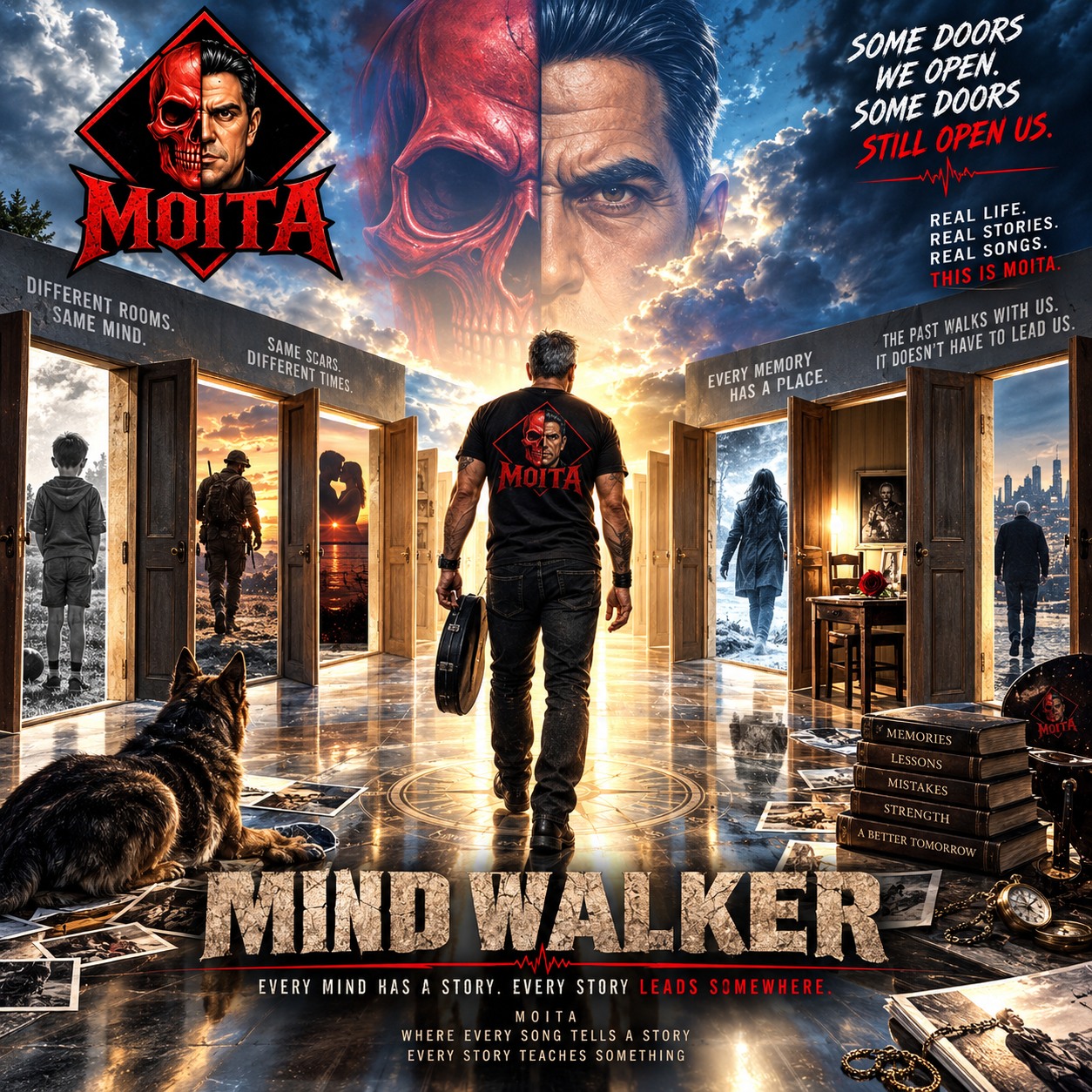
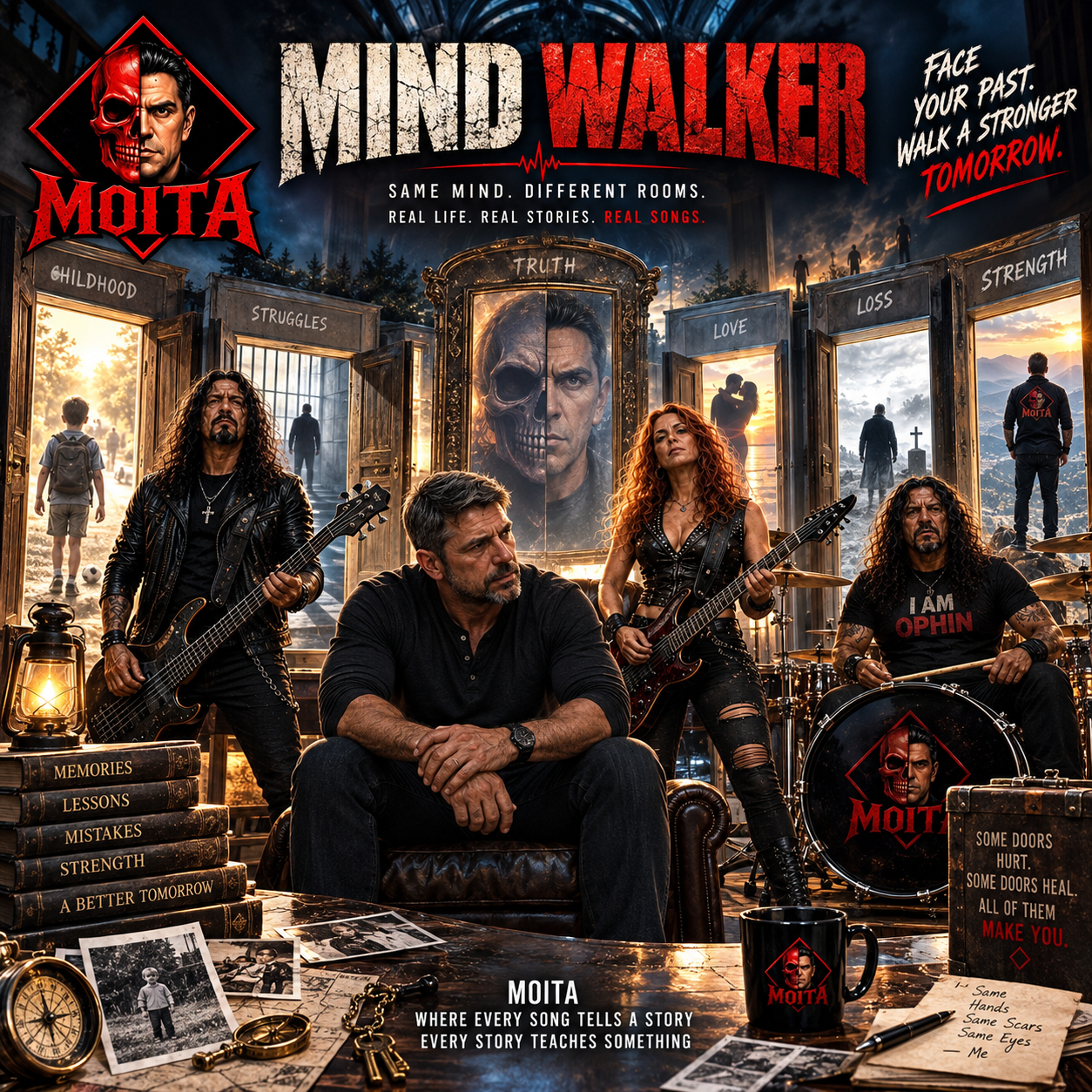
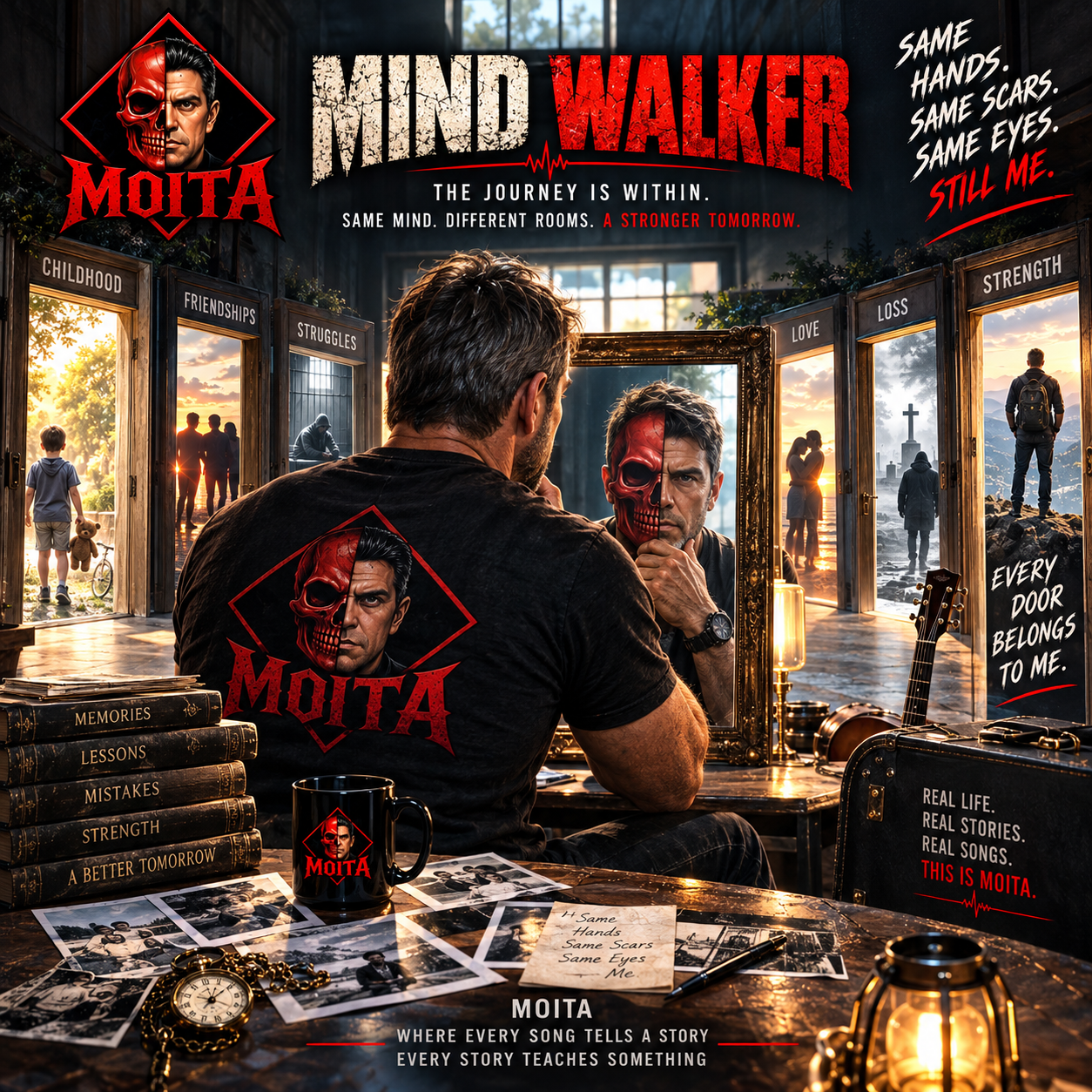
“MIND WALKER” is about walking through the one place none of us can completely escape: our own mind.
I built the song around the idea of the mind being a house, but not a comfortable one. It has hallways, doors, rooms, stairs, walls and places that have been shut for years. Behind those doors are memories. People. Losses. Younger versions of ourselves. Things we would rather forget. Things we thought we had forgotten.
Then something starts walking through that house.
At first, I wanted it to feel like an intruder.
Who is opening these doors?
Who knows where everything is hidden?
Who knows every secret?
Why does this thing seem to know the house better than the person who built it?
That is where the title comes from.
The Mind Walker seems like somebody—or something—moving through the mind without permission.
But the deeper the song goes, the more that idea begins to change.
The person being chased and the thing doing the chasing are connected.
Eventually they come face-to-face.
Same hands.
Same scars.
Same eyes.
The Mind Walker is not a stranger.
He is me.
That changes the entire song.
THE STORY BEHIND THE SONG
I wanted to take something everybody understands—memory—and turn it into a physical place.
We all have memories that can suddenly appear without being invited.
A smell can do it.
A song can do it.
A photograph can do it.
A name can do it.
Sometimes nothing obvious does it. You can be sitting there minding your own business and suddenly your mind has taken you somewhere you haven’t been in twenty or thirty years.
That fascinated me.
What if those memories were actually rooms?
What if every period of your life had its own door?
What if you could physically walk through the place where your memories were stored?
That sounds interesting until you realize something else.
Not every door would be one you wanted to open.
That became the darker side of “MIND WALKER.”
The opening puts me immediately inside that world:
“There’s a hallway behind my eyes
Where every door remembers me”
I like the idea that the doors remember me.
Normally, I would be the one remembering what is behind the door. Here I turned it around. The memory already knows who I am before I open it.
Then the footsteps begin.
At first, I don’t know what they are.
That uncertainty matters because I didn’t want to give away the answer too early. I wanted the listener to experience the same suspicion as the person inside the song.
Something is in here with me.
Something knows me.
And I don’t like how close it’s getting.
The staircase in the second verse takes everything deeper.
Names appear on the walls.
There is a table.
A chair.
An empty glass.
An empty place.
A familiar voice without a face.
I deliberately left those images open enough that people can put some of their own lives inside them. An empty chair can mean very different things depending on who is looking at it.
Then the song starts running.
Not just through a hallway anymore.
Through years.
Through scars.
Through names.
Through losses.
Through the boy I used to be.
And finally there is somebody standing at the last door.
That is the confrontation the entire song has been moving toward.
I don’t need him to give a speech.
He doesn’t need to explain himself.
He turns around.
I recognize him.
And suddenly the monster disappears.
WHY I WROTE THIS SONG
I wrote “MIND WALKER” because I liked the idea of turning an internal struggle into an actual journey.
Instead of simply saying that somebody is remembering their past, I wanted to put them inside it.
Walk the hallway.
Open the doors.
Hear the footsteps.
Go down the staircase.
See the names.
Reach the final room.
Then face whatever has been following you.
There is also something very human underneath the story.
We can spend a lot of time trying not to think about certain things.
That does not necessarily mean they disappear.
Sometimes we lock the door.
Sometimes we build another wall.
Sometimes we keep ourselves so busy that we don’t have time to look backward.
But the mind has an interesting way of carrying things with us.
That is why the bridge becomes so important:
“Maybe I’ve been chasing myself
Maybe I’ve been hiding for years”
Those two possibilities exist at the same time.
Am I chasing something?
Or am I running from it?
The answer is both
WHY THIS MATTERS TO ME
I have lived enough life to have a lot of doors behind me.
Some lead to good places.
Some don’t.
There are people I remember.
People I’ve lost.
Things I’ve done right.
Things I’ve done wrong.
Different versions of myself that existed at different times in my life.
I don’t need to pretend every memory is comfortable just because it belongs to me.
That would defeat the whole purpose of this song.
What matters to me is the change that happens near the end.
The past doesn’t suddenly become perfect.
The scars don’t disappear.
The losses aren’t reversed.
Instead, the man stops running.
That is a very different kind of victory.
WHY THIS SONG FITS MOITA
“MIND WALKER” fits MOITA because it takes a subject people live with every day and approaches it from an unusual direction.
It isn’t simply a song about memories.
It creates a world where memories have architecture.
The mind becomes the setting.
The past becomes the rooms.
Fear becomes the footsteps.
Recognition becomes the final door.
And acceptance changes the meaning of the entire journey.
That is something I want MOITA to keep doing.
Take an idea.
Turn it around.
Look underneath it.
Ask another question.
Then see where that question takes us.
Sometimes a song can entertain you.
Sometimes it can make you think.
The best ones can do both.
READ THIS FIRST
There is one thing worth knowing before reading or listening to “MIND WALKER.”
Don’t assume you know who the Mind Walker is.
The song wants you to believe there is an intruder.
Let it.
Walk through the hallway with that thought.
Hear the footsteps.
Open the doors.
Go down the staircase.
Keep going until you reach the person standing at the final door.
Then look at the opening of the song again.
The hallway hasn’t changed.
The doors haven’t changed.
The memories haven’t changed.
You have.
FULL LYRICS
MIND WALKER
There’s a hallway behind my eyes
Where every door remembers me
Footsteps running through the dark
From places I don’t want to see
I turn the handle, there I am
A younger face, a different time
I shut the door, but hear a knock
From somewhere deeper in my mind
One more step
One more door
I’ve walked this road before
But tonight
Something changed
I’m not walking here alone
MIND WALKER
GET OUT OF MY HEAD
YOU’RE WALKING THROUGH THE ROOMS
WHERE I BURIED MY DEAD
MIND WALKER
I CAN HEAR YOU INSIDE
YOU KNOW EVERY SECRET
AND EVERY PLACE I HIDE
I’M THE KEEPER
I’M THE KEY
THIS MIND BELONGS TO ME
SO TELL ME, MIND WALKER
WHO THE HELL ARE YOU
AND WHY DO YOU WALK LIKE ME?
There’s a staircase going down
I swear it wasn’t there before
Names are written on the walls
Some I haven’t said in years
I see a table, see a chair
An empty glass, an empty place
I hear a voice I used to know
But darkness doesn’t have a face
One more step
One more door
Something’s breathing on the floor
I know this house
I built these walls
So who keeps walking through them all?
MIND WALKER
GET OUT OF MY HEAD
YOU’RE WALKING THROUGH THE ROOMS
WHERE I BURIED MY DEAD
MIND WALKER
I CAN HEAR YOU INSIDE
YOU KNOW EVERY SECRET
AND EVERY PLACE I HIDE
I’M THE KEEPER
I’M THE KEY
THIS MIND BELONGS TO ME
SO TELL ME, MIND WALKER
WHO THE HELL ARE YOU
AND WHY DO YOU WALK LIKE ME?
Now I’m running through the years
Past every scar and every name
Past the boy I used to be
Past every loss that left a stain
The hallway bends, the ceiling shakes
Every light begins to die
Then I see somebody standing
At the final door inside
He doesn’t run
He doesn’t speak
He only turns and looks at me
Same hands
Same scars
Same eyes
Jesus Christ
He’s me
Maybe I’ve been chasing myself
Maybe I’ve been hiding for years
Maybe every locked-up memory
Was never meant to disappear
Maybe the monster in the hallway
Was the truth I wouldn’t see
I wasn’t walking through my mind
MY MIND WAS WALKING THROUGH ME
MIND WALKER
I KNOW WHO YOU ARE
YOU CARRIED EVERY MEMORY
YOU CARRIED EVERY SCAR
MIND WALKER
YOU WERE NEVER INSIDE
YOU WERE THE PART OF ME
I SPENT A LIFETIME TRYING TO HIDE
I’M THE KEEPER
I’M THE KEY
EVERY DOOR BELONGS TO ME
I AM THE HALLWAY
I AM THE MEMORY
I AM THE MAN
I WAS AFRAID TO SEE
MIND WALKER
THE MAN WALKING BACK TO ME
No more footsteps behind me
No more knocking at the door
I turn around
The hallway’s empty
Because I’m not running anymore
SECTION ONE
LYRIC JOURNEY
PART 1
“There’s a hallway behind my eyes
Where every door remembers me”
This is where I want you to enter MIND WALKER with me.
The hallway isn’t somewhere I can physically take you. It exists inside my head, and I wanted the first line to make that clear without simply saying, “I’m thinking about my past.”
That would tell you what is happening, but it wouldn’t let you experience it.
A hallway gives us somewhere to walk.
It also gives us somewhere to get lost.
Put doors along both sides of it and suddenly there are choices everywhere. Open this one. Leave that one alone. Walk past another because you already know what’s behind it.
But the second line changes something.
“Where every door remembers me”
I didn’t write that I remember every door.
The door remembers me.
That’s important because right from the beginning I’m giving the memories some power of their own.
I might decide I haven’t thought about something for twenty years. That doesn’t mean it never happened.
I might decide there are parts of my life I don’t want to visit anymore. That doesn’t erase them either.
The door is still there.
And in the world of this song, it knows exactly who is standing on the other side.
“Footsteps running through the dark
From places I don’t want to see”
Now I’m not alone.
I don’t know that yet for certain, but I can hear something.
Footsteps.
That immediately changes the hallway.
If I’m walking through an empty building and I hear footsteps somewhere behind me, I’m going to wonder who the hell else is in there.
But there is another part of these lines that matters just as much.
“From places I don’t want to see”
I already know there are places in this hallway I don’t want to visit.
That tells you something before you know anything else about me.
I’m not an innocent tourist wandering around my memories.
There are things here I’m avoiding.
Most people probably understand that in their own way.
You can live a long life and collect some beautiful memories. You can also collect things you would rather leave exactly where they are.
You don’t have to hate your entire past to have a few doors you don’t want opened.
“I turn the handle, there I am
A younger face, a different time”
The first door opens.
And there I am.
Not a monster.
Not somebody who hurt me.
Not some great mystery.
Me.
Only younger.
I think most people have had the experience of seeing an old photograph of themselves and staring at it for a little while.
You know that’s you.
But look long enough and it can become strange.
That person had your name.
He had your face.
But he didn’t know everything you know now.
He hadn’t met everybody you would eventually meet.
He hadn’t made all the mistakes you would eventually make.
He hadn’t experienced all the good things either.
He didn’t know which people would stay.
He didn’t know which people would leave.
He didn’t know what life was going to teach him.
I’m sixty-two years old now. If I open a door and see myself at twenty, I’m looking at myself, but I’m also looking at somebody who still has more than forty years ahead of him that I have already lived.
That’s a strange thing when you really think about it.
He doesn’t know me yet.
But I remember him.
“I shut the door, but hear a knock
From somewhere deeper in my mind”
My reaction is simple.
Shut the door.
I don’t stand there having a conversation with the younger me.
I don’t ask him questions.
I close it.
Then comes the knock.
That knock is one of the first signs that I’m not controlling this journey as much as I think I am.
I can shut a physical door.
Memory doesn’t always work that way.
We’ve probably all had something come into our minds that we weren’t trying to remember.
Maybe somebody says a name.
Maybe you hear an old song.
Maybe you drive down a street you haven’t been on for years.
Suddenly something comes back.
You didn’t sit there and order the memory.
It just showed up.
That’s the knock.
And notice where it comes from.
“Somewhere deeper in my mind”
Not behind the door I just closed.
Deeper.
So now I have a decision.
Do I turn around and leave?
Or do I keep walking?
“One more step
One more door
I’ve walked this road before”
I keep going.
One step.
Then another door.
I like keeping these lines short because the movement has changed.
We’re walking now.
I’m not stopping to describe every room.
I’m moving through the place.
“I’ve walked this road before”
That tells you this isn’t my first time looking backward.
I’ve been through parts of this mind before.
I’ve thought about the past before.
I’ve remembered people before.
I’ve questioned things before.
I’ve probably shut some of these same doors before.
But something about tonight is different.
“But tonight
Something changed
I’m not walking here alone”
There it is.
Now I know.
Or at least I believe I know.
Somebody else is here.
That’s where the story begins changing from memory into confrontation.
Up until this point, everything could simply be me walking through my past.
Now there is another presence.
I can hear it.
I can feel it.
And I don’t know who it is.
That uncertainty is important because I don’t want to solve the mystery for you yet.
I’m walking through my own mind, and somehow there is somebody in here with me.
If that doesn’t bother you, you’re a lot calmer than I am.
“MIND WALKER
GET OUT OF MY HEAD”
Now I give it a name.
MIND WALKER.
I still don’t know who it is, so the name describes what I believe it’s doing.
It’s walking through my mind.
And my first reaction isn’t curiosity anymore.
It’s anger.
Get out.
There is something almost territorial about those words.
This is my head.
My memories.
My life.
You don’t belong here.
“YOU’RE WALKING THROUGH THE ROOMS
WHERE I BURIED MY DEAD”
This is where the hallway becomes much heavier.
When I say “buried my dead,” I’m not talking about literally burying people in rooms.
I’m talking about everything that is gone but still has a place inside memory.
People die.
Relationships end.
Friendships disappear.
Periods of our lives finish.
Dreams change.
Homes disappear.
Families change.
And sometimes the person we used to be disappears too.
There are many ways something can become part of our past.
Some of those things we remember happily.
Others we put somewhere and don’t visit very often.
Those are the rooms.
And now this Mind Walker is going into them without asking me.
That is why the anger grows.
“MIND WALKER
I CAN HEAR YOU INSIDE
YOU KNOW EVERY SECRET
AND EVERY PLACE I HIDE”
Now the mystery gets stranger.
This thing doesn’t just know the hallway.
It knows everything.
Every secret.
Every hiding place.
Think about what that means.
How could a stranger know every secret in my own mind?
How could an intruder know where I’ve hidden everything?
At this point, I’m too busy being angry to ask the obvious question.
Maybe it isn’t an intruder.
But I’m not ready for that answer yet.
“I’M THE KEEPER
I’M THE KEY
THIS MIND BELONGS TO ME”
I’m trying to take control back.
I’m the keeper.
I’m the key.
Not only do I own the house, I’m telling myself I control access to it.
I decide which doors open.
I decide which doors remain closed.
I decide who comes in.
That’s what I believe.
But look at what has already happened.
I heard footsteps I didn’t create.
I opened a door and found a younger version of myself.
I closed it and heard knocking somewhere deeper.
Now something is walking through rooms I thought were sealed.
I’m declaring complete control at the exact moment the song is showing me that my control isn’t as complete as I thought.
Then I finally ask the question.
“SO TELL ME, MIND WALKER
WHO THE HELL ARE YOU
AND WHY DO YOU WALK LIKE ME?”
That last line is the first real crack in everything I believe.
Why do you walk like me?
I could have asked why you’re following me.
I could have asked what you want.
I could have asked how you got inside.
Instead, I notice something familiar.
You move like I do.
That’s a clue.
A big one.
But when you’re standing inside the mystery, clues don’t always look as obvious as they do afterward.
I still believe there are two of us.
Me.
And the Mind Walker.
I don’t understand yet that the question I just asked is already pointing me toward the answer.
And before I can understand it, the hallway is about to take me somewhere I haven’t been yet.
Down.
SECTION ONE
LYRIC JOURNEY
PART 2
“There’s a staircase going down
I swear it wasn’t there before”
The hallway has changed.
Until now I’ve been moving forward, opening doors and walking past different parts of my memory.
Now I have to go down.
I wanted the staircase to feel different from the doors because we’re entering another level of the mind. Whether that staircase was always there doesn’t really matter. What matters is that I don’t remember seeing it before.
That’s why I say:
“I swear it wasn’t there before”
Something about this journey is taking me somewhere I haven’t allowed myself to go.
Maybe the staircase was always there.
Maybe I walked past it a hundred times.
Maybe I simply wasn’t ready to see it.
I don’t answer that because I don’t think I need to.
The important thing is that I’m standing at the top of it now.
And the only direction left is down.
“Names are written on the walls
Some I haven’t said in years”
The deeper I go, the more personal everything becomes.
Names.
I could have described photographs hanging on the walls or faces appearing in the darkness, but names interested me more.
A name can be incredibly powerful.
Sometimes one name is enough to bring back an entire period of your life.
You remember the person.
Then you remember where you knew them.
Then something they said.
Maybe how they laughed.
Maybe something you did together.
Maybe something you wish had happened differently.
A name can carry years inside a few letters.
And these aren’t all names I’ve been thinking about lately.
“Some I haven’t said in years”
That matters.
There are people who pass through our lives and then disappear from our daily conversations.
Some because life simply moved in different directions.
Some because relationships ended.
Some because somebody died.
Some because we chose to walk away.
Some because they chose to walk away from us.
The reason doesn’t have to be the same for every name.
The wall can hold all of them.
I don’t tell you which names are written there because those names belong to my hallway.
If you’re walking beside me through the song, you probably have your own wall.
“I see a table, see a chair
An empty glass, an empty place”
This part slows down.
Nothing is chasing me for a moment.
I’m just looking.
A table.
A chair.
An empty glass.
An empty place.
Those are ordinary things.
That’s exactly why I like them.
Sometimes ordinary objects carry more memory than anything dramatic ever could.
A chair can just be a chair until the person who always sat in it isn’t there anymore.
A table can be just a table until you remember who used to sit around it.
An empty glass can mean absolutely nothing to one person and an entire story to somebody else.
I don’t tell you who belongs in that empty place.
I don’t want to.
If I give you a name and explain everything, then it becomes only my empty chair.
Leave it empty and you might put somebody there yourself.
That is one of the things music can do that I find interesting.
I can write the room.
You can bring your own memory into it.
“I hear a voice I used to know
But darkness doesn’t have a face”
Now sound returns.
First it was footsteps.
Then knocking.
Now a voice.
And once again, it’s familiar.
“I used to know”
Those words are different from saying, “I know that voice.”
There is distance in them.
Time has passed.
The voice belongs somewhere behind me.
But I can’t see who is speaking.
“Darkness doesn’t have a face”
That line keeps me from solving anything yet.
I recognize something without being able to identify it completely.
That’s becoming a pattern throughout this hallway.
The younger face was mine.
The Mind Walker walks like me.
The voice is familiar.
The house is mine.
Everything keeps pointing back toward me, but I’m still treating each clue as though it belongs to something else.
“One more step
One more door
Something’s breathing on the floor”
Now the pre-chorus returns, but it doesn’t feel exactly the same.
The first time it was:
“One more step
One more door”
and I was beginning to realize I wasn’t alone.
This time I already know something is here.
Now I can hear breathing.
I wanted that to make the presence feel closer.
Footsteps can be somewhere down a hallway.
A knock can come from behind a door.
Breathing feels close.
Too close.
The mystery isn’t staying behind me anymore.
It’s catching up.
“I know this house
I built these walls”
This is one of those lines where I almost give myself the answer again.
I know the house.
I built the walls.
So let’s think about that for a second.
If this entire place represents my mind, then of course I built it.
Every year added something.
Every experience added something.
Every person.
Every mistake.
Every success.
Every loss.
Every lesson.
Every memory.
Some walls may have gone up because I needed them.
Some doors may have been closed because I wasn’t ready to deal with what was behind them.
Some rooms may have stayed open because I wanted to visit them.
However they got there, this is my house.
“So who keeps walking through them all?”
There is the contradiction.
I built the house.
I know the walls.
I know the doors.
But somehow I still believe the person walking through it must be somebody else.
That tells you how determined I am not to recognize him.
Then the chorus comes back.
“MIND WALKER
GET OUT OF MY HEAD
YOU’RE WALKING THROUGH THE ROOMS
WHERE I BURIED MY DEAD”
The words haven’t changed.
But I have gone deeper since the first time I sang them.
Now I’ve seen names on the walls.
I’ve seen the empty place.
I’ve heard a familiar voice.
I’ve admitted that I built the house.
So when I shout “GET OUT OF MY HEAD” this time, there is more desperation behind it.
The first chorus was a warning.
This one feels more like resistance.
I don’t want this thing going any deeper because I am beginning to see what lives down here.
“MIND WALKER
I CAN HEAR YOU INSIDE
YOU KNOW EVERY SECRET
AND EVERY PLACE I HIDE”
The second time these words arrive, the question becomes harder to ignore.
How does he know?
Not one secret.
Every secret.
Not one hiding place.
Every place I hide.
A stranger shouldn’t know that.
Even somebody who has known me for years wouldn’t necessarily know everything I have never said.
But this thing does.
That should tell me something.
Still, I resist.
“I’M THE KEEPER
I’M THE KEY
THIS MIND BELONGS TO ME”
I repeat the claim.
Mine.
My mind.
My key.
My house.
There is something almost stubborn about it now.
I’m telling the Mind Walker who owns the place, but maybe I’m really trying to convince myself.
Then I ask again:
“SO TELL ME, MIND WALKER
WHO THE HELL ARE YOU
AND WHY DO YOU WALK LIKE ME?”
The question hasn’t changed.
The evidence has.
Now I know he walks like me.
He knows my secrets.
He knows where I hide.
He can move through the house I built.
He can reach rooms I don’t want opened.
Every clue points in one direction.
I still don’t want to look in that direction.
So the song takes away my choice.
“Now I’m running through the years
Past every scar and every name”
Walking is over.
Now I’m running.
And I’m not simply running through a hallway anymore.
I’m running through years.
That is where the physical house and my life begin becoming the same thing.
The names I saw written on the walls are now flying past me.
So are the scars.
I chose scars because scars tell us that something happened and time passed afterward.
A scar isn’t the original moment.
It is what remains.
Some scars are on the body.
Some aren’t.
Either way, they can become evidence of where we’ve been.
And now I’m running past all of them.
“Past the boy I used to be
Past every loss that left a stain”
There he is again.
The younger me.
At the beginning, I opened a door and saw a younger face.
Now I’m running past the boy I used to be.
The song is starting to bring its own pieces back together.
That younger face wasn’t just an image behind one random door.
He belongs to this journey.
He is part of the person I am trying to understand.
Then come the losses.
“Every loss that left a stain”
I didn’t say every loss destroyed me.
I didn’t say every loss never healed.
I said it left a stain.
Something remained.
That distinction matters to me.
We can survive something and still remember it.
We can move forward and still carry evidence.
We can laugh again after grief.
We can love again after heartbreak.
We can rebuild after losing something.
Moving forward doesn’t require pretending nothing happened.
“The hallway bends, the ceiling shakes
Every light begins to die”
Now the house itself starts changing.
The hallway that gave me somewhere to walk is bending.
The ceiling is shaking.
The lights are going out.
Everything that gave me a sense of direction is disappearing.
I wanted this moment to feel like the mind can no longer maintain the walls I’ve been depending on.
The closer I get to the truth, the less protection the house gives me.
And in the darkness, finally, I see him.
“Then I see somebody standing
At the final door inside”
Not another staircase.
Not another hallway.
The final door.
That word matters.
Final.
The chase cannot continue forever.
I’ve reached the end of the place I’ve been running through.
Somebody is standing there.
And this time there is nowhere else for either one of us to go.
SECTION ONE
LYRIC JOURNEY
PART 3
“He doesn’t run
He doesn’t speak
He only turns and looks at me”
After all that movement, everything stops.
I have been walking through hallways, opening doors, going down stairs and finally running through years.
Now the person I’ve been trying to identify is standing directly in front of me.
And he does nothing.
He doesn’t attack me.
He doesn’t run toward me.
He doesn’t try to escape.
He doesn’t explain himself.
He simply turns around.
I wanted that silence because anything he said would take away from what happens next.
There isn’t anything he needs to tell me.
I only need to look at him.
“Same hands
Same scars
Same eyes”
This is where recognition happens.
Not all at once.
Piece by piece.
First the hands.
Same hands.
Then the scars.
Same scars.
Then the eyes.
Same eyes.
The scars are especially important because they connect us through more than appearance.
If he carries the same scars, then he didn’t just somehow end up with my face.
He has been through what I’ve been through.
He carries evidence from the same life.
Then I reach the eyes.
There are some things you can argue with yourself about.
This isn’t one of them.
I know those eyes.
“Jesus Christ
He’s me”
That’s all I wanted there.
I could have written a whole verse explaining the discovery.
It would have ruined it.
After spending the entire song asking who the hell the Mind Walker is, the answer needs to hit quickly.
He’s me.
Now think about everything that came before this moment.
The younger face behind the first door was me.
The Mind Walker walked like me.
He knew every secret.
He knew every place I hide.
He could walk through the house I built.
He could reach every room.
He carried the same scars.
The clues were there almost from the beginning.
I just wasn’t ready to put them together.
That’s important to the song because sometimes an answer can be right in front of us and we still avoid it.
Not because we’re stupid.
Sometimes because accepting the answer means accepting something else with it.
If the Mind Walker is me, then I can’t keep treating him like an intruder.
I have to reconsider the whole journey.
“Maybe I’ve been chasing myself
Maybe I’ve been hiding for years”
Notice the first word.
Maybe.
For most of the song I’ve been speaking with certainty.
Get out of my head.
This mind belongs to me.
Who the hell are you?
Now that certainty is gone.
I finally start questioning myself instead of questioning him.
Maybe I’ve been chasing myself.
Then the next line turns it around.
Maybe I’ve been hiding for years.
Those two things sound like opposites, but inside this song they can both be true.
One part of me has been searching.
Another part has been avoiding.
I can spend years trying to understand why certain things affect me while also refusing to look at the experiences that might help explain them.
I can ask questions while being afraid of the answers.
I can look backward and still skip the parts I don’t want to see.
That is the chase.
The strange thing is that both people in the chase are me.
“Maybe every locked-up memory
Was never meant to disappear”
This is where I have to be careful about what I’m actually saying.
I’m not saying everybody should force themselves to dig through every painful experience they’ve ever had.
I’m not saying every memory needs to be opened every day.
And I’m definitely not saying we should spend our lives living backward.
I’m saying that locking something away and making it disappear are not the same thing.
The song has shown that from the beginning.
I shut the first door.
The knock came from somewhere deeper.
I went down the staircase.
The names were still on the wall.
The empty place was still empty.
The familiar voice was still there.
Closing a door didn’t rewrite history.
Maybe that wasn’t what the door was for.
Maybe a closed door sometimes means this happened, it belongs to my story, but I don’t need to live inside that room anymore.
That’s very different from pretending the room never existed.
“Maybe the monster in the hallway
Was the truth I wouldn’t see”
For most of the song I needed a monster.
Something else had to be responsible for those footsteps.
Something else was opening the doors.
Something else was walking through my memories.
Something else was frightening me.
Then the figure turns around and has my hands, my scars and my eyes.
The monster disappears because there never was one.
What frightened me was recognition.
The truth I wouldn’t see wasn’t necessarily one particular terrible memory.
It was bigger than that.
All those rooms belong to the same life.
Mine.
The good rooms.
The bad rooms.
The stupid decisions.
The victories.
The losses.
The people I loved.
The people who hurt me.
The people I may have hurt.
The younger versions of myself.
The man standing here now.
They’re all somewhere in the same house.
That doesn’t mean I approve of everything behind every door.
Acceptance and approval aren’t the same thing.
I can admit something happened without saying it was right.
I can admit I made a mistake without deciding that mistake defines the rest of my life.
I can remember somebody without wanting them back in my life.
I can miss somebody who died without pretending they are still physically here.
I can look at the boy I used to be without wanting to become him again.
The truth is simply that these things belong somewhere in my history.
“I wasn’t walking through my mind
MY MIND WAS WALKING THROUGH ME”
This is the line where the whole idea turns inside out.
From the opening lyric, I believed I was the one travelling.
I entered the hallway.
I opened the doors.
I went down the staircase.
I ran through the years.
I reached the final door.
So I thought I was walking through my mind.
But now I understand it differently.
My mind has been travelling through my life with me.
Every experience added something.
Every loss added something.
Every lesson added something.
Every person left something, even if all they left was a memory.
The past doesn’t physically walk through us. This is still a metaphor.
But what we’ve lived can affect the person we become.
It can affect what we recognize.
What we fear.
What makes us laugh.
What makes us angry.
What we’re careful about.
What we value.
What we refuse to tolerate.
What we forgive.
What we remember.
What we try to forget.
That’s why I wanted the line to be:
“MY MIND WAS WALKING THROUGH ME”
The Mind Walker isn’t just a man wandering around inside my head.
He’s the history I’ve been carrying while that history has also been shaping the man carrying it.
Now the chorus returns for the final time.
But this time I cannot sing the old chorus.
I can’t say:
“GET OUT OF MY HEAD”
I know who he is now.
So the first words have to change.
“MIND WALKER
I KNOW WHO YOU ARE”
That is the difference between the first chorus and the final one.
At the beginning, the title was almost an accusation.
MIND WALKER.
Who are you?
Get out.
Now I say the same name with recognition.
I know who you are.
Nothing about the past has changed between those two choruses.
The rooms are still there.
The names are still there.
The empty chair is still empty.
The scars are still scars.
What changed is my understanding.
“YOU CARRIED EVERY MEMORY
YOU CARRIED EVERY SCAR”
Earlier I was angry because the Mind Walker knew everything.
Now I understand why.
Of course he knows.
He carried it too.
Those aren’t my memories and his memories.
They’re ours because there was never really an “ours.”
There was only me.
The man running.
The man following.
The younger face.
The boy I used to be.
The man at the final door.
Different versions.
One life.
“MIND WALKER
YOU WERE NEVER INSIDE
YOU WERE THE PART OF ME
I SPENT A LIFETIME TRYING TO HIDE”
This is where the separation finally breaks.
“You were never inside” doesn’t mean the journey wasn’t taking place in my mind.
It means the Mind Walker was never a separate thing living inside me.
He wasn’t an invader.
He wasn’t a creature.
He wasn’t another person who somehow got into my head.
He was part of me.
And the hardest part of that admission is the last line:
“I SPENT A LIFETIME TRYING TO HIDE”
Not five minutes.
Not one bad night.
A lifetime.
That doesn’t mean I’ve spent every waking second running from my past.
It means there are things human beings can become very good at putting away.
We work.
We build.
We create.
We raise families.
We make money.
We lose money.
We travel.
We laugh.
We argue.
We survive.
Life keeps moving.
And somewhere along the way, we can convince ourselves that because we’re moving forward, everything behind us has disappeared.
Then one day a door opens.
A name appears.
A voice returns.
And we realize the hallway has been there the whole time.
Now I have a choice.
I can start running again.
Or I can finally take the key I’ve been claiming was mine from the beginning and understand what it actually opens.
SECTION ONE
LYRIC JOURNEY
PART 4
“I’M THE KEEPER
I’M THE KEY
EVERY DOOR BELONGS TO ME”
These words sound familiar because part of them is familiar.
Earlier I said:
“I’M THE KEEPER
I’M THE KEY
THIS MIND BELONGS TO ME”
Back then I was defending myself.
I thought somebody had entered my mind without permission, so I was almost shouting my ownership at him.
This is mine.
Get out.
Now I say:
“EVERY DOOR BELONGS TO ME”
That changes the meaning.
I’m no longer trying to keep somebody else out.
I’m accepting what belongs to me.
Every door.
Not only the good ones.
Not only the memories that make me smile.
Not only the moments I’m proud of.
Every door means the ones I shut too.
The younger face behind the first door belongs to me.
The names on the walls belong somewhere in my history.
The empty chair belongs there.
The scars belong there.
The losses belong there.
Even the things I would do differently today still belong somewhere in the story of how I got here.
That doesn’t mean I have to open every door every morning.
It doesn’t mean I have to live inside those rooms.
It doesn’t mean the worst thing that ever happened to me gets to become the most important thing about me.
It simply means I don’t have to pretend somebody else owns that part of the house.
There is a difference between carrying your history and allowing your history to carry you wherever it wants.
At the beginning of MIND WALKER, I didn’t understand that difference.
Now I do.
“I AM THE HALLWAY
I AM THE MEMORY”
At the beginning, the hallway felt like somewhere I had entered.
Now I understand that I didn’t enter some foreign place.
The hallway exists because I exist.
Every year added distance to it.
Every experience added something behind one of those doors.
Every person who became part of my life left something.
Some stayed.
Some didn’t.
Some memories remained clear.
Others faded.
Some doors probably haven’t been touched in decades.
But all of them together make the hallway possible.
That’s why the line isn’t:
I own the hallway.
It’s:
“I AM THE HALLWAY”
That goes further.
The house is no longer something separate from me.
Neither is the memory.
“I AM THE MEMORY”
That doesn’t mean I’m only my past.
I don’t believe that.
If we were only our past, nobody could change.
Nobody could learn.
Nobody could rebuild.
Nobody could decide tomorrow will be different from yesterday.
The past is part of us.
It isn’t the only part.
That distinction matters.
I can recognize where I’ve been without deciding that’s the only place I’m allowed to go.
“I AM THE MAN
I WAS AFRAID TO SEE”
This is the real confrontation.
Not with the Mind Walker.
With myself.
There are many reasons somebody might be afraid to look at themselves honestly.
Maybe they don’t like something they did.
Maybe they don’t like something that happened to them.
Maybe they don’t recognize the person they used to be.
Maybe they’re carrying guilt.
Maybe anger.
Maybe grief.
Maybe they’re simply afraid that looking backward will hurt too much.
Everybody’s reason can be different.
For me, the line has to remain broad enough to carry the entire hallway.
I am the man I was afraid to see.
Not because every part of that man is terrible.
Because seeing him means seeing all of him.
You don’t get to keep only the victories and throw away every failure.
You don’t get to keep the laughter and pretend the grief never happened.
You don’t get to keep the man while denying the boy.
A life isn’t assembled that neatly.
We’re complicated.
Sometimes we’re contradictory.
Sometimes we make good decisions for bad reasons.
Sometimes bad decisions teach us something valuable.
Sometimes we think we understand an event while we’re living through it, then twenty years later we see it completely differently.
That’s part of why the hallway matters.
The person standing at one end of it isn’t the same age as the person who first created some of those memories.
Time has happened between them.
So has life.
“MIND WALKER
THE MAN WALKING BACK TO ME”
I like the word “back” here.
If I had written:
The man walking toward me
it would mean something different.
Toward me could still be a stranger approaching.
Back to me suggests he belongs.
Something separated us.
Now that separation is ending.
For most of the song, I believed the Mind Walker was following me.
Then I thought I was chasing him.
Now neither one is true.
He’s coming back.
And I’m finally standing still long enough to let him.
That is why I don’t destroy him at the end of the song.
There is no fight.
There is no final battle.
I don’t throw him through a door.
I don’t kill the monster.
I don’t burn down the house.
What would I actually be destroying?
Myself.
That would miss the entire point.
The victory in MIND WALKER isn’t defeating the man at the final door.
It’s recognizing him.
Then the song becomes quiet.
“No more footsteps behind me”
Those footsteps have followed us from the beginning.
They were one of the first signs that something was wrong.
“Footsteps running through the dark”
At first, they created fear because I didn’t know who was making them.
Now they’re gone.
Why?
Because nobody is following me anymore.
The man who was behind me is no longer somebody separate.
“No more knocking at the door”
That takes us back almost to the beginning too.
“I shut the door, but hear a knock”
That first knock told me I couldn’t simply close one door and end the journey.
Something deeper was calling me forward.
Now the knocking has stopped.
There is nothing left demanding to be recognized.
The final door has already opened.
I’ve already seen the face.
I’ve already seen the hands.
I’ve already seen the scars.
I’ve already seen the eyes.
There is no mystery left standing outside.
“I turn around”
That is one of the shortest lines in the song.
It may also be one of the most important.
For the entire journey, I’ve been moving away from something.
Walking.
Descending.
Running.
Even when I believed I was chasing the Mind Walker, I was still moving through the house instead of simply stopping and facing what was there.
Now I do something completely different.
I turn around.
Sometimes a very small physical action can carry the whole meaning of a song.
That’s what this one does for me.
I stop running long enough to look behind me.
“The hallway’s empty”
At the beginning, an empty hallway would have frightened me.
If I heard footsteps but couldn’t see anybody, the emptiness would make the mystery worse.
Now the same emptiness means peace.
Nothing is coming.
Nothing is hiding.
Nothing is chasing me.
Nothing needs to.
The hallway didn’t disappear.
The doors didn’t disappear.
The memories didn’t disappear.
The past wasn’t rewritten.
The hallway is simply empty.
And then we reach the last line.
“Because I’m not running anymore”
That’s where I wanted to leave MIND WALKER.
Not with some claim that everything in life can be fixed.
Not with the idea that every painful memory disappears once you face it.
Not with some perfect ending where the past suddenly becomes beautiful.
Life doesn’t work like that.
Some things can’t be changed.
Some people don’t come back.
Some decisions can’t be undone.
Some losses remain losses.
Some scars remain scars.
But running from something and carrying it are not the same thing.
The man at the beginning of this song hears footsteps and immediately believes something is after him.
The man at the end turns around.
That is the journey.
He hasn’t erased the hallway.
He has changed his relationship with it.
The first time through MIND WALKER, maybe you’re listening for the mystery.
Who is walking through those rooms?
Who is knocking?
Whose voice is in the darkness?
Who is standing at the final door?
The second time through, you already know.
Now the opening feels different.
You hear:
“Where every door remembers me”
and you know why.
You see the younger face and understand that the answer has already appeared.
You hear:
“Why do you walk like me?”
and realize how close I am to discovering the truth.
You hear me shouting:
“THIS MIND BELONGS TO ME”
and know that I’m arguing with a part of myself.
Then you reach the final door again.
Same hands.
Same scars.
Same eyes.
He’s me.
Maybe that’s when MIND WALKER deserves another listen.
Not because the ending changed.
Because now you know who has been walking beside you from the very first line.
SECTION TWO
THE STORY
MIND WALKER started with an idea I found interesting: what if the inside of a person’s mind was an actual place you could walk through?
Not just thoughts floating around.
An actual place.
Hallways.
Doors.
Staircases.
Rooms.
Places you recognize immediately and others you haven’t visited for years.
Once I had that idea, the story started becoming darker because I thought about what those rooms would actually contain.
If I could physically walk through my own mind, would I really want to open every door?
Probably not.
I’ve lived long enough to know there would be some good rooms in there. There would be people I love, funny moments, accomplishments, mistakes I can laugh about now, places I’ve travelled, things I’ve built, songs I’ve written and moments I would happily experience again.
But there would be other doors too.
Loss.
Pain.
Regret.
People who aren’t here anymore.
Things I wish had happened differently.
Versions of myself I wouldn’t necessarily recognize today.
That became the real foundation of the song.
THE HALLWAY BEHIND MY EYES
The first line establishes the entire world:
“There’s a hallway behind my eyes”
Once I wrote the mind as a physical place, I could walk through it instead of simply talking about memories.
The next line took the idea somewhere I liked even more:
“Where every door remembers me”
Normally, we remember what is behind a door.
I reversed it.
The door remembers me.
That makes the mind feel alive.
Before I touch the handle, whatever is behind that door already knows who has arrived.
There is something unsettling about that.
You can pretend you’ve forgotten a memory.
The memory hasn’t necessarily forgotten you.
That doesn’t mean memories are literally alive or hiding somewhere waiting for us. This is the language of the song. I’m turning something invisible into something the listener can see.
Then I introduce the footsteps.
Now the story has changed.
I’m not simply exploring anymore.
Something else is here.
THE FIRST DOOR
“I turn the handle, there I am
A younger face, a different time”
I didn’t want the first door to reveal a monster.
I wanted it to reveal me.
That is an important clue, although at this point in the song I don’t completely explain what it means.
Behind the door is an earlier version of myself.
That happens in real life in a different way.
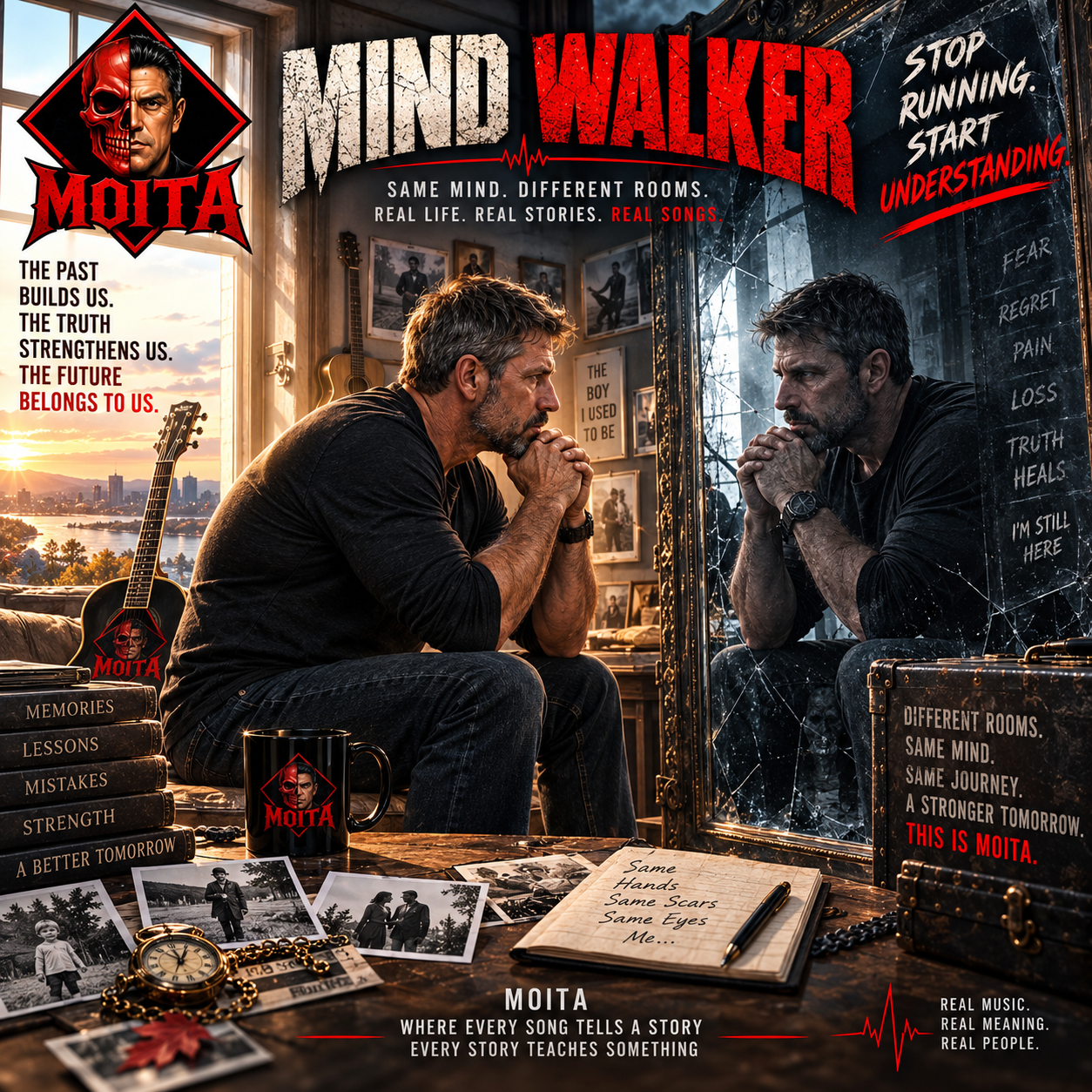
Look at an old photograph of yourself and you know it’s you, but sometimes that person almost feels like somebody else.
You remember what he looked like.
You may remember where he lived.
You may remember what mattered to him.
But you’re looking at him through all the years that happened afterward.
He doesn’t know what you know.
He hasn’t experienced what you have experienced.
He hasn’t collected your scars yet.
That younger face is you.
But he isn’t the complete person you are today.
So I shut the door.
Then comes the knock.
That is where the mind refuses to cooperate.
I may be finished with the memory.
The memory isn’t necessarily finished with me.
WHO IS WALKING WITH ME?
The first pre-chorus is where the suspicion really begins.
“One more step
One more door
I’ve walked this road before”
I’ve been here.
That’s important.
This isn’t some completely foreign place. The narrator recognizes it.
But then:
“But tonight
Something changed
I’m not walking here alone”
That’s where MIND WALKER becomes more than a walk through memories.
Now there is a presence.
The chorus treats that presence like an intruder.
“GET OUT OF MY HEAD”
That’s a natural reaction when something enters your thoughts that you don’t want there.
We use expressions like that all the time.
I can’t get it out of my head.
I can’t stop thinking about it.
That memory came back.
That person has been on my mind.
MIND WALKER takes those ordinary experiences and gives them legs.
Now something is literally walking through the rooms.
THE ROOMS WHERE I BURIED MY DEAD
That is one of the heavier lines in the song:
“YOU’RE WALKING THROUGH THE ROOMS
WHERE I BURIED MY DEAD”
I don’t mean somebody has literally been buried inside a room.
The dead are the people, relationships, moments, losses and parts of life that exist now only through memory.
When somebody dies, life continues.
But memories of them don’t simply disappear because the person is gone.
The same can happen with other kinds of loss.
A relationship ends.
A friendship disappears.
A period of your life closes.
A dream dies.
A version of yourself no longer exists.
We carry a surprising number of things that are over.
Some we visit willingly.
Others we put behind a door.
That is the kind of burial I am talking about.
I’M THE KEEPER. I’M THE KEY.
At this point, I still believe I’m in control.
“I’M THE KEEPER
I’M THE KEY
THIS MIND BELONGS TO ME”
There is almost a challenge in those lines.
This is my house.
These are my rooms.
These are my memories.
Who gave you permission to walk through them?
But then I ask the question that quietly gives away more than I realize:
“WHY DO YOU WALK LIKE ME?”
That’s the crack in the wall.
If this thing is an intruder, why is it familiar?
Why does it move like me?
Why does it know every room?
Why does it know every secret?
Maybe I’ve asked the wrong question.
THE STAIRCASE
Verse Two goes downward.
“There’s a staircase going down
I swear it wasn’t there before”
I wanted the second part of the journey to feel deeper than the first.
The hallway is memory.
The staircase is descent.
We’re moving toward things that are harder to reach.
That is why the names appear.
“Names are written on the walls
Some I haven’t said in years”
I like that image because almost everybody has names like that.
Somebody you knew when you were young.
Somebody you haven’t seen for decades.
Somebody you lost.
Somebody you don’t speak to anymore.
Somebody whose name you deliberately stopped saying.
Then one day, for whatever reason, that name comes back.
Suddenly the wall has writing on it again.
THE EMPTY PLACE
“I see a table, see a chair
An empty glass, an empty place”
I deliberately didn’t tell the listener whose place it is.
I don’t think I need to.
That empty place can belong to whoever the listener puts there.
For one person, it might represent somebody who died.
For another, somebody who left.
For somebody else, it might represent their own younger life.
Sometimes leaving space unexplained allows a lyric to become more personal to the person hearing it.
Then I hear the voice:
“I hear a voice I used to know
But darkness doesn’t have a face”
Again, recognition without complete visibility.
I know something about this place.
I know that voice.
But I still haven’t faced what is actually happening.
THE HOUSE I BUILT
The second pre-chorus becomes more aggressive:
“I know this house
I built these walls
So who keeps walking through them all?”
That question is almost ridiculous once you know the ending.
If I built the house, and the person walking through it knows everything I know, maybe I should start considering the possibility that he belongs there too.
But when we’re frightened, we don’t always begin with the most logical answer.
Sometimes we begin with defence.
Get out.
Stay away.
Leave that door closed.
Don’t go in there.
The song needs that resistance because without it, the final recognition wouldn’t mean very much.
RUNNING THROUGH THE YEARS
By Verse Three, walking isn’t enough anymore.
“Now I’m running through the years”
That changes the speed of the entire story.
I’m no longer opening one memory at a time.
Everything is coming.
Scars.
Names.
Childhood.
Loss.
The years start collapsing into each other.
“Past the boy I used to be
Past every loss that left a stain”
That boy matters.
He’s another version of the person standing in the hallway.
The Mind Walker isn’t just the man I am today.
He carries every version that came before him.
Then the building itself begins reacting.
The hallway bends.
The ceiling shakes.
The lights begin dying.
And there is nowhere left to go except the final door.
THE MAN AT THE FINAL DOOR
I wanted this moment to be simple.
No long explanation.
No complicated conversation.
“He doesn’t run
He doesn’t speak
He only turns and looks at me”
Then recognition happens piece by piece.
“Same hands
Same scars
Same eyes”
That’s enough.
And then:
“Jesus Christ
He’s me”
That’s the moment the whole song turns around.
The intruder was never an intruder.
The person I thought was following me belongs in this house because he is part of the person who built it.
The frightening part isn’t discovering a stranger.
It’s recognizing myself.
THE MONSTER CHANGES
The bridge asks the questions I couldn’t ask earlier:
“Maybe I’ve been chasing myself
Maybe I’ve been hiding for years”
Those two lines are the heart of the confrontation.
You can spend years chasing answers while simultaneously avoiding the answer you don’t want.
Then comes another possibility:
“Maybe every locked-up memory
Was never meant to disappear”
Locking something away and erasing it are not the same thing.
That distinction matters.
There are experiences we move beyond without forgetting.
There are losses we learn to live with without pretending they never happened.
There are mistakes we can accept without approving of them.
There are earlier versions of ourselves we don’t have to become again in order to acknowledge that they existed.
Then the monster gets identified:
“Maybe the monster in the hallway
Was the truth I wouldn’t see”
The fear wasn’t necessarily what happened in the past.
Part of the fear was facing the fact that all of it belongs to my story.
THE LINE THAT TURNS THE SONG INSIDE OUT
“I wasn’t walking through my mind
MY MIND WAS WALKING THROUGH ME”
For me, that’s where the title finally earns its meaning.
The entire time I believed I was the explorer.
I thought I was travelling through memories.
But memories travel through us too.
They affect what we fear.
What we love.
What we avoid.
What we recognize.
How we react.
What we carry forward.
The past isn’t physically walking around inside us. I’m not making a medical claim about how memory works.
I’m describing the human experience of discovering that what happened before can still influence who is standing here now.
THE FINAL CHORUS
The words change because the relationship has changed.
At first:
“GET OUT OF MY HEAD”
Now:
“I KNOW WHO YOU ARE”
That’s the difference between fear and recognition.
The Mind Walker carried every memory and every scar.
He wasn’t something hiding inside me.
He was the part of myself I had spent a lifetime trying not to face.
Then the earlier declaration returns:
“I’M THE KEEPER
I’M THE KEY”
But now it means something different.
Earlier, it was territorial.
Stay out of my house.
Now it is acceptance.
“EVERY DOOR BELONGS TO ME”
That includes the doors I like.
And the ones I don’t.
I don’t have to live behind every door.
I don’t have to keep opening every door.
But I can acknowledge that they’re part of the house.
THE MAN WALKING BACK TO ME
The ending could have been about defeating the Mind Walker.
I didn’t want that.
Destroying him would defeat the meaning of the song.
So instead:
“I AM THE HALLWAY
I AM THE MEMORY
I AM THE MAN
I WAS AFRAID TO SEE”
The thing I was trying to escape wasn’t defeated.
It was recognized.
That is why the final description becomes:
“THE MAN WALKING BACK TO ME”
Not toward me.
Back to me.
There is a difference.
He belongs here.
THE EMPTY HALLWAY
The outro becomes quiet again.
“No more footsteps behind me
No more knocking at the door”
Why?
Because there is nobody left to chase me.
I turn around.
The hallway is empty.
Not because the memories disappeared.
Not because the past was erased.
Not because every difficult thing was magically fixed.
The hallway is empty because I finally understand who was walking through it.
And the final line says everything I need the ending to say:
“Because I’m not running anymore”
SECTION THREE
LYRIC EXPLORATION
MIND WALKER begins inside a place that does not physically exist, but I wanted it to feel real enough that you could almost walk into it.
“There’s a hallway behind my eyes
Where every door remembers me”
Those two lines establish the rules immediately.
We are inside the mind.
But instead of explaining memory scientifically or psychologically, I give it architecture. Memories become rooms. The years become doors. The mind becomes a building large enough to walk through.
The unusual part is that I don’t say I remember what is behind the doors.
The doors remember me.
That reversal gives the memories a presence of their own.
It also raises the first uncomfortable question.
If I stopped visiting a memory years ago, does that mean it stopped being part of me?
The song doesn’t answer that immediately.
Instead, I hear footsteps.
“Footsteps running through the dark
From places I don’t want to see”
Already there is avoidance.
I haven’t even opened the first door, and I’ve admitted there are places in my own mind I don’t want to visit.
That is where the real journey begins.
THE YOUNGER FACE
“I turn the handle, there I am
A younger face, a different time”
The first person I meet is myself.
Not the man standing in the present.
A younger version.
That creates a strange situation because we can recognize our younger selves while also feeling separated from them.
The face belongs to me.
The life belongs to me.
But time has put distance between us.
Then I do something important.
“I shut the door”
I don’t stay.
I don’t investigate.
I don’t ask the younger version of myself anything.
I close the door.
But immediately:
“but hear a knock
From somewhere deeper in my mind”
That knock tells me closing the door hasn’t ended anything.
I can control the handle.
I cannot completely control what comes back into my thoughts.
ONE MORE STEP
The first pre-chorus moves cautiously.
“One more step
One more door”
The repetition makes the journey feel almost methodical.
Keep moving.
Keep opening.
Keep going.
Then:
“I’ve walked this road before”
That line tells us this isn’t the first encounter with the past.
I’ve been through parts of this hallway before.
Maybe everybody has.
We revisit old memories throughout our lives, but we don’t necessarily understand them the same way each time.
Something that meant one thing at twenty can look very different at sixty.
Experience changes the person looking backward.
Then the atmosphere shifts:
“But tonight
Something changed
I’m not walking here alone”
Now memory becomes mystery.
The song gives the unknown presence a name.
MIND WALKER.
“GET OUT OF MY HEAD”
The first chorus isn’t welcoming.
It’s confrontation.
“MIND WALKER
GET OUT OF MY HEAD”
At this point I treat the Mind Walker as something separate from me.
That distinction is essential because the song depends on it.
There is me.
And there is you.
“You’re walking through the rooms”
“You know every secret”
“Every place I hide”
I have divided myself into two sides without realizing it.
The conscious voice claims ownership.
“I’M THE KEEPER
I’M THE KEY
THIS MIND BELONGS TO ME”
There is confidence in that statement, but there is also fear underneath it.
If I’m really in complete control, why am I shouting at something to leave?
That contradiction is intentional.
The narrator is declaring control at exactly the moment he is beginning to realize he may not understand what is happening.
WHERE I BURIED MY DEAD
“YOU’RE WALKING THROUGH THE ROOMS
WHERE I BURIED MY DEAD”
This is one of the darkest images in the song, but it isn’t meant literally.
The mind is not a cemetery.
The rooms represent what has ended but remains remembered.
People.
Relationships.
Periods of life.
Dreams.
Earlier versions of ourselves.
Loss comes in many forms.
Death is obviously one of the deepest, but human beings also grieve things that never had a funeral.
A marriage can end.
A friendship can disappear.
A home can be lost.
A career can finish.
Children grow up.
Parents age.
A younger version of ourselves disappears simply because time keeps moving.
Those things can remain somewhere in memory even after that part of life is over.
The song calls those places rooms.
THE QUESTION THAT ALMOST SOLVES THE MYSTERY
“So tell me, Mind Walker
Who the hell are you
And why do you walk like me?”
The last line is the important one.
Why do you walk like me?
I could have asked why he knows me.
I could have asked why he’s following me.
Instead, I notice something physical and familiar.
His movement resembles mine.
The answer is already standing in front of me.
I just don’t understand it yet.
THE STAIRCASE THAT WASN’T THERE
Verse Two changes direction.
“There’s a staircase going down
I swear it wasn’t there before”
Until now, I’ve been travelling horizontally through a hallway.
Now the journey descends.
That gives the impression that we’re entering something deeper.
It also introduces uncertainty.
Was the staircase always there and I never noticed it?
Did I avoid it?
Did my mind create it?
The song doesn’t need to answer that literally.
Its purpose is to make the journey feel less controlled.
The deeper I go, the less familiar my own house becomes.
NAMES ON THE WALL
“Names are written on the walls
Some I haven’t said in years”
Names are powerful because a name can unlock an entire person in memory.
Sometimes hearing one name brings back a face.
Then a place.
Then a conversation.
Then an entire period of life.
The lyric doesn’t tell you whose names are on the wall.
That is deliberate.
I have my names.
You have yours.
The song becomes stronger if I don’t steal that space from the listener.
THE TABLE, THE CHAIR AND THE EMPTY GLASS
“I see a table, see a chair
An empty glass, an empty place”
Nothing dramatic happens here.
Nobody jumps out.
Nothing attacks me.
It is simply empty.
Sometimes absence can carry more weight than action.
An empty place tells us somebody or something should be there.
But I don’t explain who.
Then:
“I hear a voice I used to know
But darkness doesn’t have a face”
Recognition continues without complete understanding.
I know the voice.
I cannot see the person.
That keeps the song balanced between memory and fear.
The familiar keeps appearing inside the unfamiliar.
THE HOUSE AND THE WALLS
“I know this house
I built these walls”
This is another major clue.
The narrator finally admits authorship.
This isn’t somebody else’s house.
I built it.
The walls belong to me.
The rooms belong to me.
The doors belong to me.
So the next question becomes more important:
“So who keeps walking through them all?”
By now, the listener may already suspect the answer.
The narrator still resists it.
That resistance allows the second chorus to return with the same accusation:
“GET OUT OF MY HEAD”
Nothing has been resolved yet.
The Mind Walker still feels like an invader.
But after the second chorus, there is nowhere left for the song to go except toward the truth.
RUNNING THROUGH THE YEARS
“Now I’m running through the years
Past every scar and every name”
The pace changes.
Earlier I was taking one step and opening one door.
Now everything is moving.
Years become something I can physically run past.
Scars and names appear together because both can carry history.
Some scars are visible.
Others aren’t.
Some names bring happiness.
Others bring pain.
The lyric doesn’t separate them into neat categories because memory doesn’t always arrive neatly.
Then I pass:
“the boy I used to be”
That boy connects directly back to the younger face behind the first door.
The song is beginning to circle back on itself.
The pieces that seemed separate are becoming connected.
“Past every loss that left a stain”
A stain is different from an open wound.
That matters.
The line isn’t saying every loss is happening again right now.
It’s saying some losses leave evidence behind.
Life continued.
But something remained.
THE HOUSE STARTS BREAKING APART
“The hallway bends, the ceiling shakes
Every light begins to die”
The mind-house that seemed solid at the beginning is no longer stable.
I wanted the environment to react as the truth gets closer.
The familiar structure is collapsing.
The lights disappear.
There is less room to hide.
Then:
“Then I see somebody standing
At the final door inside”
The phrase final door matters.
This is the destination.
There isn’t another staircase after this.
There isn’t another hallway.
The chase has reached the place where somebody has to turn around.
HE DOESN’T SPEAK
“He doesn’t run
He doesn’t speak
He only turns and looks at me”
I wanted silence here.
If the figure started explaining himself, the moment would become weaker.
Recognition doesn’t require a speech.
The discovery happens visually.
“Same hands
Same scars
Same eyes”
Three observations.
That’s all it takes.
The hands connect us physically.
The scars connect our histories.
The eyes make denial almost impossible.
Then the reaction:
“Jesus Christ
He’s me”
There is no poetry needed after that.
No complicated metaphor.
No long explanation.
The entire mystery collapses into two words.
He’s me.
MAYBE I’VE BEEN CHASING MYSELF
The bridge begins differently from everything before it.
The certainty disappears.
Now I say:
“Maybe”
Again.
And again.
“Maybe I’ve been chasing myself
Maybe I’ve been hiding for years”
That is the first honest reconsideration of everything that happened.
If the Mind Walker is me, then who has been chasing whom?
Maybe the question itself is wrong.
Maybe one part of me has been trying to reach another part that kept running.
Then:
“Maybe every locked-up memory
Was never meant to disappear”
This doesn’t mean every painful memory should be constantly revisited.
It means hiding something and erasing something are different things.
The song is about recognition, not about living permanently in the past.
THE MONSTER IN THE HALLWAY
“Maybe the monster in the hallway
Was the truth I wouldn’t see”
That line changes what the listener thought the danger was.
The Mind Walker looked like the monster because I didn’t understand him.
Once I recognize him, the fear has to be reconsidered.
Maybe the frightening part wasn’t the figure.
Maybe it was what recognizing him would force me to admit.
My past belongs to me.
My scars belong to me.
My mistakes belong to my history.
My losses belong to my history.
The younger person belongs there too.
None of that means those things control who I become next.
It means I stop pretending they happened to somebody else.
MY MIND WAS WALKING THROUGH ME
“I wasn’t walking through my mind
MY MIND WAS WALKING THROUGH ME”
This is the reversal the entire song has been building toward.
At the beginning, I imagined myself entering the mind.
By the bridge, I understand that the things carried in the mind have travelled through my life too.
Memory can influence how we interpret the present.
Past experiences can affect what catches our attention, what feels familiar, what we fear, what we avoid and what we value.
The lyric turns that complicated human experience into one image:
The Mind Walker.
I KNOW WHO YOU ARE
The final chorus begins with the same title but a completely different relationship.
“MIND WALKER
I KNOW WHO YOU ARE”
Compare that with:
“GET OUT OF MY HEAD”
That is the emotional distance the song has travelled.
Nothing had to be destroyed.
Something had to be recognized.
Then:
“YOU CARRIED EVERY MEMORY
YOU CARRIED EVERY SCAR”
The Mind Walker becomes less threatening.
He has been carrying the same history.
The same weight.
The same evidence of life.
“YOU WERE NEVER INSIDE”
That sounds strange at first because the whole song has taken place inside my mind.
But the meaning is different.
He wasn’t a separate creature living inside me.
He was part of me all along.
THE KEEPER AND THE KEY RETURN
“I’M THE KEEPER
I’M THE KEY”
These words appeared earlier, but repetition doesn’t mean they carry exactly the same meaning.
The first time they were defensive.
This mind belongs to me, so get out.
The second time they become acceptance.
“EVERY DOOR BELONGS TO ME”
Now ownership includes the difficult rooms.
I don’t have to like everything behind those doors.
I don’t have to stay there.
I don’t have to allow the past to become the whole house.
But I don’t have to run down the hallway pretending those rooms belong to somebody else either.
I AM THE HALLWAY
“I AM THE HALLWAY
I AM THE MEMORY”
At the beginning, the hallway seemed like a place I had entered.
Now I understand that the metaphor represents me.
My mind isn’t just where the story takes place.
My life created the story.
Then comes the real acceptance:
“I AM THE MAN
I WAS AFRAID TO SEE”
That is different from saying I love everything I’ve ever done or everything that has happened to me.
Acceptance doesn’t require pretending the past was perfect.
It means recognizing the person in the mirror without needing him to become a stranger.
THE MAN WALKING BACK TO ME
“MIND WALKER
THE MAN WALKING BACK TO ME”
The direction has completely changed.
For most of the song, I believed something was following me.
Now I see somebody returning.
The word back is important.
You can only come back to somewhere you belonged before.
The Mind Walker wasn’t trying to take over the house.
He was part of the person who lived there.
NO MORE FOOTSTEPS
The outro removes almost everything.
No shaking ceiling.
No dying lights.
No running.
No shouting.
“No more footsteps behind me
No more knocking at the door”
The silence now means something completely different from the darkness earlier in the song.
Then:
“I turn around
The hallway’s empty”
If this were simply a horror story, that might be another frightening image.
But it isn’t.
The hallway is empty because the division between the person running and the person following has ended.
There aren’t two people anymore.
And that brings the entire journey down to its final sentence:
“Because I’m not running anymore”
For me, that is where MIND WALKER actually ends.
Not with victory over a monster.
Not with forgotten memories.
Not with every wound magically healed.
It ends with a decision.
Turn around.
Recognize the man.
Stop running.
SECTION FOUR
REFLECTION
WHAT HAPPENS WHEN YOU STOP RUNNING?
That is the question I am left with at the end of MIND WALKER.
For most of the song, I am convinced something is following me.
I hear footsteps.
I hear knocking.
I see doors I don’t want to open.
I find names I haven’t spoken in years.
I recognize voices from places I would rather leave alone.
My first instinct is to defend myself.
Get out of my head.
This mind belongs to me.
Then I reach the final door and discover something I wasn’t expecting.
The person following me isn’t a stranger.
It’s me.
That changes everything.
THE PAST DOESN’T NEED PERMISSION
One thing I’ve learned about getting older is that memories don’t always wait until you invite them in.
Sometimes they arrive because of something obvious.
An old photograph.
A familiar song.
A person’s name.
A place you haven’t visited for years.
Sometimes you don’t know what brought them back.
There you are, going about your day, and suddenly you’re somewhere else for a few seconds.
Years disappear.
A face returns.
A voice comes back.
Something you thought you hadn’t thought about for decades is suddenly standing right in front of you.
That doesn’t necessarily mean you’re trapped in the past.
It means you have one.
And the longer you live, the more history you carry.
I certainly have plenty of it.
Some of mine makes me smile.
Some makes me laugh.
Some makes me proud.
Some I would handle differently if I had another chance.
Some involves people I miss.
Some belongs exactly where it is: behind me.
But all of it helped create the man standing here now.
That doesn’t mean the past gets to control the future.
Those are two different things.
EVERY DOOR DOESN’T NEED TO STAY OPEN
There is an important distinction in this song.
Facing the past doesn’t mean living in it.
I don’t believe we need to spend every day reopening every difficult door in our lives.
Some doors can remain closed.
Some memories deserve peace.
Some chapters are finished.
Some people are no longer part of our lives for good reasons.
Some mistakes have already taught everything they are capable of teaching.
Recognizing that a room exists doesn’t mean moving back into it.
That is why:
“EVERY DOOR BELONGS TO ME”
matters so much to me.
Ownership isn’t imprisonment.
I can acknowledge the room without allowing it to become the entire house.
THE PERSON YOU USED TO BE
There is another question inside MIND WALKER that interests me.
How many different versions of ourselves do we carry?
Think about yourself at ten.
Twenty.
Thirty.
Forty.
Fifty.
Sixty.
Are they the same person?
Yes.
And no.
The name may be the same.
The face changes.
The body changes.
What we know changes.
What we believe can change.
The things we fear can change.
People enter our lives.
People leave.
We succeed.
We fail.
We get hurt.
We recover.
We make decisions we are proud of and probably a few that make us wonder what the hell we were thinking.
Yet somehow all those different versions become one life.
That is why I included:
“Past the boy I used to be”
The boy didn’t disappear completely.
He grew.
Everything that happened afterward became part of the man.
I don’t need to become that boy again.
But I don’t have to pretend I never was him.
SCARS DON’T HAVE TO BE OPEN WOUNDS
The word scars appears more than once in this song.
I chose scars instead of wounds for a reason.
A wound suggests something is still open.
A scar tells us something happened.
There is evidence.
There may even still be pain connected to it.
But a scar also tells us time has passed.
That distinction matters.
I don’t want MIND WALKER to suggest that every difficult experience stays permanently raw.
Human beings can change.
We can learn.
We can adapt.
We can forgive.
We can decide not to forgive and still move forward.
We can understand something better years later.
Sometimes we simply learn how to carry what cannot be changed.
The scar remains part of the story without remaining the entire story.
THE MONSTER WE CREATE
For most of MIND WALKER, I turn the unknown figure into a monster.
Why?
Because I haven’t looked at him yet.
That interests me beyond the song.
How often does something become more frightening because we refuse to look directly at it?
Not every fear disappears when confronted.
Real life isn’t that simple.
Some fears are justified.
Some situations genuinely require distance, boundaries, professional help or protection.
But other fears grow in the dark because we never turn on the light.
The Mind Walker grows frightening because I keep running ahead of him.
The moment he turns around, the mystery ends.
Same hands.
Same scars.
Same eyes.
He never needed a monster’s face.
I gave him one because I didn’t know who he was.
THE TRUTH AT THE FINAL DOOR
The biggest discovery in this song isn’t that I have memories.
Everybody does.
It isn’t that I’ve experienced loss.
Everybody eventually does in one form or another.
The discovery is that I cannot separate myself completely from the life that created me.
I can change direction.
I can learn.
I can apologize.
I can forgive.
I can rebuild.
I can decide that something from my past will never happen again.
I can become a very different person.
But I cannot honestly say that the earlier chapters belong to somebody else.
They belong to the same book.
That is what the final door represents to me.
Recognition.
Not surrender.
Not defeat.
Recognition.
WHAT WOULD BE BEHIND YOUR DOORS?
This is where MIND WALKER stops being only my song.
If your mind had that hallway, what would be there?
Which door would you open immediately?
Which one would make you smile before you even touched the handle?
Which one haven’t you opened for years?
Whose name would be written on your wall?
Who would be sitting at that table?
Which chair would be empty?
What younger version of yourself might be standing behind one of those doors?
And if you reached the end of the hallway and found yourself waiting there, would you recognize the person looking back?
I don’t know your answers.
I shouldn’t.
Those belong to you.
But that is one of the things I like most about this song.
I can build the hallway.
You decide what is behind the doors.
THE HALLWAY ISN’T THE ENEMY
By the end, I don’t destroy the hallway.
I don’t burn down the house.
I don’t throw away the key.
That would give the song a completely different meaning.
Instead, I finally understand the place.
“I AM THE HALLWAY
I AM THE MEMORY”
The hallway exists because I have lived.
The doors exist because things happened.
Some beautiful.
Some painful.
Some ordinary.
Some unforgettable.
That is life accumulating behind us.
Maybe there is something valuable in understanding that.
We don’t have to celebrate every chapter.
We don’t have to reopen every chapter.
But we can stop pretending the book began yesterday.
WHY THE LAST LINE MATTERS TO ME
The final line could easily have been something dramatic.
I could have ended with another huge MIND WALKER chorus.
I didn’t want that.
After all the doors, footsteps, darkness, shaking ceilings and confrontation, I wanted the ending to become quiet.
“I turn around
The hallway’s empty
Because I’m not running anymore”
That is enough.
Nothing is chasing me because I am no longer divided into the man running and the man following.
The memories haven’t vanished.
The scars haven’t vanished.
The people I’ve lost haven’t magically returned.
The past hasn’t changed.
What changed is the direction I am facing.
Sometimes that is all we can change.
And sometimes that is enough to begin something different.
THANK YOU FOR WALKING THE HALLWAY
If you’ve stayed with MIND WALKER from the first door to the last one, thank you.
This song asks you to spend a little time somewhere most of us visit every day without ever physically seeing it.
Inside our own minds.
Maybe you recognized one of the rooms.
Maybe an empty chair made you think of somebody.
Maybe the younger face behind the door reminded you of yourself.
Maybe none of those things happened and you simply enjoyed the story.
That’s fine too.
I don’t write these songs to tell you what you must feel.
I write them because an idea gets into my head and I want to see where it leads.
This one led down a hallway.
Then down a staircase.
Then through years.
And finally to a man standing at the last door.
I thought the story was about finding out who he was.
By the end, I realized the more important question was whether I was willing to stop running from him.
That is what MIND WALKER leaves with me.
Maybe it will leave something different with you.
MOITA
WHERE EVERY SONG TELLS A STORY
EVERY STORY TEACHES SOMETHING
SECTION FIVE
MOITA DOCUMENTARY & LEARNING CENTRE
THE REAL WORLD BEHIND MIND WALKER
MIND WALKER turns the mind into a building.
Hallways become memories.
Doors become moments from the past.
Names appear on walls.
An empty chair represents absence.
Footsteps become the feeling that something from behind us is catching up.
That is the world of the song.
The real human mind is obviously much more complicated.
There are no actual hallways behind our eyes. Memories are not stored in little rooms with doors waiting to be opened. The Mind Walker is a metaphor, not a medical description.
But the metaphor opens the door to something worth learning about.
Memory.
Identity.
Aging.
Why certain things return to us unexpectedly.
Why some memories remain vivid while others become difficult to retrieve.
And why the person remembering something today may understand it differently from the person who originally experienced it.
This is where the documentary begins.
WHAT IS MEMORY?
Memory is not simply a recording device inside the brain.
Our ability to remember is part of cognition, alongside abilities such as thinking, learning, planning and making decisions. The brain systems involved in memory allow experiences and information to influence us beyond the moment in which they originally happened.
That makes memory essential to everyday life.
Think about how much of an ordinary day depends on it.
Recognizing somebody.
Knowing where you live.
Remembering an appointment.
Knowing how to operate something you’ve used hundreds of times.
Remembering a conversation.
Knowing the meaning of a word.
Remembering where you left your keys.
Knowing your own history.
We usually don’t stop and admire memory when it works.
We simply use it.
MIND WALKER approaches memory from a different direction.
Instead of asking only, “What do I remember?”
The song asks:
What has remembering helped make me?
THE HOUSE IS A METAPHOR
One thing I want to make clear is the difference between songwriting and science.
When I write:
“There’s a hallway behind my eyes
Where every door remembers me”
I’m creating an image.
I’m not claiming that this is how neuroscientists describe memory storage.
Songs are allowed to turn invisible things into visible ones.
We do it constantly.
We talk about a broken heart even though heartbreak isn’t literally a heart breaking.
We say somebody carries the weight of the world.
We talk about opening old wounds.
We say we’ve closed a chapter of our lives.
MIND WALKER uses architecture in the same way.
The hallway gives memory somewhere to travel.
The doors allow memories to be separated.
The staircase creates depth.
The final door creates a destination.
And the person walking through all of it gives the mind a human shape.
WHY CAN SOMETHING FROM YEARS AGO SUDDENLY RETURN?
This is one of the experiences that helped make the idea behind MIND WALKER interesting to me.
Something can suddenly remind us of another time.
Maybe it’s music.
Maybe it’s a photograph.
Maybe it’s a person’s name.
Maybe it’s returning to a familiar place.
Maybe it’s something completely ordinary.
The interesting part is that remembering is not always something we deliberately sit down and decide to do.
Sometimes a memory simply seems to arrive.
That is where the footsteps in MIND WALKER become useful as a metaphor.
The narrator isn’t calling the Mind Walker.
He hears him coming.
The memory has entered the conversation before he has decided whether he wants it there.
THE BOY I USED TO BE
One of the most important lines in MIND WALKER is easy to pass by:
“Past the boy I used to be”
The song is dealing with memory, but it is also dealing with identity.
I can remember myself as a child.
I can remember myself as a young man.
I can look at photographs from different periods of my life.
Those people are all me.
But I’m not exactly the same person I was then.
Knowledge accumulates.
Experience accumulates.
Relationships change.
Responsibilities change.
Our bodies change.
Our understanding of the world can change.
Research on aging shows that cognition does change over time, but aging is not simply a story of everything getting worse. For example, the U.S. National Institute on Aging notes that older adults may take longer to recall names or words or may find multitasking more difficult, while accumulated knowledge and vocabulary can remain strengths. Older adults also remain capable of learning new skills and forming new memories.
I find that important.
Getting older isn’t simply losing pieces of yourself.
It also means accumulating a lifetime.
THE DIFFERENCE BETWEEN FORGETTING AND LOSING MEMORY
Because MIND WALKER deals so heavily with memory, there is another distinction worth making.
Everybody forgets things.
Normal forgetfulness and serious memory impairment are not automatically the same thing.
Occasionally losing something, forgetting a word and remembering it later, or making an occasional mistake can occur with normal aging. More serious patterns—such as repeatedly getting lost in familiar places, persistent confusion about time or people, or memory problems that interfere with ordinary daily activities—can warrant medical evaluation.
That distinction matters because people can become frightened when they notice ordinary lapses in memory.
At the same time, meaningful changes shouldn’t simply be dismissed as “getting older.”
If somebody is concerned about noticeable changes in memory or thinking, qualified health professionals can help determine what may be happening.
MIND WALKER is not a song about diagnosing memory disorders.
But once a song opens a door into the subject of memory, I think it is responsible to separate metaphor from medicine.
MEMORY CAN BE AFFECTED BY MANY THINGS
Memory difficulties don’t automatically point to one cause.
The National Institute on Aging lists a wide range of factors that can affect memory, including sleep problems, medication side effects, depression and anxiety, alcohol or drug misuse, nutritional problems, head injuries and certain medical conditions. Major stressful life events and grief can also temporarily affect concentration and memory.
That is important because the human brain doesn’t operate separately from the rest of life.
Physical health matters.
Sleep matters.
Emotional health matters.
Medications can matter.
Life circumstances can matter.
This is another reason not to diagnose ourselves from a song, an internet post or a single forgotten name.
THE EMPTY CHAIR
“I see a table, see a chair
An empty glass, an empty place”
I deliberately left that image unexplained in the song.
Here in the Learning Centre, we can look at why an image like that can carry so much meaning.
Objects become connected to experiences because experiences happen around objects.
A kitchen table isn’t just wood.
For somebody, it can mean Sunday dinner.
A particular chair may remind somebody of a parent.
A workshop can bring back somebody who taught you how to build things.
A song can bring back a relationship.
A hospital can bring back fear.
A school can bring back childhood.
A particular road can bring back an entire period of someone’s life.
The object itself hasn’t necessarily changed.
The person looking at it has history attached to it.
That is what the empty chair is doing inside MIND WALKER.
The song doesn’t need to tell you whose chair it is.
Your own memory may fill it.
WHEN A SONG BECOMES A MEMORY
Music deserves special attention here because MIND WALKER is itself a song about memory.
Most people have experienced hearing an old song and suddenly being transported mentally to another time.
You may remember where you were when you first heard it.
Who you were with.
What car you drove.
Where you lived.
Who you loved.
What your life felt like.
That is one of the extraordinary things about music.
A song lasts four or five minutes.
Its relationship with somebody can last fifty years.
That means music doesn’t only entertain us in the present.
It can become attached to our personal history.
Years later, somebody presses play and a door opens.
That is almost MIND WALKER happening in miniature.
THE NAMES ON THE WALL
“Names are written on the walls
Some I haven’t said in years”
Names are interesting because they are tiny things carrying enormous amounts of information.
A few letters can represent an entire human being.
Say the right name and you may immediately remember a face.
Then a voice.
Then a place.
Then something that happened.
Then how you felt.
One name can open several doors at once.
That is why the names in the song don’t need biographies.
The point isn’t who those particular people are.
The point is what a name can carry.
THE SCARS
MIND WALKER repeatedly returns to scars.
“Past every scar and every name”
Then later:
“Same hands
Same scars
Same eyes”
And finally:
“YOU CARRIED EVERY MEMORY
YOU CARRIED EVERY SCAR”
The scar becomes evidence connecting the two men.
The person being chased and the person doing the chasing have lived the same life.
That is why recognition becomes unavoidable.
A scar is also a useful metaphor because it represents both injury and survival.
Something happened.
Something remained.
But a scar is not identical to the original wound.
Time has passed.
That fits the larger idea behind the song.
Remembering something isn’t the same thing as reliving the original event exactly as it happened.
The person remembering has continued living.
THE BRAIN CHANGES, BUT IT ALSO KEEPS LEARNING
One thing worth knowing about aging is that change doesn’t mean the brain simply stops being capable of learning.
The National Institute on Aging reports that although some cognitive functions can change with age, older adults remain capable of learning new skills, forming new memories and developing language abilities. Researchers also continue studying the brain’s capacity to adapt as people age.
That matters to the larger MOITA conversation.
Curiosity does not have an expiration date.
Neither does creativity.
Neither does learning.
You can encounter a new idea later in life.
You can learn something that changes how you understand an old experience.
You can develop a skill you didn’t have when you were younger.
You can create.
You can question.
You can change your mind.
The hallway gets longer because life keeps happening.
New doors are still being built.
WHEN MEMORY PROBLEMS DESERVE ATTENTION
A song like MIND WALKER should never make somebody afraid of their own ordinary memories.
It also shouldn’t pretend that all memory problems are harmless.
There is a meaningful difference between occasionally forgetting something and experiencing cognitive changes that interfere with daily life. Dementia is not considered a normal part of aging, and Alzheimer’s disease is one cause of dementia rather than another word for ordinary forgetfulness.
If someone experiences persistent or concerning changes in memory, thinking, orientation or the ability to handle everyday activities, discussing those changes with a qualified health professional is more useful than trying to diagnose the cause alone.
Education should reduce unnecessary fear while still encouraging people to take genuine concerns seriously.
THE MIND WALKER IS NOT A DIAGNOSIS
This deserves its own chapter because songs can be interpreted in ways the songwriter never intended.
The Mind Walker is not schizophrenia.
It is not dementia.
It is not Alzheimer’s disease.
It is not a neurological diagnosis.
It is not a psychiatric diagnosis.
It is a character created from a metaphor.
The song takes memory, identity, avoidance and self-recognition and gives them a body that can walk through a fictional hallway.
That is all.
If somebody sees part of their own emotional experience in the song, that’s their connection to the art.
But the song should never be used to diagnose anybody.
THE FINAL DOOR AND SELF-RECOGNITION
At the final door, MIND WALKER stops being mainly about memory and becomes a song about recognition.
The figure turns.
Same hands.
Same scars.
Same eyes.
“He’s me”
The science around memory is complicated.
The meaning of that moment doesn’t need to be.
A person can change without denying who they were.
A person can move forward without erasing every difficult chapter.
A person can acknowledge mistakes without allowing those mistakes to become their entire identity.
A person can remember somebody they’ve lost without remaining permanently trapped at the moment of loss.
And somebody can look at a younger version of themselves and think:
I wouldn’t make all the same decisions today.
That’s part of what getting older can mean.
You don’t only accumulate years.
You accumulate perspective.
WHY CURIOSITY MATTERS
The Learning Centre exists because one song can lead to questions much larger than the song itself.
MIND WALKER can lead us toward questions about memory.
How does the brain form memories?
Why do we forget?
Why can music bring back old experiences?
How does aging affect memory?
What is the difference between ordinary forgetfulness and cognitive impairment?
How does our understanding of our own past change as we age?
Those questions move beyond anything I could completely answer inside one song.
That’s exactly the point.
The song doesn’t need to contain the entire lesson.
Sometimes its job is simply to open the first door.
CONTINUE EXPLORING
For readers who want to continue learning about memory, aging and cognitive health, the U.S. National Institute on Aging provides accessible, medically reviewed information about brain health, memory changes, normal age-related forgetfulness and signs that deserve professional attention.
National Institute on Aging — Brain Health
Memory Problems, Forgetfulness, and Aging
How the Aging Brain Affects Thinking
Beyond those resources, there are other directions worth exploring: autobiographical memory, the relationship between music and memory, how memories change across a lifetime, cognitive aging, neuroscience, identity, grief and the ways human beings make meaning from their own histories.
You don’t have to study all of them.
Choose the door that interests you.
That’s how learning usually begins.
One question.
One door.
Then another.
MIND WALKER started with a hallway that didn’t exist.
It ended by opening a very real subject.
The extraordinary thing about the human mind isn’t simply that we remember.
It’s that we can become curious about why we remember, what those memories mean to us, and what we choose to do with the life still ahead.




Reviews
There are no reviews yet.